Each month, the conservation ag group at Cornell University offers an analysis of the latest scientific papers dealing with conservation agriculture research from around the world. For this on-going web series, our editors will be selecting several research papers from the Cornell list that will be of special interest to North American no-tillers, strip-tillers and cover croppers.
Intensification of crop rotations often leads to less water being available to the subsequent crop in the rotation, often causing lower crop yield and reduced profit. New research compares likely impact of three crops on the following season, compared to a fallow rotation.
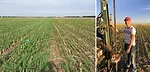
Nick Vos is pushing to overcome moisture challenges on his farm in southwestern Kansas by no-tilling and using covers to recycle available nutrients and keep his sandy soils protected.
Nick Vos is pushing to overcome moisture challenges on his farm in southwestern Kansas
by no-tilling and using covers to recycle available nutrients and keep his sandy soils protected.
Texas A&M AgriLife researchers have shared interesting results about wheat varieties and their ability to use stored soil water. What can you do to improve soil water storage and availability, outside of just buying the right variety? You guessed it.
Higher crop yields and improved land productivity is possible with no-tilled fields with continuous cropping vs. a fallowed winter-wheat system with tillage, says USDA-ARS researcher Randy Anderson.
Leaving Residue on the surface to keep the soil from getting so hot that it seriously impacts plant growth is among the benefits of no-tilling. Along these lines, there’s some interesting research being done at Montana State University that demonstrates how cooler soils not only lead to higher yields, but also reduce the need for fallowing fields to conserve moisture and favorably impact climate change.
Kansas State University agronomist Alan Schlegel discusses his multi-year field tests of intensive dryland cropping systems for western Kansas, going beyond the conventional wheat-sorghum-fallow rotations.
Leaving fields in fallow, and heavily tilling to keep them that way, is a deeply ingrained tradition in the often-parched southeastern corner of Montana, where I farm with my wife of 41 years, Lana.
Get full access NOW to the most comprehensive, powerful and easy-to-use online resource for no-tillage practices. Just one good idea will pay for your subscription hundreds of times over.
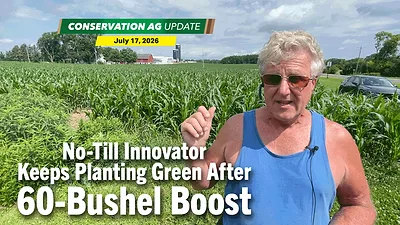
On this episode of Conservation Ag Update, brought to you by Titan International, a big piece of equipment is unveiled at the Kinze Product Innovation Day in Williamsburg, Iowa.
We have engineered and developed the most advanced concave system that threshes all crops, eliminates rotor loss, improves grain quality, gives you a cleaner sample – all with one set of XPR concaves.
At Titan International, our product portfolio reflects our commitment to innovation and high-quality products. Titan International offers a full line of solution-focused wheel, tire, and undercarriage products for a wide variety of off-the-road equipment in agriculture, construction, forestry, mining, power sports, high-speed trailers, and outdoor power equipment segments. As one of the largest North American manufacturers, with a network of dealers all over the world, Titan is an industry leader that original equipment manufacturers and operators can count on for durable products and quality service.