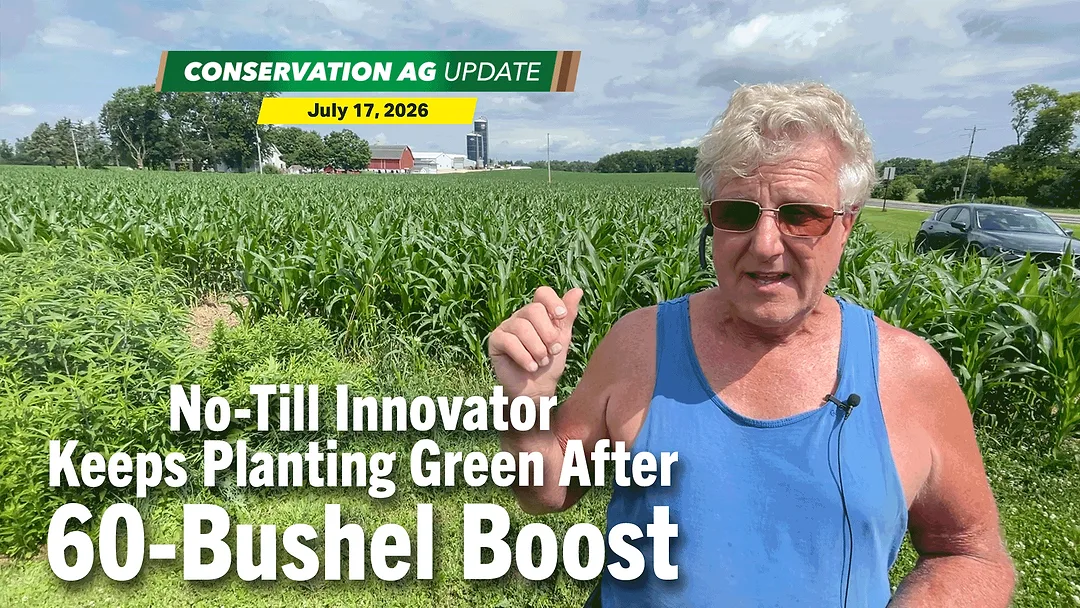
On this episode of Conservation Ag Update, brought to you by Yetter Farm Equipment, we get the scoop on the benefits of planting green with Jackson, Wis., no-tiller Ross Bishop.
Across the road from Bishop’s farm, we catch up with Greg Olsen, field projects director for Sand County Foundation, as he installs CropX Soil Sensors for a new soil health study.
In the Cover Crop Connection, Pennsylvania no-tiller Grant Troop showcases a unique aerated manure system, which he says is ideal for no-tillers, cover croppers and anyone who cares about soil health.
Later in the episode, Sabanto CEO/founder Craig Rupp explains why he believes autonomy will be mainstream in 3 years.
In the Video of the Week, the resiliency of a no-till field is on display after an historic rainfall event.
This episode of Conservation Ag Update is brought to you by Yetter Farm Equipment.
Since 1930, Yetter Farm Equipment has been providing farmers with profitable solutions. From residue management and fertilizer placement to seedbed preparation, our equipment is designed to maximize your inputs, save you time, and deliver a strong return on investment.
Explore our full line of planter attachments, precision fertilizer placement options, strip-till units, and stalk rollers at yetterco.com. Let Yetter help you prepare your equipment lineup for success today.
TRANSCRIPT
Jump to a section or scroll for the full episode...
- Planting Green Pays Immediately for Wisconsin No-Tiller
- Sand County Foundation Measures Impact of No-Till with CropX Sensors
- Smart Manure Aeration System ‘Fits Like a Glove,’ for No-Till & Cover Crop Users
- Sabanto Takes Autonomy ‘Leap’ with Bayer Investment
- Video of the Week: No-Till Field Gets 9 Inches of Rain Overnight
Planting Green Pays Immediately for Wisconsin No-Tiller
Welcome to Conservation Ag Update, big thanks to Yetter for hopping on board as our sponsor this quarter. We begin this week in Jackson, Wis., where I just paid a visit to No-Till Innovator Ross Bishop. He’s implementing several of the practices we talk about on this program.
There’s a lot going on at Ross’s farm, including this prairie strips project that he’s working on with the Sand County Foundation. We’ll have more on that in the coming days on No-TillFarmer.com, and later in our Video of the Week.
Ross no-tills all his corn, and plants multi-species cover crop mixes wherever he can. He started planting green in 2012 and never looked back, even after dark as you can see here.
“In 2012, when we all know was a bad drought here, I planted a 45-acre of annual ryegrass and that grew the next spring. I ended up planting that field around the 18th of May and it was above my knees, probably 2-feet tall. I thought it was going to be a disaster. I split the field in half, soybeans and corn. My yield average that year on the farm was 116. That planted field into cover crop was 178. The beans were 45. My average beans were 33 across the whole farm. I found huge value planting green, and I’ve been doing that ever since 2012.”
We saw Ross planting in the dark earlier. Here he is planting in the snow! He seeded cereal rye (70 pounds per acre) into corn stubble with a 30-foot drill on January 15th after he got back from the No-Till Conference. Ross says it was 18 inches tall when he planted soybeans green into it this spring.
Ross’ farm is also one of 24 across the Lake Michigan Basin participating in a soil sensor project being led by the Sand County Foundation.
Sand County Foundation Measures Impact of No-Till with CropX Sensors
We tagged along with field projects director Greg Olson, as he installed the CropX soil moisture and temperature sensors on the farm across the street from Ross, which is under conventional management. The sensors collect soil moisture and temperature readings at 4-, 12- and 22-inches.
By comparing data from fields under soil health management with data from adjacent conventionally managed fields, farmers will better understand how management can influence water infiltration and holding capacity, leaching potential, aggregate stability and other critical soil properties. I asked Greg for some of his biggest takeaways from the study so far.
“One of the things we tend to see is there’s better water management in the soil of the soil health systems. Now, I’m not going to say it’s drastic, but we’re seeing it’s better. During a drought, we had sites in Dodge County years ago, and we noticed when the drought hit, the soil health system was maintaining about 1-2% better soil moisture in the peak of the drought, which that could technically be … when you’re getting close to wilting point and crop death … that could be an extra couple days or even a week or two. That’s critical in a drought.”
“In the opposite side of the things, when it comes down to these extreme rain events we have, the soil health management systems are able to infiltrate a little better from what we’ve seen, so that means they’re managing that water better from both sides —keeping the water when you need it and migrating it out when there’s too much.”
If you’re wondering what the soil health management principles are…Sand County lists 6 of them: minimize soil disturbance, maximize soil cover, maximize plant diversity, maximize presence of living plants/roots, integrate livestock and know your context.
Smart Manure Aeration System ‘Fits Like a Glove,’ for No-Till & Cover Crop Users
Earlier this summer I caught up with Pennsylvania no-tiller Grant Troop and he filled me in on a unique Smart Manure Aeration System that puts dollars and time back in the pockets of no-tillers and he even refers to it as “a soil health dream.” Let’s check it out.
“Air comes up through and it'll circulate sections. So the whole thing's done does each section about a minute. And it keeps the manure constantly homogenized, oxidized, oxidize the compounds in the manure that are toxic like hydrogen sulfide, methane, gas, amonia. Those things all get oxidized so they're not a problem. There's no dangerous elements to hauling the manure anymore. With the oxidation, you remove about 90% of the odor of the manure. So if you're in an area where you have neighbors that don't like smelling manure, you really have something spread out now that's going to smell more like compost and manure, which makes it really nice. The nutrients are instantly available to the plant. So guys putting manure out to plant corn, no-till corn.”
“Historically we've worried about how long it's going to take for those nutrients to become plant available. With this system, the nutrients are instantly available to the new crop so you don't have that lag time. You can reduce the amount of nitrogen you put on that planting time and have a really prolific crop starting there. You don't have to do any agitation to haul the manure because it's in a constantly homogenized state all the time. If you got a growing crop in the summer hayfield in the spring, if you're growing forage crops, you can go and spread on those crops right away. Instant feed, it coats the crop in a different way than regular pit manure. Regular pit manure will leave a kind of a shiny, sticky coat on the crop. And oftentimes when you get to harvest, that bottom that you spread the manure on will still have a coating of manure.”
“It increases the ash content. You're taking in manure with the forage. With this material, you'll see that it flakes off, dries off, it flakes off the crop right away. Doesn't have that shiny sticky layer to it. So it goes straight to the soil and the nutrients instantly available in the oxidized form, which is where you want to increase the crop availability.”
Troop says users have reported about a 15% increase in just hay yields alone where they’re putting aerated manure on the crops.
Sabanto Takes Autonomy ‘Leap’ with Bayer Investment
Big news in the precision technology world. Sabanto takes another leap in its quest for widespread autonomy after receiving a big funding round from Leaps by Bayer, which is the strategic investment unit of Bayer.
Sabanto’s goal is to expand its dealer network and increase the production and deployment of its retrofit kits in row crop operations. The kits essentially transform tractors into fully autonomous machines with a cloud-connected communications system, multiple GNSS receivers, obstacle-detecting sensors, cameras and AI.
A couple weeks ago, we shared the story of Quint Pottinger, who used the Sabanto kit to autonomously plant over 800 corn acres, many of which were no-tilled into thick cereal rye.
Sabanto CEO and founder Craig Rupp tells me other farmers have saved big money on labor and equipment costs with autonomy, and 3 years from now, the technology is going to be everywhere.
“It’s going to be mainstream. And the future I see is multiple smaller systems versus one large system. It makes complete sense to me. You go out with a 400-horsepower machine versus four smaller 100-horsepower machines. When you unleash a 400-horespower tractor into a field and the field gets done in two hours, you’re going to be spending the day chasing the tractor, moving it from one to the other. Whereas smaller systems, they’re going to take a little bit longer and you have redundancy. It’s more scalable. I get more acres. I can just get one smaller system as opposed to spending $2 million for a large system. They’re easier to work on. They’re less complicated. They’re more fuel efficient. And that’s the future I see three years from now. You know what? If I go back three years and if I said there’s going to be a day when a farmer’s going to farm all his corn acres autonomously, everyone would’ve laughed at me. If I would’ve said it a year ago, they would’ve said, ‘No, it’s not going to happen.’ It happened already. Quint (Pottinger).”
Craig formed a farmer advisory board of about 24 farmers. They meet with COO Corey Spaetti once a month to receive updates on the technology, and give their feedback on how it can be improved.
Video of the Week: No-Till Field Gets 9 Inches of Rain Overnight
Back to Ross Bishop’s farm for our Video of the Week, as promised. What does a no-till field look like after getting over 9 inches of rain in one night? Let’s find out.
“It’s August 10th. We just had 9.1 inches of rain overnight. It’s 11 in the morning. I’m looking at a no-till wheat field. The water coming off is crystal clear. You see right through it. If we had that tilled soil, that would be brown like chocolate milk. That would be headed down to Lake Michigan, and I’m sure nobody would want that. We have no-till and cover crops here for 30 years. I see my yields getting better every year and less labor and I save fuel. As I get older, I don’t have the ambition to do the rock picking and working the ground. Prairie strip in the background. We are enjoying our no-till and cover crops and making the environment a better place.”
If you have any videos you’d like to see on the program, send them my way Nnewman@LessiterMedia.com. Thanks for tuning in.
Join us for the 2026 National Strip-Tillage Conference
Before we go, I wanted to let you know our National Strip-Till Conference is coming up August 6 in Springfield, Ill. More info at StripTillConference.com. Here’s a taste of what to expect ….
What do you think? Send me your thoughts and story ideas to Nnewman@Lessiter Media.com. Thanks for watching. Until next time, for more stories visit no-tillfarmer.com, striptillfarmer.com and covercropstrategies.com.