Ever been frustrated when you couldn’t convince a neighbor to start no-tilling, or just stop plowing as much? Tired of seeing soil and nutrients wash into the ditch or waterways? Or reading about dust storms popping up again?
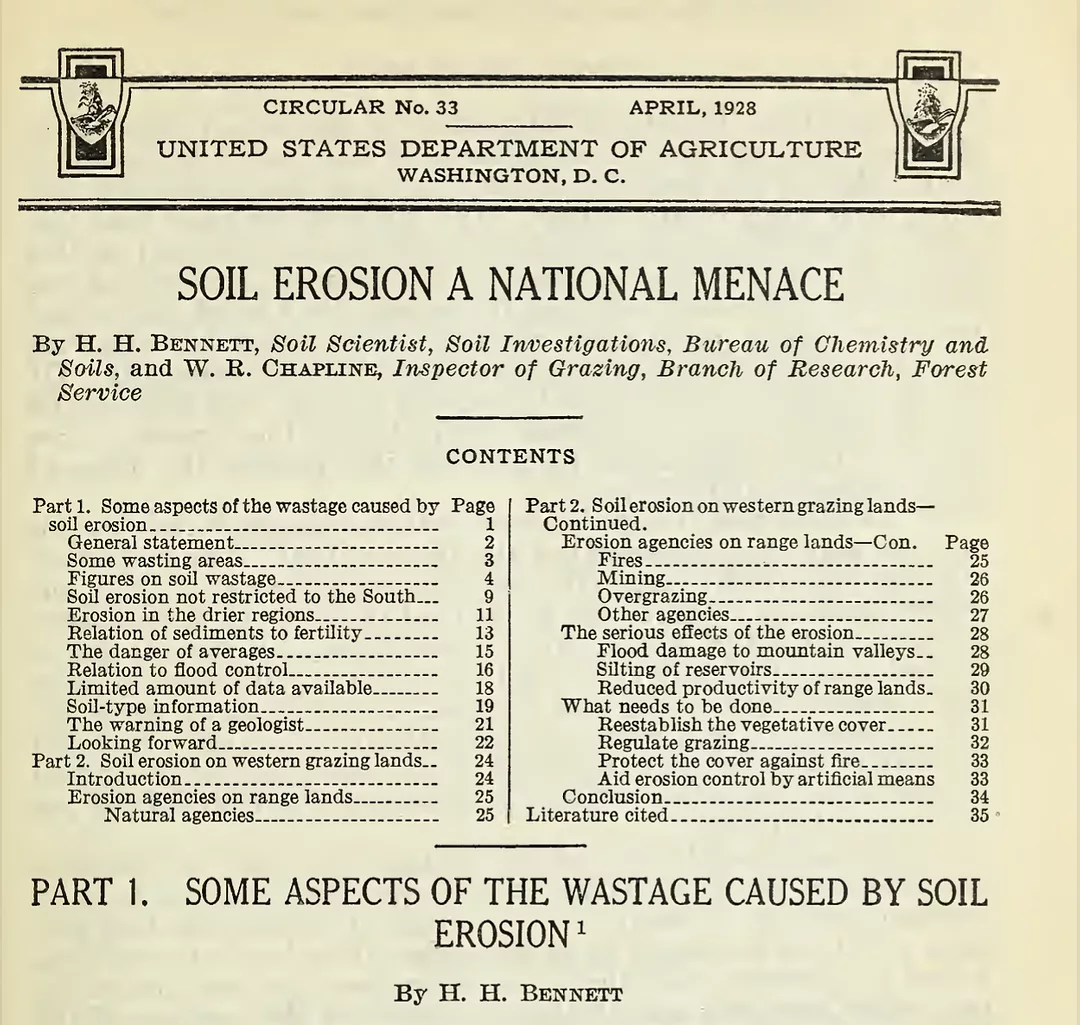
You aren’t alone. This battle has been fought for nearly a century, and it started with soil scientist Hugh Hammond Bennett, who penned a “circular” in 1928 entitled, “Soil Erosion: A National Menace.”
When the NRCS posted about Bennett in announcing its 90th birthday earlier this year, I found a link to Bennett’s 58-page document about “soil wastage.” W. R. Chapline, inspector of grazing for the Forest Service, co-authorized the account.
READ HUGH HAMMOND’S STUDY HERE
Working as a soils investigator for the Bureau of Chemistry and Soils, Bennett had spent more than 25 years studying soils in the U.S. and documented the destruction he witnessed due to poor land management. This was several years before the Dust Bowl era began, and well before the Soil Conservation Service (now the NRCS) was created.
Back in the 1920s evidence had already been documented that topsoil was disappearing and it was costing farmers big time:
* No less than 126 billion pounds of plant-food material was being removed from fields and pastures in the U.S. annually, Bennett calculated, most of it coming from cultivated and abandoned fields and overgrazed pastures and ranges. That’s 21 times the annual net loss due to crop removal (5.9 billion pounds). The amount of P, N and K alone annually removed from the soil material equaled 54 billion pounds.
*Citing a Bureau of Soils chemical analysis of 389 samples of surface soil from throughout the U.S., and the price of the cheapest forms of fertilizer at the time, the lost nutrients exceeded $2 billion. There was evidence to show at least $200 million, “could be charged up as a tangible yearly loss” to farmers. The figures didn’t factor in lost lime, magnesium and sulfur.
Hammond also pointed out that rebuilding the soil surface requires, “time, work and money” and in most places the soil exposed by erosion was heavier, stiffer, more difficult to plow, less penetrable to plant roots, and absorbed less rain. “And apparently,” he added, “its plant-food elements frequently have not been converted into available plant nutrients to anything like the degree that obtains in the displaced surface soil.
“It bakes easier and, as a consequence, crops growing on it are less resistant to dry seasons, because of rapid evaporation from the hardened surface, and the many cracks that form deep into the subsoil to enlarge the area exposed to direct evaporation.”
Certain areas in the Piedmont region of the South had, within a period of 30 years, lost their topsoil entirely, with 10 inches or more of loam and clay loam having been washed off down to the clay subsoil. Bennett noted: “Some 400 to 600 pounds of fertilizer was required to produce as much cotton per acre as formerly was grown with 200 to 250 pounds of fertilizer of no better quality.”
Today, the USDA says soil erosion leads to “significant economic losses” of $44 billion annually, with 1.72 billion tons of soil are lost each year.
Certainly, thanks to the efforts of the NRCS, conservation districts, farmers, agronomists, researchers and manufacturers, we’re in a much better position today. More than 110 million acres of crops are no-tilled, and 18 million acres see cover crops, the 2022 Census of Agriculture shows.
This helps illustrate why the reorganization of the USDA — which Secretary Brooke Rollins says is meant to re-focus the agency’s mission on agriculture — cannot afford to fail. Our nation’s soil resource, and its food security, depends on it.