 Premium content is for our Digital-only and Premium subscribers. A Print-only subscription doesn't qualify. Please
No-Till Farmer
Get full access NOW to the most comprehensive, powerful and easy-to-use online resource for no-tillage practices. Just one good idea will pay for your subscription hundreds of times over.

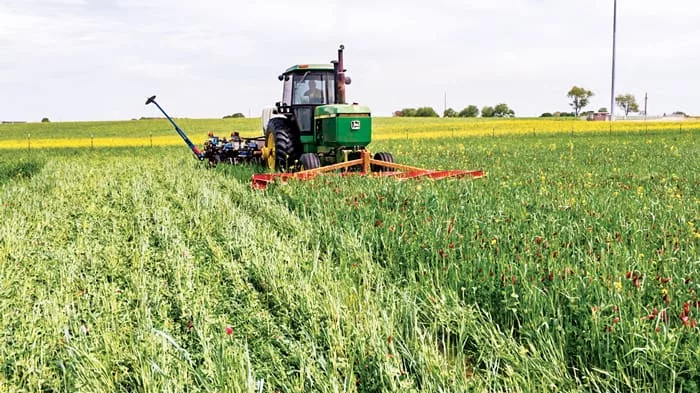
START SIMPLE. For beginning cover-crop users, using a mix with low biomass potential — 6,000 pounds of biomass per acre or less — might be best to start with because it’s easier to plant into and won’t need to be rolled down or crimped, says NRCS district conservationist Adam Daugherty. But getting to medium- or high-biomass covers eventually will lead to more resilient soils and potentially lower inputs, he notes.
There are many variables for growers to consider when they’re implementing cover-crop mixes into their no-till rotation — including mix design, carbon-to-nitrogen (C:N) ratios, cash crop goals, termination strategies and biomass management.
“The goals will be different for everyone and will change from field to field, with changing conditions and with time,” says NRCS district conservationist Adam Daugherty.
Here are strategies for thinking through some of these important decisions that were shared by Daugherty at the National No-Tillage Conference last January.
It’s vitally important for no-tillers to understand the C:N ratio of crop residue and how they play a role in the soil. C:N ratios are especially important when ascertaining how long it will take for soil microbes to break down residue.
“The soil is a jungle ecosystem,” says Daugherty. “It has big and little critters. They all have to eat and they all play a role in cycling residue.”
The ideal C:N ratio to feed microbiology in the soil, so it can efficiently consume biomass and cycle nutrients, is 24:1. Higher C:N ratios will slow down the decomposition of biomass and lower C:N ratios will speed it up, Daugherty says.
Most annual cropping systems have a high C:N ratio: wheat straw is 80:1 and corn stover is 57:1, which means residue decomposes slowly and leaves more protective biomass on the soil surface. Plants with a lower C:N ratio (legume hay is 17:1) decompose residue faster and result in less cover being left on the soil surface.
…
Get full access NOW to the most comprehensive, powerful and easy-to-use online resource for no-tillage practices. Just one good idea will pay for your subscription hundreds of times over.
Download these helpful knowledge building tools

We have engineered and developed the most advanced concave system that threshes all crops, eliminates rotor loss, improves grain quality, gives you a cleaner sample – all with one set of XPR concaves.

At Titan International, our product portfolio reflects our commitment to innovation and high-quality products. Titan International offers a full line of solution-focused wheel, tire, and undercarriage products for a wide variety of off-the-road equipment in agriculture, construction, forestry, mining, power sports, high-speed trailers, and outdoor power equipment segments. As one of the largest North American manufacturers, with a network of dealers all over the world, Titan is an industry leader that original equipment manufacturers and operators can count on for durable products and quality service.

Provide expert analysis and decision support to increase productivity and profitability.