TAKEAWAYS

  • When evaluating cover crop economics, think about seeding rates, yield response and termination dates.
  • Consider terminating covers and apply herbicides in the same pass to cut down on labor and fuel costs.
  • Terminate cereal rye early to avoid potential soil moisture losses or yield hits.

Independent research agronomist Jim Stute recently unveiled the results of a long-term study of the economic and weed suppression effects of cover crop adoption and management in southeast Wisconsin.

Funded by Sustainable Agriculture Research and Education (SARE), Stute’s study evaluated yield response and the net return-on-investment of cereal rye as a cover crop for both corn and soybean. 

The study found positive economic results when costs were managed appropriately, and that cover crops can be financially sound even for rented land, but that farmers’ timing when terminating their rye cover was critical for success. 

Speaking at the National No-Tillage Conference in January, Stute says the perception is cover crops are a long-term proposition and results won’t be seen for a couple of years after starting a program. They want data from farm fields rather than experiment stations. 

The East Troy, Wis., based educator hopes the study results will persuade farmers. “Our goal is an economic argument for adoption. We are trying to build the business case,” he says. 

Control What You Can

Stute’s group conducted 70 on-farm trials from 2022 through 2024 across his home region of southeast Wisconsin, which has highly erodible soils — at least half of it leased. Beyond it being where Stute is based, that made it the ideal testing ground for financial benefits of cover crop adoption, even in the short-term.

The study measured crop yield and input costs for corn and soybeans — when no cereal rye was planted, and with cereal rye managed different ways. To test beyond the economics of simply planting the rye cover crop or not, Stute studied variable seeding rates and timing, cover crop termination timing, row placement and supplemental nitrogen in corn.

“We can’t change the weather,” Stute says. “And we can’t change the characteristics on our farm, other than soil fertility. So we looked at rye management because that’s what we can change.”

‘Financial Win’

The results of Stute’s study convinced him that when managed appropriately, adopting cereal rye as a cover crop was a financial win for farmers. 

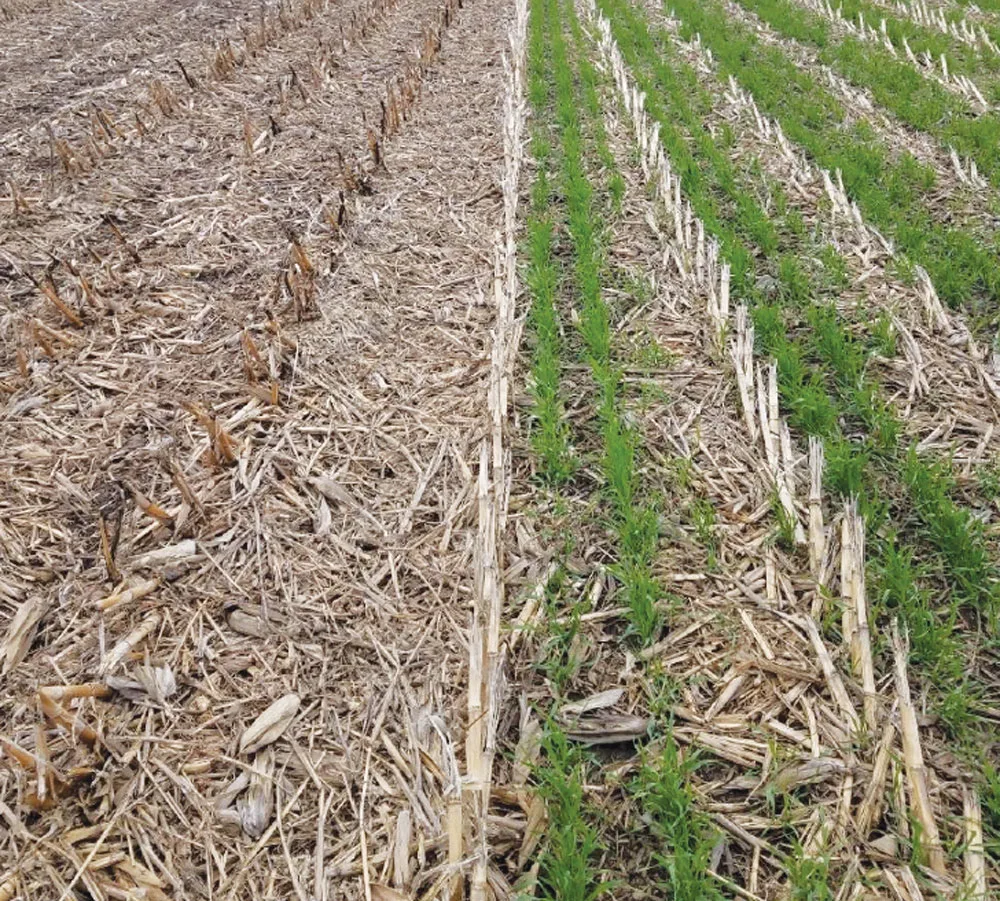
Studies showed positive yield response to the cover crop for both corn (2.1%) and soybeans (2.3%). And that yield response, along with cost share opportunities and cost containment — by co-applying the cover crop termination and residual herbicide on the same pass — resulted in a higher net gain for the cooperating farmers.

“The return (on investment) is related to yield response and cost containment on the financial side,” he notes. “That means we need lower seeding rates. We need earlier termination, and we need to think about co-application efficiencies in the economics.”

yield-response-and-net-return-for-cereal-rye-cover-crop.jpg

COVERS & YIELD. These graphs compare yield response and net return for cereal rye cover crop use vs. no rye, grouped by all data and the top 25% of responses. At left, corn following rye, on average, yielded 97.7% of corn without rye, soybean 98.7% for all data, or conversely rye reduced corn yield by 2.3%, soybean by 1.3%. In the top 25%, rye increased yield 3.3% in corn (103.3) and 6.1% in soybean (106.1). On net return, rye reduced returns by $55.92 per acre in corn, $43.47 an acre in soybean, and in the top 25% of fields, by $10.07 and $0.11. Jim Stute

Stute notes most a quarter of the cooperating farmers who fared best in the trials were planting on sites where cover crops had not been used before. In corn more than half the sites hadn’t seen covers and for soybeans it was about one third. 

Stute says that the first-year response in the study had “stunned” him. “That kind of dispels this myth that cover crops are a long-term proposition. You can get an immediate return, so that makes cover crops appropriate for rental ground.”

“For those thinking about covers on your own land or on rental land, it’s not something you need to be afraid of. But use cost share, follow our best practices or best practices for your neighborhood.”

Factoring in EQIP

Stute included an assumed a federal Environmental Quality Incentives Program (EQIP) cost share for management on most of the test plots, as part of the financial equations he recommends to succeed financially with cover crops.

A “real simple” EQIP cost share rate of $56.81, at a 75% payment, comes out to $42.63, he says. 

“What this does is shift the distribution. And you can see that with cost share, suddenly we have a $20 margin to even our worst-performing corn site,” he explains. “I think of that as using this strategy as an insurance policy. Unless there’s catastrophic failure, in which case your crop insurance is going to kick in, this is almost guaranteed for positive revenue.”

However, some of the best-performing test sites financially used lower seeding rates — less than 55 pounds ahead of soybeans and less than 50 pounds ahead of corn — than what is required to meet EQIP standards. Stute still recommends using the lower seeding rates, as found best in the study, and then enrolling in one of the state- or privately-funded cost share programs rather than EQIP. 

Stute says studies showed adopting cereal rye as a cover was best done first before soybeans, planting into cornstalks and then managing in soybeans. The study, which ran through a drought year, showed adopting cover crops had a positive impact on yield due to increased resilience to the dryness.

But timing when seeding covers was critical to both the financial and the soil health success of adoption.

“My take-home message for farmers is getting cereal rye in early and capture those growing degrees. Unless you get a very open winter, we're not seeing rye growth for three months out of the year,” he says.

Termination Timing

The study also found early termination of rye was critical both for the yield bump and for potential for weed suppression.

“We see a slight soybean yield bump to having the rye compared to no rye (terminated early), and then it’s downhill from there,” Stute says. “In a drought year, it's a quadratic response, a curve, which accelerates with time. So you’re losing yield potential as you delay termination. 

“In a year with abundant rainfall, that relationship is not as strong, but we still have the potential to lose yield. It’s important to terminate early, otherwise waiting until later is risky due to a flash drought can develop overnight.”

When the study’s findings were challenged by a southern Indiana farmer in the audience, as to if the resulting recommendations would work for him, Stute acknowledged again that the study was specific to southeast Wisconsin’s latitude and local conditions. He believe that’s the reason more regional studies like this are needed.

“I talked about having no growing degree days or very little in the shoulder seasons and then nothing over winter. So we don’t get the kind of biomass you're talking about. We need more groups like ours to get together and conduct a study that matches your conditions,” he says. 

Stute intentionally stuck to the economics of cover crops adoption in his study, rather than the soil health benefits, because he says those benefits are already better understood.

“My overarching thought,” he says, “is if I’ve got a successful cover crop, I am protecting my soil. And soil health is a given. But we know that people are somewhat hesitant to adopt covered crops because of the economics.”

Stute, whose farm has been 100% no-till with cover crops since 2003, hopes the study could be used, at least in his region, as a model for farmers who know that adopting cover crops would be better for their soil health and for the environment, and but already financially stretched thin and risk-averse.

“When I ponder my life choices, I wonder what the hell I was doing (before),” he says. “It’s a no-brainer, and the data will bear that out. I guess the take-home message is sometimes we’re a lot smarter than how we behave.”