 Premium content is for our Digital-only and Premium subscribers. A Print-only subscription doesn't qualify. Please
No-Till Farmer
Get full access NOW to the most comprehensive, powerful and easy-to-use online resource for no-tillage practices. Just one good idea will pay for your subscription hundreds of times over.
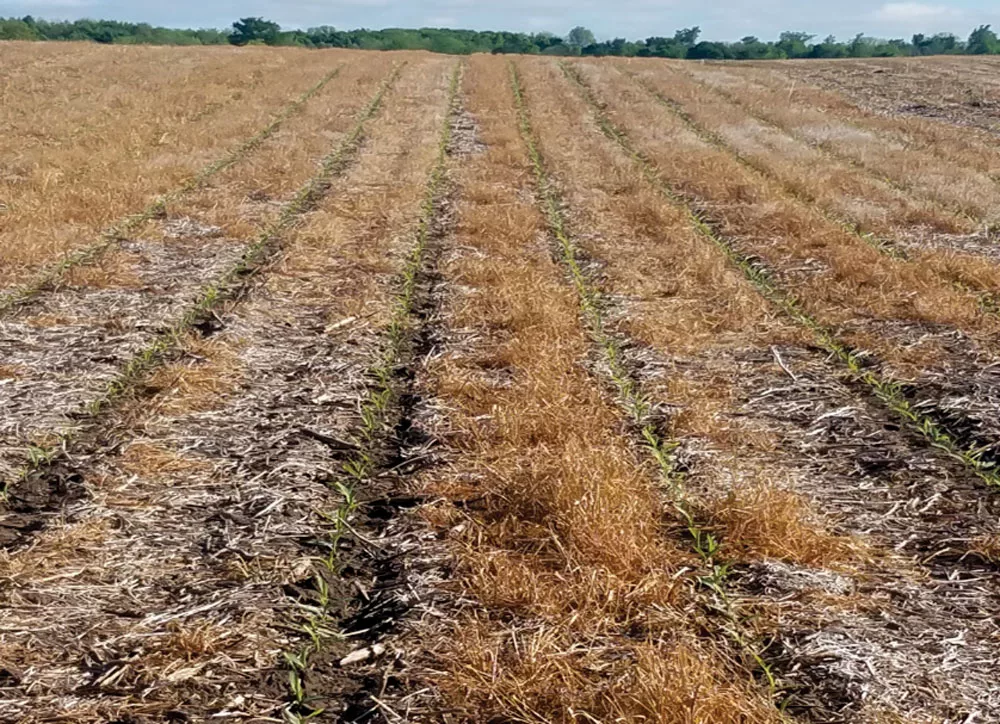
MAKE WAY. A 16-row Horsch planter with Martin row cleaners is used to no-till corn and soybeans. With cover crops, the Bakers believe residue managers are critical to clearing the path and create better conditions for successful planting. Blaine Baker
If we're building soil organic matter (SOM), we’re doing something right.
There’s a lot of money to be made in SOM. The higher the SOM, the more moisture and nutrients are held in the soil, and the more microbes there are breaking down the nutrients to make them available to the crop and the more resilient your fields become when conditions from weather to input costs apply pressure.
Soil organic matter isn’t easy to build, but very easy to deplete. On our farm, SOM is trending up when it’s trending down on so many farms across the U.S. That turn likely started when we began to dabble in no-till with a rented county conservation district no-till drill in the early ’70s.
We kept no-tilling a little more and a little more, adding attachments and adjusting our own planter to figure it out as we went. Some attachments didn’t last longer than 100 acres before we took them off.
Our soils are now very mellow due to years of no-till and cover crops. Today, you could no-till our fields with almost any commercial planter straight off the lot. We use a…

Get full access NOW to the most comprehensive, powerful and easy-to-use online resource for no-tillage practices. Just one good idea will pay for your subscription hundreds of times over.
Download these helpful knowledge building tools

We have engineered and developed the most advanced concave system that threshes all crops, eliminates rotor loss, improves grain quality, gives you a cleaner sample – all with one set of XPR concaves.

At Titan International, our product portfolio reflects our commitment to innovation and high-quality products. Titan International offers a full line of solution-focused wheel, tire, and undercarriage products for a wide variety of off-the-road equipment in agriculture, construction, forestry, mining, power sports, high-speed trailers, and outdoor power equipment segments. As one of the largest North American manufacturers, with a network of dealers all over the world, Titan is an industry leader that original equipment manufacturers and operators can count on for durable products and quality service.

Provide expert analysis and decision support to increase productivity and profitability.