 Premium content is for our Digital-only and Premium subscribers. A Print-only subscription doesn't qualify. Please
No-Till Farmer
Get full access NOW to the most comprehensive, powerful and easy-to-use online resource for no-tillage practices. Just one good idea will pay for your subscription hundreds of times over.
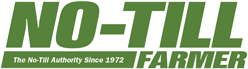
BOOSTING PROFITS. Cover crops and oats serve up savings and yields. Residue gives Larsen the upper hand with glyphosate resistant waterhemp and the crop rotation has eliminated the need to purchase expensive corn rootworm protection in his traited corn hybrids. Corn and soybean crops in rotation with oats also see yield bumps up to 11%. Martin Larsen
Oats are a legacy project for me. Getting oats growing on more acres in my community has great impacts on a variety of areas in my life about which I care deeply: water quality, community, my family and my farm.
Growing oats and encouraging others to do so, too, is the backbone of my conservation strategy. I’m a part-time conservation technician at the Olmsted County Soil & Water Conservation District. I’m also a fifth-generation farmer and a water quality enthusiast.
Our geography is unique. On the surface I farm an area where glacial-till soils transition to windblown Loess. The resulting hodge podge means I get to farm soils that range from high clay content with higher soil organic matter (SOM) to lower SOM silty loams.
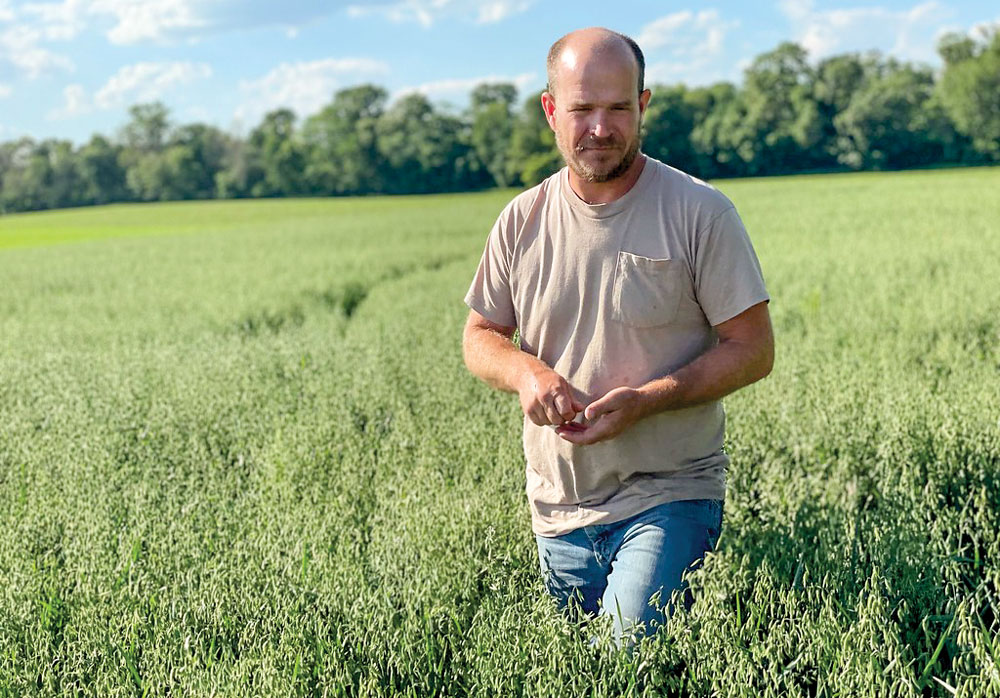
NAME: Martin Larsen
LOCATION: Byron, Minn.
ACRES: 1,490
YEARS NO-TILLING: 11
CROPS: Corn, soybeans, oats
PRIMARY SOIL TYPE: Glacial Till to Loess transition
ANNUAL PRECIPITATION: 33 inches
Underneath the surface is where things get truly interesting. Eroded Karst limestone bedrock riddled with caverns supplies all the public and private drinking water for our community. Water from our farms filters, and in some cases flows directly, into the underground water supply.
When surface water infiltrates into these caves and aquifers, they can take a wide range of…

Get full access NOW to the most comprehensive, powerful and easy-to-use online resource for no-tillage practices. Just one good idea will pay for your subscription hundreds of times over.
Download these helpful knowledge building tools

We have engineered and developed the most advanced concave system that threshes all crops, eliminates rotor loss, improves grain quality, gives you a cleaner sample – all with one set of XPR concaves.

At Titan International, our product portfolio reflects our commitment to innovation and high-quality products. Titan International offers a full line of solution-focused wheel, tire, and undercarriage products for a wide variety of off-the-road equipment in agriculture, construction, forestry, mining, power sports, high-speed trailers, and outdoor power equipment segments. As one of the largest North American manufacturers, with a network of dealers all over the world, Titan is an industry leader that original equipment manufacturers and operators can count on for durable products and quality service.

Provide expert analysis and decision support to increase productivity and profitability.