No-tillers have many different priorities to filter through when making equipment decisions. These include agronomic potential, financial returns, conservation practices, diversification advantages and landowner relationships, to name a few. Regardless of the top priority, says Rob Rudolphi, farmers have to evaluate how a new piece of equipment will fit in on their farm.
Rudolphi, an Iowa farmer and marketing manager for Horsch, has experimented with no-till, cover crops and planter adjustments for several years. In Horsch’s early days of operation, the company also ran experiments allowing the results of their equipment to speak for themselves.
Ahead of their times and lacking sales, Horsch began doing on-farm no-till and minimum tillage research and “selling with a spade.” Digging up earthworms in no-till, minimum-till and conventional tillage systems clearly demonstrated the direct correlation between tillage and soil health.
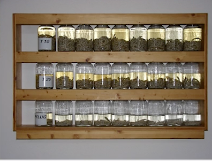
Company founder Michael Horsch counted earthworms, above, found in a square meter in fields that received varying levels of tillage. The jars on the bottom of the shelf contain worms, preserved in formaldehyde, from conventional tillage fields while the worms on the top were found in no-till fields at a much higher density. He used this data to market his no-till drills.
Emergence a Key Priority
Horsch’s planters are equipped to fit seamlessly into a no-till operation, Rudolphi says. The Horsch philosophy on machine design centers on being agronomically correct, robust, precise, having a clean design and being simple and intuitive to use and service.
Rudolphi says equipment that claims to work well in conventional till, minimum till and no-till systems probably aren’t well suited for any condition.
“There is no opener in the world that will perform flawlessly in a deep tilled soil that’s whipped to a foam and into a firm no-till, cover crop seedbed,” he says. “They’re completely different environments. It may work, but it will not be optimal in both of those conditions.”
Rudolphi says uniform emergence dictates 5-9% of a crop’s potential, and the objective at planting is to get as much potential as possible out of the farmers’ inputs.
Unique Approach
“Our planters have a little different approach,” Rudolphi says. “They look a little different than most planters you see on the market.”
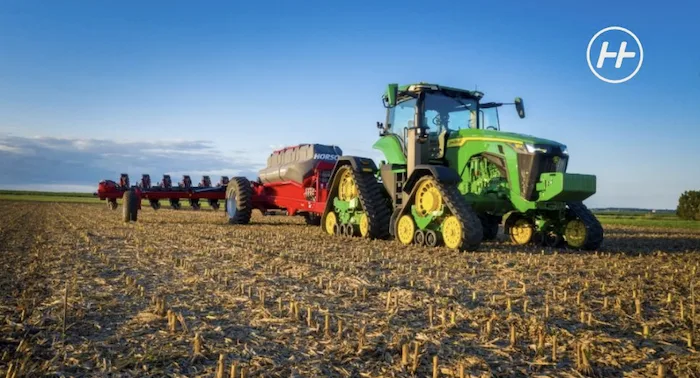
The Horsch Maestro planter has what Europeans consider a “seed wagon” design. A large tank positioned on the chassis ahead of the planter reduces the frequency of needing to refill seed or fertilizer. The weight on the chassis is transferred to the toolbar when the planter is lowered. This weight helps stabilize the row units to achieve the best seed to soil contact possible, aided by Horsch’s unique rolling seed-lock wheels.
“It's a really good take on a seed firmer,” Rudolphi says. “It's a hollow core wheel. As you set it down, it bulges out like a radial tire. It's pneumatic, so it's got some squish and it's just rolling. It doesn't drag. It rolls and it gently presses that seed directly into the moist soil right at the bottom of the trench.”
The down pressure also impacts uniform emergence, and Rudolphi says there are a few easy ways to evaluate if the down pressure is set appropriately.
“If you can see indents from your gauge wheels behind the planter there's a good chance you're running a little too much down pressure,” Rudolphi says. “But, if that seed is at the bottom of the trench and in a pretty happy environment, I think you're probably in a pretty good place.”
Avatar Air Seeder
The Horsch Avatar Air Seeder has a similar “seed wagon" construction to the Maestro. The Avatar is a single rank, greatly improving ease of shop work. Additionally, everything on the toolbar is greaseless. The Avatar also has a two seed hopper design.
“You can get very, very creative and very versatile with a machine like this,” Rudolphi says.
He proposed putting fertilizer in one hopper and seed in the other, seed in both to double capacity, or even putting different seed types in each hopper so small and large seeds in a cover crop mix could simultaneously be applied at the correct rate.
In a trial Rudolphi conducted that compared 10-inch Horsch Avatar drilled soybeans to 20-inch high speed planted soybeans, he found that there was no yield difference. This excited him as the high speed planter was one of the most expensive planters available.
Looking Forward
Horsch has recently launched a 90-foot planter to address concerns regarding even larger productivity. As they have with their other planters and air seeders, Horsch evaluated similar equipment on the market and considered how they could provide a tool with a unique advantage.
“There's no point in having a large frame planter with big time capacity only to have to refill it all the time,” Rudolphi says. “So how do we get the capacity on the frame to match the productivity of the planter?”
In a trial, Horsch tested its 90-foot planter against a competitor's 90-foot planter. Across 13 days, the Horsch planted 7,326 acres of beans, while the competitor planted 6,217 acres of corn in 14 days.
“If you standardize that to 14 days, that's a 1,600 acre swing,” Rudolphi says. “Nothing to do with planting speed because those were pretty comparable. Everything had to do with transportability and having the capacity for less fills, less wasted time, more time with the opener in the ground, and less time on the side of the field tendering the product. Highly productive planting versus high speed planting, and sometimes they can be the same thing.”
“In the Horsch farming system, we think it's very simple,” Rudolphi says. “Seeder for all the things a seeder does, a planter to precision plant the row crops that you want to, and something to feed your crop and take care of it. That's the Horsch farming system.”