
Alpha, Ill., No-Till Innovator Marion Calmer started conducting independent on-farm research in 1985 and no-tilling in 1988. During a classroom presentation at the 2026 National No-Tillage Conference, Calmer shared his observations, insights and tips for supercharging no-till corn and soybean yields.
Soybeans
Planting Date
Calmer recommends planting soybeans early, even before corn. He cites Beck’s Practical Farm Research (PFR) data showing that planting on April 16 provided a $882 gross revenue versus a gross revenue of $653 from planting on May 15.
“That's a $200 drop to keep in mind,” Calmer says. “I like to plant early and we've even tried getting out earlier than April 16th.”
Seed Treatments
“If you're going to plant early, seed treatments have got to be part of the program,” Calmer says. Using seed treatments on soybeans provided a $44 an acre return, according to PFR Research.
Spacing
Calmer admits that accomplishing even spacing and emergence, particularly in no-till soybeans, is challenging. When using John Deere RTK guidance, Calmer recommends putting the globe on the planter to eliminate even just a few inches of variance from the original AB line that may happen if the globe were on the tractor. Calmer plants 30-inch corn and 15-inch beans, so fitting the beans between the corn rows without hitting the old roots necessitates such precision.
Planting Population
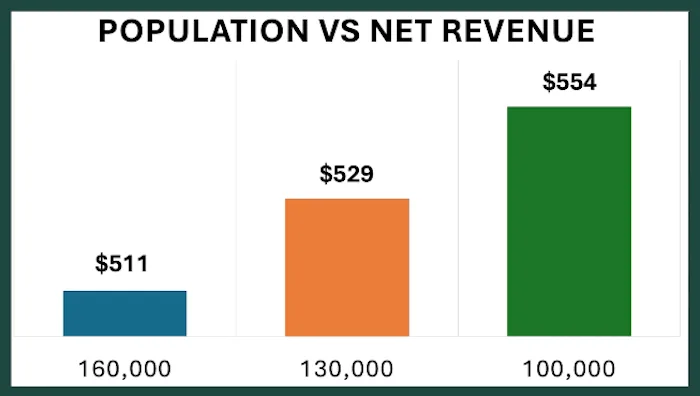
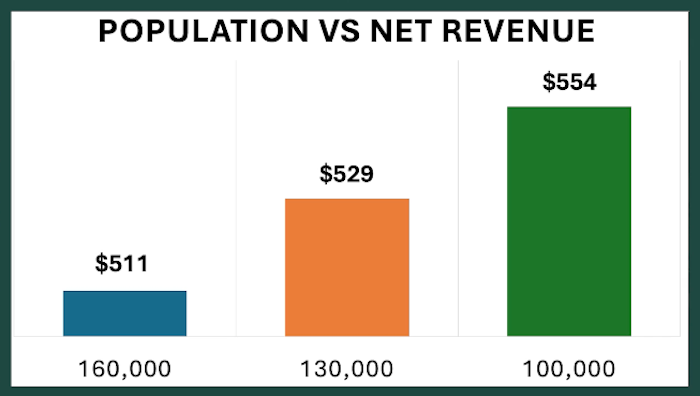
Calmer used to plant soybeans at 200,000 seeds per acre, but has now backed down to 100,000. On test plots, he has also grown soybeans at 50,000 where he only lost a couple bushels of yield, but had significantly higher weed pressure. Beck’s PFR found that at 160,000 seeds per acre, farmers could expect a net revenue of $511 per acre, whereas at 100,000 seeds per acre, the net revenue was $554. Calmer also believes planting at a lower population has helped him combat white mold issues since it allows for better airflow.
AMS Weed Control
Calmer projects that Roundup provides him with 70% weed control, but adding liquid ammonium sulfate (AMS) to his hard water boosted effectiveness to 87%. Making a slurry with dry AMS provides 97% weed control. Calmer says that blending the AMS can be challenging and loses benefits when not done correctly.
Fungicide Timing
When not applied at the correct stage, Calmer says farmers won’t make any money from applying fungicide. Beck’s PFR studies found applying fungicide to soybeans at R2 lost the farmer $4 per acre, and applying at R4 lost $3 per acre. However, applying at R3 provided a benefit of $18 per acre.
Chopping and Spreading Bean Stalks
Calmer uses the wind to his advantage in residue management and encourages other farmers to do the same. He cuts beans according to the direction the wind is blowing so the chaff is always blown from left to right to have a consistent layer of residue. Calmer also uses double spinners on a 30-foot platform. He says that evenly spread residue helps the crop mature at the same time.
Corn
Planting Date
In west central Illinois, Calmer aims to plant his corn between April 16-30, aiming for even emergence and appropriate soil temperature. He notes that some of his best yielding corn was planted on the tail end of the optimum planting window, closer to May 1.
Strip-Till/Cover Crops
Calmer uses a 30-foot Environmental Tillage Systems SoilWarrior each fall in his strip-till system. The coulters work his phosphorus (P), potassium (K) and ag lime into the soil surface ahead of anhydrous. Calmer prefers to plant corn with vertical rooting genetics that can better utilize his precisely applied fertilizer. Having just recently started using cover crops, he expects they will positively impact his soil.
Tire Pressure
“There's money to be made here by getting out and deflating your radial tires,” Calmer says. Most of the weight in a radial tire is concentrated in the center of the tire causing compaction. Calmer says the compaction applied to the soil by a tire is about 1 pound per square inch greater than the tire pressure. Decreasing the tire pressure greatly reduces compaction.
Closing Wheels
In no-till settings, Calmer recommends anything other than the rubber John Deere closing wheel. Schaffert closing wheels have been found to add 3.6 bushels per acre, and Yetter closing wheels add 5.1 bushels per acre, he says. This yield increase largely comes from breaking sidewall compaction and closing the furrow to provide adequate seed to soil contact.
Fungicide Timing and Application
Calmer recommends spraying fungicide before the silks turn brown and says that the first pass of fungicide provides the largest return. Beck’s PFR data shows the largest return occurring at R1 at $22.42 per acre. At R2, the return drops to $5.21 per acre.
Calmer predicts farmers will continue to move toward drone applications over crop duster planes as they opt for more precise application methods. Planes provide a $3 per acre return, ground sprayers provide an $8 per acre return and a drone provides a $13 per acre return, according to Beck’s PFR data.
Short Corn
After one year of trials, Calmer found that short corn had a yield advantage of about 6 bushels per acre. He notes that if a wind event happens, short corn is more likely to remain standing whereas when harvesting downed regular corn, a farmer could easily leave 30-50 bushels in the field.
Fall Residue Management
“I like to chew up the stalks at harvest time, but the important thing is not just making short pieces, but being able to expose the center part of the corn stalk, the pith,” Calmer says. Breaking the rind open allows the microbes in the soil to more easily break down the pith. In continuous corn, the Univ. of Illinois found a 9.75 bushel per acre increase from chopping stalks.
Soil Stewardship
“We all know that the soil reproduces itself at the rate of one sheet of paper per year,” Calmer says. “During our lifetime, we are in charge of one of God's most valuable resources, and the soil has to last for the rest of time. Think about that. And we're here for just a blink of an eye.”