It’s been 50 years since No-Till Farmer launched, and a lot has influenced the practice in those five decades. From equipment and chemical innovations to government influence to cover crops and the soil health movement, many factors have impacted no-till — both good and bad.
In honor of the 50th anniversary, we reached out to four no-tillers who can attest to no-till’s evolution over the years: Joe Breker, Ray McCormick, Bill Richards and Dwayne Beck, who all attended the first National No-Tillage Conference in 1993. Here they share their first impressions of the practice, the biggest turning points, and what they envision for no-till’s future.
Joe Breker, Havana, N.D.
Joe Breker first heard about no-till in a soils class at North Dakota State University (NDSU). The professor didn’t know much about the practice himself, so he challenged the class to learn more about it. This led Breker to Ron Swindler, a Mott, N.D., no-tiller.
Swindler had been no-tilling for a couple of years at that point, and his passion for the practice piqued Breker’s interest as a way to keep the soil from blowing and washing. From there, Breker connected with a network of international farmers who would eventually form the group the Northern Prairies Ag Innovation Alliance — previously known as the Manitoba North Dakota Zero-Till Farmers Assn. Soon he adopted the practice on his farm in Havana, N.D, and since 1980, he and his wife, Patty, have been no-tilling on 2,500 acres of cropland. They also have 500 acres of pasture that’s been in a rotational grazing system for more than 30 years.
Son in-law Austin and daughter Olivia Stenvold are also now part of the family farm, owning and renting additional land. Olivia also is part owner and manager of the Coteau des Praires Lodge, a 10,000-square-foot lodge on Breker’s farm. One of the reasons they constructed the lodge was to allow the public access to a working family farm.
Cover Crops A Necessity
Breker’s first impression of no-till was just as he suspected: a lot less erosion. But it also came with its own challenges. The soil biology would eat up the residue faster than he could grow it. And in years when they received above-average precipitation, his fields couldn’t handle the moisture. By the mid-1990s, most of the farmers in his area were back into a tillage rotation.
Recognizing Roundup
All four no-tillers agree that Monsanto’s (now Bayer’s) Roundup herbicide and Roundup Ready crops were a turning point in no-till. Whether it was a true benefit to the practice in the long run is something they don’t see eye-to-eye on.
Pertaining to herbicide-resistant crops, Joe Breker thinks it gave farmers an excuse not to use good crop and herbicide rotations.
“One thing Roundup Ready crops really sped up were the resistant weeds and salinity,” he says.
Dwayne Beck is in the same camp. Once Monsanto cut Roundup’s price, it was a major breakthrough for no-till. But it also led to overuse and soon glyphosate resistance.
“It’s like giving a young boy a hammer,” Beck says. “Everything he sees is a nail.”
But Bill Richards and Ray McCormick both think Roundup has done far more good than harm for no-till.
Richards recalls how in the early 1990s, he became the chief of the USDA Soil Conservation Service, now known as the NRCS, to promote no-till. That was also around the time Monsanto cut the price.
“Agriculture policy is asking you to do this, and Roundup was cheap,” he says. “That was when we had the greatest increase ever in no-till.”
McCormick says that it revolutionized burndown and controlling weed growth, giving farmers the ability to plant into a lot of material and kill it. He’s had to defend Monsanto against some of the conservation and environmental groups he works with, explaining that it’s one of the greatest inventions ever.
“It’s going to save the planet, because no-till, cover crops and soil health help sequester the carbon, and Roundup makes that possible,” he says. “For me, Roundup, Monsanto — they’ve been the heroes.”
That is when he started using cover crops, which had a big impact on his no-till practice.
“In the 42 years I’ve no-tilled, the big change was adding more plants — basically now known as cover crops,” he says. “Without cover crops, I would not have been able to continue raising small grains in my no-till crop rotation.”
He’s not alone. He says there are very few no-tillers left in his part of the state who are not using cover crops to balance out the moisture. Some produce high-quality forages for grazing.
“That’s how you make one plus one equal three!” he says.
Good and Bad Influences
Cover crops were the most significant impact on Breker’s no-till practice, but it certainly wasn’t the only advancement.
“There was a lack of machinery when we first started, but that’s not the case anymore,” he says, pointing to improvements in residue spreading on combines as one of them. Before he had to run a harrow to spread the residue out.
But some influences were more of a hindrance to the practice. Breker says farm programs and crop insurance have not done no-till any favors because they put so much attention on the three major crops of corn, soybeans and wheat, which
has encouraged poor, short rotations.
“The best support from a government program standpoint and the best support from insurance were all in those major crops,” he says. “And whenever you have a short rotation, it’s not good for soil health. It becomes more difficult to use cover crops, too, although it is getting better.”
Future in Soil Health
Soil health, Breker believes, is going to be the key driver in the future of no-till. It will be the adoption of a combination of soil health practices together that will lead to a continued increase in the practice, especially for regions like his that still rely heavily on tillage to deal with excessive moisture.
For farmers in his area to successfully adopt no-till, the focus has to be on improving soil health by using no-till in combination with more plants in their system.
No-till’s ability to sequester carbon will also be key to its future and growth.
“We have the potential with reduced tillage or near elimination of tillage and more plants in the system, along with good rotations, to vastly change the amount of stored carbon in our soil,” Breker says. “That has some pretty extreme implications for the long haul of no-till and cover crops.”
Ray McCormick, Vincennes, Ind.
Ray McCormick grew up on a conservation-minded farm in southwestern Indiana. His grandfather and father never grew soybeans on rolling hills because of erosion. So when Ray heard about no-till, he asked a fertilizer dealer friend if it would work. It would, his friend told him, but he would have to do exactly as he said.
That included seeding a wheat cover crop with fertilizer after harvesting corn, burning down the cover with paraquat and surflan, and then no-till drilling soybeans. McCormick’s father was doubtful. He predicted they’d never get a stand and would have horrible weeds.

“No-till, cover crops and soil health help sequester the carbon, and Roundup makes that possible…” — Ray McCormick
“Instead, we had a beautiful stand, no weeds, and it was our highest-yielding soybean crop,” McCormick recalls.
Today, McCormick no-tills 100% of his 2,350 acres of row crops, which are primarily corn and soybeans.
Machinery Matters
Not every experience with no-till was as successful as McCormick’s first one, and in hindsight, he says there were a lot of things they didn’t do right.
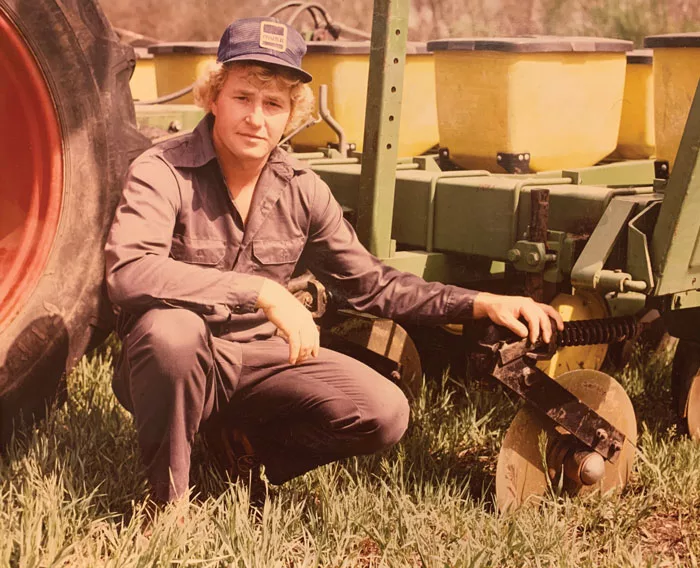
A lot of that was due to the lack of equipment. McCormick recalls how his corn yields soared after they invested in a Nu-Till planter, which was equipped with row cleaners, drag chains, Martin closing wheels, pop-up fertilizer and 2-by-2-inch fertilizer openers.
One innovation that McCormick feels helped revolutionize no-till were the Martin row cleaners, which replaced the no-till coulters on his John Deere planter.
“In those days, the row cleaner was a big advancement in being able to get through the residue,” he says. “Getting a good stand was the trouble. John Deere planters weren’t made to no-till — they still aren’t made to no-till — so they were not a good machine for no-till without adaptations.”
Not all equipment innovations have helped the no-till movement, though. McCormick has seen some equipment manufacturers advertise tools as no-till, even though they’re still disturbing the soil, such as vertical tillage implements.
“They’re stirring up the most valuable part of the soil, the upper couple of inches. So essentially we’re stirring up that heavy carbon, heavy organic matter,” he says, defeating the entire purpose of no-till.
Covers Bring Pride
But the biggest positive influence on no-till McCormick has witnessed over the years is the push for soil health, primarily driven by cover crops. He believes it’s because cover crops give no-tillers something to do and a sense of pride.
“No-till farmers were looked at as lazy,” he says. “They weren’t out working the ground all night long in the fall.”
No-till also had the reputation of being ugly, which wasn’t appealing to a lot of farmers. With cover crops, it helped change how no-tillers were viewed by their neighbors.
“Putting on cover crops is doing something in the fall, and then you have the emergence of green,” McCormick says. “So there’s a certain amount of pride.”
Livestock Comeback
As for the future of no-till, McCormick believes soil health will continue playing a large role, especially with more focus going toward carbon sequestration.
“There’s really only one place where we can put all the carbon dioxide in the atmosphere, and that’s the land,” he says.
Part of that includes the integration of livestock. At the National No-Tillage Conference one year, another no-tiller changed McCormick’s mind about getting rid of his livestock after discussing how he could graze them on his cover cropped acres. Now McCormick is expanding his cattle herd as fast as he can, and he predicts more growers will integrate livestock into their no-tilled, cover-cropped systems.
“It’s a win-win because land is so expensive,” he says. “It’s a way to bring a young person into the farming operation and bring livestock into the equation on the same land.”
Bill Richards, Circleville, Ohio
When Bill Richards was attending Ohio State University in the 1950s, a professor said the only reason to till was for weed control.
As more herbicides came out over the years, the less tillage Richards did. And the less tillage he did, the more efficient he could farm, allowing him to grow his acreage while earning the nickname “Grandfather of No-Till,” along the way.
“When we proved to ourselves we could grow a decent crop without disturbing or turning the soil, that was the breakthrough that encouraged us to keep on going,” he says.
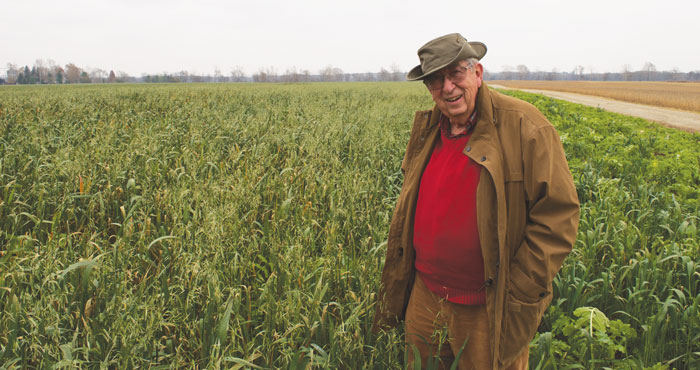
“When we proved to ourselves we could grow a decent crop without disturbing or turning the soil, that was the breakthrough that encouraged us to keep on going…” — Bill Richards
Richards has since retired, but his sons continue farming their 3,000 acres of corn and soybeans in Circleville, Ohio.
Equipment Speeds No-Till, Efficiency
A big driving factor in the increase of no-till, especially for Richards’ operation, were equipment innovations. The first was Allis Chalmers’ A-C No-Till coulter. They were deep fluted, so they could do a small amount of tillage in the row while also cutting the residue. Richards was able to cut his horsepower significantly because it eliminated three other operations he had on his planter: a big sweep, fingers to pull the residue back, and a packer wheel, all in front of the planting units.
The second was the 60-foot-wide toolbar from Kinze, allowing him to double his planting capacity from 12 rows to 24 in one pass. John Deere was selling planters by the unit at the time, so farmers could put their own planting systems together. The efficiency he achieved from no-tilling and using a 60-foot planter allowed him to expand up to 8,000 acres in the ’80s.
Challenges Facing No-Till
While no-till and equipment allowed Richards to expand his acreage significantly, he thinks a growing acreage and new machinery may also be a hindrance to the practice’s future.
“As these farms get bigger and bigger, no-till takes more management and discipline,” he says. “And the equipment companies keep tempting us with more tillage gadgets like the vertical till. It makes the fields look much prettier, but it really doesn’t raise yield a bit.”
Some of the challenge also lies in who owns the land. The problem with no-till and all conservation practices is that it takes a few years to realize their benefits, and a lot of farm ground is owned by absentee landlords.
“It’s hard to make a 5-year investment in no-till and cover crops in order to get soil quality and production improvements if you don’t have tenure,” he says.
Government Pros and Cons
Another influence on no-till that has had both positive and negative implications is the government.
Richards says a great benefit to no-till was the inclusion of conservation efforts in the 1985 Farm Bill, as it required farmers to keep their erosion under a certain level if they wanted to receive financial benefits.
But government payments have also been a detriment to no-till. During a farmer tour in Australia one year, the Australian farmers talked about why they had such a higher percent of no-tilling there compared to the U.S.
Richards recalls an Australian farmer saying, “Well, we don’t get government payments like you Yankees do. We have to no-till in order to stay in business.”
Economics, Policy May Drive Future
What will it take to see no-till continue to expand? Richards thinks the government may have to bring back conservation compliance and enforce it with crop insurance. He says that alone would improve water quality and erosion faster than anything else that can be done.
But it may depend on what prompted Richards to no-till in the first place: economics.
“No-till is not necessary when you’re selling 200-bushel corn at $5 a bushel,” he says. “If you sell 200-bushel corn at $3 a bushel or less, you’d be looking for any way possible to cut corners.”
Dwayne Beck, Pierre, S.D.
Dwayne Beck saw a lot of erosion growing up on the farm. Later, while teaching in a rural community, he continued seeing a lot of runoff in the spring.
“None of that made any sense to me,” he says. “I thought I would do a better job of trying to get the water to stay where it belongs.”
Eventually Beck became the research manager of the Dakota Lakes Research Farm in Pierre, S.D., a nonprofit owned by farmers initially formed to solve the issue of irrigation runoff.
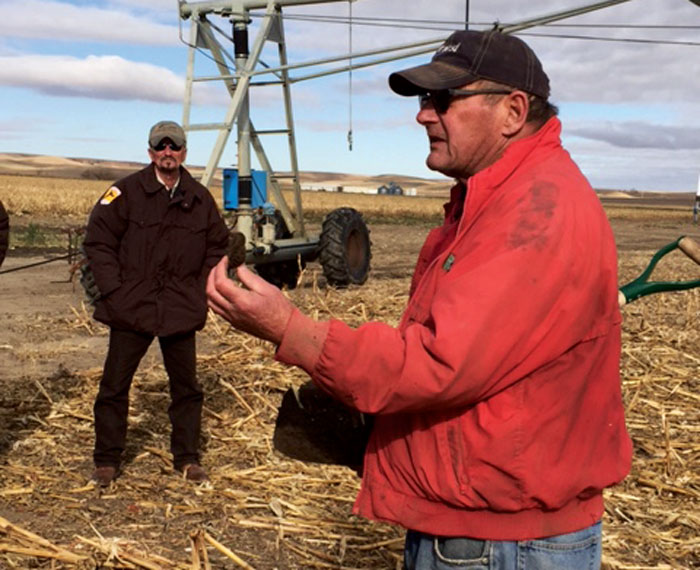
“If you’re going to farm in this part of the country, you have to no-till to be competitive…” — Dwayne Beck
“During some of this early work with runoff from irrigators, we noticed that if we didn’t do anything, the water went into the soil best,” he says, “which was totally opposite of what the scientific literature at the time was saying.”
From there, the research farm evolved into what is today known as “The Home of Regenerative Agriculture,” with a focus on research of agronomics that mimic natural ecosystems through no-till, diverse rotations and livestock integration.
Big Manufacturer Furthers No-Till
In the early days of no-tilling at Dakota Lakes Research Farm, equipment was a big challenge. First they thought a low-disturbance, hoe-type opener — “which I don’t think there is such a thing,” Beck says — was the right idea. But they found that it caused more weeds than if they used a tiny slot with a disc. And shank-type openers wouldn’t go through the residue.
Back then, drills were also “pretty crotchety,” Beck says, and either too heavy or too light. So when John Deere came out with the 750 No-Till Drill, it was a “Goldilocks” solution for growers in central South Dakota.
“That was a huge change here because all of a sudden people went, ‘Well, there’s a company that we know and trust and it’s not a shortline,’” Beck recalls.
Economics Increase No-Till Adoption
Farm economics also helped further no-till along, at least for Beck’s area.
“If you’re going to farm in this part of the country, you have to no-till to be competitive,” he says.
He recalls how the first Dakota Lakes board members were some of the first to no-till and were suddenly able to start paying more for land. Back then it wasn’t uncommon for farmers to follow a wheat-fallow rotation.
“If you’re only growing one 50-bushel wheat crop every other year, you can’t pay much for land,” he says. “But when the no-till guys can grow 70-bushel wheat and 150-bushel corn and then a 2,000-pound acreage crop of sunflowers, you can pay more for land.”
He adds that they’re having a historically dry year this year, and most no-tillers aren’t going to notice a big hit to yield, whereas if they were conventionally tilling, they “would have gotten nothing.”
No-Till No Choice
No-till has been adopted so well in his region that there are young farmers who don’t remember tillage. Beck worries that if older generations don’t warn them about the dangers of tillage, they might be tempted to try it.
“Somebody might come along and say, ‘We’ve got this really neat idea, you flip it over,’ and that will mineralize a whole bunch of organic matter in the short term and make it look good for a little while, and then it degrades,” he says.
But for the most part, he’s optimistic about no-till’s future — because he doesn’t see any other way for agriculture and society to survive without it.
“Eventually, policymakers are going to have no choice but demand that people do things better,” he says. “And as a society, we should all be demanding that.”
The 2024 No-Till History Series is supported by Calmer Corn Heads. For more historical content, including video and multimedia, visit No-TillFarmer.com/HistorySeries.