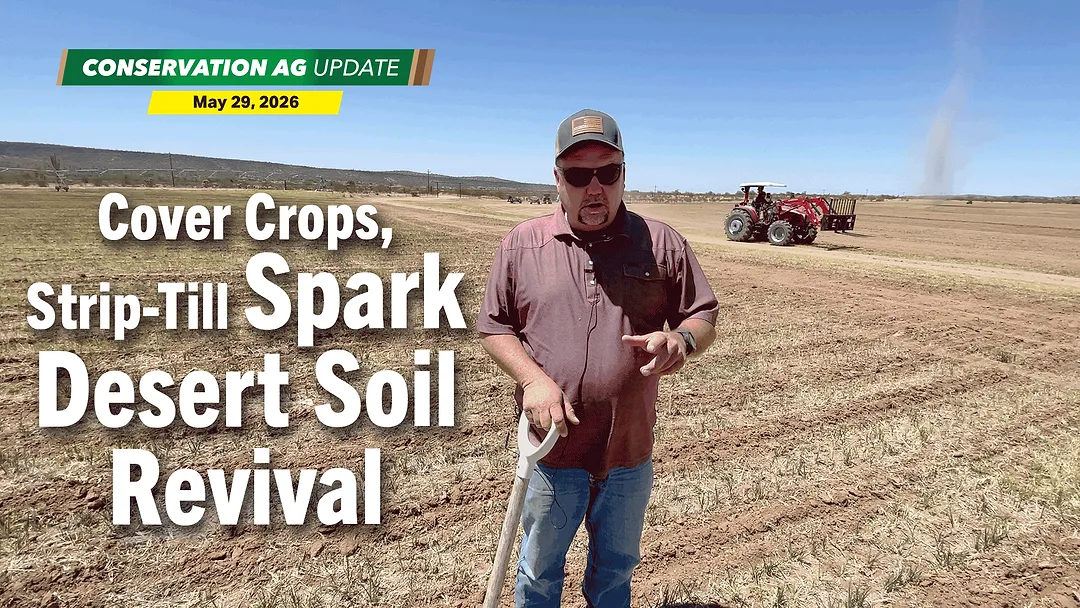
On this episode of Conservation Ag Update, brought to you by Titan International, we pay a visit to Strip-Till Innovator Robert Boyle’s farm in Coolidge, Ariz., for an up-close look at how he’s transforming his soils with cover crops and diverse rotations.
Plus, we poll no-tillers from around the U.S. to see how they’re using different methods and equipment to seed cover crops.
In the Cover Crop Connection, managing editor Mackane Vogel heads to Pennsylvania to visit with a longtime cover cropper.
Later in the episode, Alan Kraus, soil health specialist with Rice and Steele Soil and Water Conservation Districts, fills us in on a special soil health bus tour and explains why strip-till is gaining traction in his neck of the woods.
In the Video of the Week, hear from Pivot Bio CEO Chris Abbott in an exclusive 1-on-1 interview about the company’s research and manufacturing of biological nitrogen products.

This episode of Conservation Ag Update is brought to you by Titan International.
Titan International is a global leader in off-the- road wheels and tires, and is the maker of Titan Wheels, Titan Tires and Goodyear Farm Tires. Super Single Goodyear Farm Tires, featuring Titan LSW®️ technology help growers unlock greater performance.
Featuring a larger rim and smaller sidewall, LSW technology minimizes soil compaction and creates a smoother ride in and out of the field. Titan has you covered with a full lineup of tires to fit every application on your farm. Contact your local Titan and Goodyear Farm Tire dealer today and learn more about LSW Tire Technology.
TRANSCRIPT
Jump to a section or scroll for the full episode...
- Innovative Farmer Transforms Soil with Cover Crops, Cutting-Edge Tech
- What Methods Are No-Tillers Using to Seed Cover Crops?
- Hitting the Road — Editors Prepare for Upcoming Farm Visits
- Soil Health Bus Tour Headed to Strip-Till Conference
- Video of the Week: 1-on-1 with Pivot Bio CEO Chris Abbott
Innovative Farmer Transforms Soil with Cover Crops, Cutting-Edge Tech
Welcome to Conservation Ag Update! I just got back from Coolidge, Ariz., where Strip-Till Innovator Robert Boyle is proving cover crops can work anywhere…even in the desert with less than 7 inches of rain.
The proof is in the soil. Check this out. An earthworm in the first dig. Robert says 15 years ago, there never would’ve been a worm in this place. He planted cover crops on this field, then strip-tilled it and planted cotton dry. Robert says his soil health journey is an ongoing 10-year process. Anytime he makes a change, he gives it at least 3 years to come around.
Driving around Robert’s farm, I was amazed by how he’s able to manage so many different fields, with each one having completely different rotations and cropping practices. For example, on another field we stopped by, Robert strip-tilled twin-row corn into a terminated mix of triticale, oats, peas, vetch, clover and kale.
As you can imagine, he uses a lot of equipment and tools to get the job done, including some cutting-edge precision technology.
Noah Newman: " Robert, we have a big piece of technology behind us here. The 360 rain. Tell us a little bit about it when you get out of this."
Robert Boyle: "So this is our autonomous sprinkler. We're using it to irrigate this crop of corn. It's our second crop with it. We've had an oak crop before that. We're using 225 gallons a minute. We're irrigating a hundred acres. Right now we're getting around on it. It takes us about seven days to get around on that corn and then be back on it. Puts on six tenths of an inch is what we're putting on right now. And then I'm putting all my fertilizer on with it. We're getting way better utilization through the banding of the fertilizer through the wide drop of the rain unit than we are with our flood irrigation. Probably going to be able to use half the liquid fertilizer we've been using."
Newman: "And out here where you get only about seven inches of rain per year, that water conservation's really important to you and the efficiency. So how much does this help with that?"
Boyle: "Oh, it's cut our water usage on our corn in half."
Newman: "Wow."
Boyle: "And then when we can cut the water usage on our corn in half, that's to let us expand our acres on our other crops that we're growing. And then with this thing being completely mobile, this machine will follow our crop rotation around the farm. We're not dedicated to just one section of the farm that we can run it on."
Newman: "And as we were driving around, you controlled from your phone, right? I saw."
Boyle: "Yeah. All the adjustments, faults, anything like that, everything runs off your phone. There's one keypad on the back that you can adjust things back there, but other than that, everything is all through the app."
Newman: "Very cool. Now, what are some other big pieces of technology that you're using in your operation here that's giving you a lot of bang for your buck?"
Boyle: "So I have telemetry on everything. All my tractors, I run ops center or razor tracking, which are compatible and so I can figure out where all my equipment's sitting at any point of the day or night. We run Crohn hay balers. I have the Chrome Smart Connect and on that every morning I can see how many bales I've made, what the weights are, moisture, how many tons per field. And so I can even see where the bales are dropped through the field."
Newman: "And it's interesting how much of a mixed fleet you have out here on your farm. I mean, every different color you could think of you have out here, but you're able to manage it all with the John Deere Operations Center, right?"
Boyle: "So I have their tracker on all the machines and then also Razor, which is a compatible company with them. So we run a complete mixed fleet of brands and manufacturers on equipment between Cases, McCormicks, Fords. So we use OpsCenter and Razor tracking in combination to where we can put trackers on all the equipment. I can see where every baler gets parked at night. Every swather gets started in the morning, but it's really key when you're dispatching your help in the morning that I can know, "Hey, I have 300 bales here, 600 bales over there, so I know where I need to send the guys and in what order."
Newman: "Awesome. Well, Robert, thanks for giving us a tour of your farm out here. Completely different ball game out here in Arizona than our neck of the woods back in Brookfield, Wisconsin. So it's been a very interesting tour."
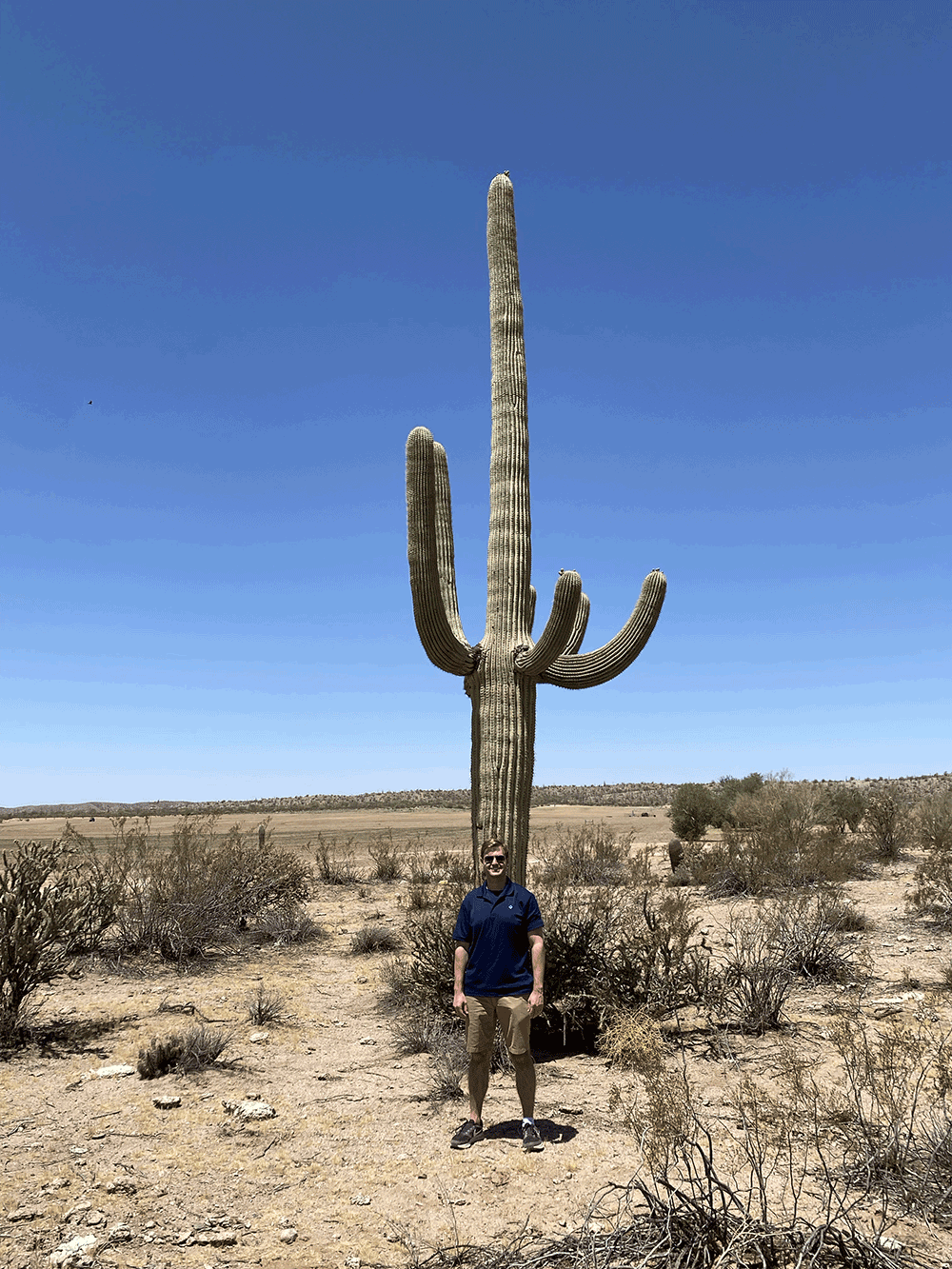
To further illustrate the environment Robert’s farming in…here’s a photo of me next to a giant saguaro next to one of his fields. Fun fact, those can live up to 200 years.
What Methods Are No-Tillers Using to Seed Cover Crops?
Robert’s cover crop playbook is probably different than yours. There are many ways to effectively seed covers. In the No-Till Farmer Email Discussion Group, we asked, “How are you seeding cover crops?” Let’s see what you said.
“I use a 15-inch Kinze planter. I can go in the field right after harvest and I can make sure I get the cover crop seed into moisture. When we have dry conditions, I can still get a good stand. I’m thinking about using a drone to get some seed out before harvest, but not all the cover crop seed.” – Gary Asay, Osco, Ill.
“We use a Horsch 60-foot, 10-inch spacing air seeder. In the eastern belt, where we have dry falls, or flooding in the fall/winter, it’s important to plant the covers and get good seed to soil contact. We use pre-mixed multi-species programs so we can just put the bag into the seed tender and quickly refill the seeder. We can plant 600 acres a day pretty easily.” – Ken Rulon, Arcadia, Ind.
“We plant our cover crops like we do a cash crop, with a drill. Drilling the cover crops allows us to get seeds placed through residue and into the soil, so we don’t depend on rain. This gets the cover crop germinated and emerged as fast as possible, at a time of year where every day makes a big difference in growth. We also fertilize our cover crops. This same fertilizer is then utilized by the following corn or soybean crop.” – Phil Needham, Calhoun, Ky.
“We’ve used everything you can think of over the decades. To get seed out there ahead of the frost, most of it now gets applied with a large drone.” – Rod Sommerfield, Mazeppa, Minn.
Speaking of cover crops, let’s check in with Mackane Vogel now for today’s Cover Crop Connection.
Hitting the Road — Editors Prepare for Upcoming Farm Visits
As the weather heats up and farmers everywhere get busier, the editorial team and I are getting plans squared away to hit the road and travel to several farms and field days in the coming months. Just like last year, my first big trip of the summer will take me out east where I’ll visit a handful of farmers in the Maryland, Delaware and Pennsylvania areas. In case you missed the content last time around, here’s a clip from a conversation I had last year with Elizabethtown, Pa., no-tiller Jim Hershey.
Jim Hershey: “So we raise corn, soybeans, wheat, and barley, and I like to add cover crops because cover crop is... I feel it's a cash crop for me even though I don't harvest it. What it's doing for the soil is just... I've seen tremendous improvement in soil profile, the soil health and water infiltration and the list goes on.”
Mackane Vogel: “Yeah, something I learned last year when I did my couple of East Coast farm visits, I visited Delaware and a couple farms in Maryland, Pennsylvania because of the Chesapeake Bay and just some of those other watershed areas, it seems like cover crops have really become almost kind of mandatory for a lot of farmers in those areas. But I mean from an erosion standpoint, it seems crucial for this area.”
Jim Hershey: “And when I started, well, then I've been cover cropping for 27, 28 years now, and planting green like 17 of those years, or maybe even in 20, I lose track it anymore. But originally for me the cover crop thing was erosion along with the no-till. It was just another way of managing your soils to help hold water, help hold soil from running off. Little did we know back then how much benefit the cover crops were doing for everything underneath the soil that we didn't see or we didn't monitor or we didn't know what was going on down there and we still don't know everything. We're learning new things all the time about how carbon sequestration, well, that you didn't hear a decade ago. I mean now it's new things evolving all the time, and so every acre of our crop land will get covered with some either multi-species cover crop or just a single cereal grain or something like that.”
Stay tuned to see which farmers I’ll be visiting this year, as I’ll be sharing blogs, photos and videos from my trip in mid-June. You can find all of that of course, at CoverCropStrategies.com.
Soil Health Bus Tour Headed to Strip-Till Conference
A special Southeast Minnesota Soil Health Bus Tour will bring up to 50 farmers to the National Strip-Tillage Conference, Aug. 6-7 in Springfield, Ill. The tour is sponsored by the Rice and Steele Soil and Water Conservation Districts. I caught up with Alan Kraus, soil health specialist with the districts, to talk about it, and why strip-till is gaining traction in his area.
Noah Newman: “So what are some of the unique challenges that growers in your districts deal with and why is strip till the benefits of strip till? Why could that be a good fit for what some of the challenges your growers are dealing with?”
Alan Kraus: “Yeah. Well, honestly, I farmed for 25 years. I used a lot of no-till on my farm. I dairy farmed in central Wisconsin and I really, really, really liked no-till farming. So I was new to strip-till myself when I came over here to Minnesota and I just have been learning a lot about it. And ultimately in my mind for our region here, these are beautiful soils. The strip-till your corn and no-till your beans is just an extremely great way to go. And so that's kind of why I began wanting to attend the strip-till conference and learning more about it and sort of saddling up alongside of farmers like David Legvold, who farms up in Northfield, Minnesota, who's also in the Hall of Fame there with strip till and really learning a lot more about it.”
“I would say in the past 10 years that I've been living and working here in this area, strip till has actually really, really increased significantly. We have a lot of farmers that are seeing those soil benefits and erosion control benefits. I mean, we get a lot of wind here in Southeast Minnesota and we just have a lot of tillage that we can really, really begin to take out.”
There are still spots on the bus. Sign up at RiceSWCD.org. And head to StripTillConference.com to reserve your spot at the conference.
Video of the Week: 1-on-1 with Pivot Bio CEO Chris Abbott
Moving on now to our Video of the Week, our Mike Lessiter caught up with Chris Abbott, the CEO of Pivot Bio for an exclusive interview following the move of company headquarters to the Twin Cities. Abbot talked about Pivot Bio’s approach to researching and manufacturing biological nitrogen products and reflected on what they’ve learned the last couple years.
“Our microbes are gene edited to only fix nitrogen and spoon feed it to the plant on the root. They’re not affected by weather with leaching or volatilization. They just deliver it. So how can the win rate not be higher?”
“Well, what we learned is nitrogen wasn’t the limiting factor for yield in those cases where win rate was a loss. And so, we had to go back and say, what causes that? Number one, total applied rate of nitrogen. If a grower doesn’t need more nitrogen, don’t buy our product. I just said that 30,000 acre customer wanted to buy our product late in the year this year and I said I’m not selling it. We’re not going to sell a product to somebody that doesn’t need more nitrogen.”
“Now some customers say, “But my nitrogen that I bought is volatile and I need an insurance policy or I need to figure out how to get more of my total nitrogen across all my sources to be more applied in season.” So, maybe that’s a shift from anhydrous in the fall to something in the spring or they’re coming out during weed and feed or maybe they’re already in the spring and they want to add a Y drop.”
“We need to help those growers get the best of the total nutrition program. That’s our product as well as what are the best synthetic nitrogen sources and timing that they can apply that. And we had to learn that the hard way.”
That’s just a taste of the conversation. Catch the full interview on the latest No-Till Farmer podcast on No-TillFarmer.com.
What do you think? Send me your thoughts and story ideas to Nnewman@Lessiter Media.com. Thanks for watching. Until next time, for more stories visit no-tillfarmer.com, striptillfarmer.com and covercropstrategies.com.