Congress: ‘Just say no’ to Bayer on pesticide legislation
By Dave Dickey
Published October 1, 2025 on Investigate Midwest
It’s off the record, on the QT, and very hush hush. Bayer AG wants no one to know, but the pesticide manufacturer is potentially just two votes away from the golden ticket it has wanted ever since acquiring Saint Louis based Monsanto in 2018.
A provision tucked deep in a spending bill to fund the Environmental Protection Agency and the Interior Department would effectively end lawsuits from plaintiffs claiming Bayer’s pesticide Roundup and its active ingredient glyphosate gave them cancer.
To date, Bayer has paid out roughly $11 billion in settlements to about 100,000 plaintiffs. At least 63,000 additional lawsuits are pending. Most of those cases are in state courts where the lawsuits typically allege Bayer’s Roundup labels fail to warn about potential cancer risks, referencing a 2015 International Agency for Research study that found glyphosate was “probably carcinogenic to humans.”
The Federal Insecticide, Fungicide, and Rodenticide Act prohibits the sale of any pesticide that is “misbranded.” Plaintiffs often successfully argue the lack of a cancer warning on the label amounts to FIFRA-defined misbranding.
Bayer has requested the Supreme Court take up whether that is indeed the case. But a Supreme Court win for Bayer could become moot if the pesticide giant has its way in Congress. The proposal follows Bayer’s intense lobbying of lawmaker
“None of the funds made available by this or any other Act may be used to issue or adopt any guidance or any policy, take any regulatory action, or approve any labeling or change to such labeling that is inconsistent with or in any respect different from the conclusion of —
(a) a human health assessment performed pursuant to the Federal Insecticide, Fungicide, and Rodenticide Act (7 U.S.C. 136 et seq.); or
(b) a carcinogenicity classification for a pesticide.”
On the face of it, the language appears innocuous and that’s how Bayer’s selling it. Bayer spokesperson Brian Leake insisted Section 453 is nothing more than routine business, “a normal part of Bayer’s political engagement.”
Meanwhile, Rep. Mike Simpson (R-ID) and chairman of the appropriations subcommittee that oversees environmental agencies, also downplayed Section 453 at a July hearing:
“The purpose of the language is to clarify existing law. The states cannot require a pesticide label that is different from the EPA’s label. The language ensures that we do not have a patchwork of state labeling requirements. It ensures that one state is not establishing the label for the rest of the states.”
In other words, move along. There’s nothing to see here.
Except there’s plenty to see.
Should Section 453 become law the only pesticide labels permitted by FIFRA must be based on a carcinogenicity classification or human health assessment. And since EPA does not classify glyphosate as a carcinogen, “misbranded” lawsuits would become mute.
Bayer has paid out roughly $11 billion in settlements to about 100,000 plaintiffs and at least 63,000 additional lawsuits are pending…
And if EPA wanted to change the label, Section 453 would require the agency to conduct a new assessment on whether glyphosate is a carcinogen, a process that can take at a minimum four years and sometimes longer than a decade.
In the meantime, Bayer will argue it can’t disclose potential harms that are different from the EPA-approved label — a label that currently discloses no potential cancer harm from glyphosate. What an irony.It’s insidious.
And dangerous because Section 453 not only would apply to glyphosate, but some 57,000 other active pesticide products. What if independent research discovered new evidence of a pesticide’s danger? Too bad. Section 453 ties EPA’s hands, preventing new immediate public label warnings.
Anti-pesticide groups are sounding alarms. And they should.
There’s likely little chance Section 453 survives Democrat scrutiny in the U.S. Senate. It might squeak by in the U.S. House. Bayer is reportedly twisting arms of lawmakers in farm belt states.
Bayer is desperate to put glyphosate lawsuits behind it. Here’s one sure fire way to get it done: Stop producing glyphosate based Roundup. Research and bring to market a pesticide alternative. And stop expecting Congress or the courts to clean up your ill-fated decision to buy Monsanto
Read the original article on Investigate Midwest »
Low-dose herbicide applications can accelerate resistance
By Cindy Benjamin
Published August 6, 2025 on WeedSmart
Some weeds can really thrive on lower-dose applications of herbicide, producing more biomass and more seed. Research conducted by Dr Asaduzzaman and Eric Koetz examined weed populations with resistant and susceptible individuals to investigate this phenomenon further.
Eric Koetz, weed research agronomist with NSW Department of Primary Industries and Regional Development, says that sub-lethal applications are known to promote herbicide resistance in weed populations by selecting for individual plants that can survive exposure to a particular mode of action.
“These sub-lethal doses cause an effect called hormesis, which results in a weed showing a fitness advantage in response to a low-dose herbicide application,” he says. “The hormesis effect can stimulate some weeds to grow more biomass and produce more seed than plants from the same population that have no herbicide applied.”
Stubble shading weeds, dust on the target leaves, spray drift, or poor boom setup are all examples of how low dosing can occur and potentially trigger a hormetic response in weeds.
Hormesis can be measured in both resistant and susceptible individuals in a weed population. If the weeds are resistant to the herbicide at higher rates, this fitness advantage can accelerate the spread of the resistant genes. This response to a low-rate application can bulk up the weed seed bank and put more selection pressure on future herbicide applications.
“In glasshouse studies, we have observed this effect in awnless barnyard grass sprayed with glyphosate and tall fleabane sprayed with paraquat,” says Eric. “Research at the University of Queensland has also measured the hormesis effect in sowthistle treated with glyphosate.”
In the awnless barnyard grass (ABG) experiments, low-rate glyphosate applications (34 and 67.5 g a.i/ha) boosted biomass production in both glyphosate-susceptible and glyphosate-resistant plants. As the glyphosate rate increased, biomass production in the susceptible population dropped quickly. This demonstrates that the hormesis response exists naturally in ABG.
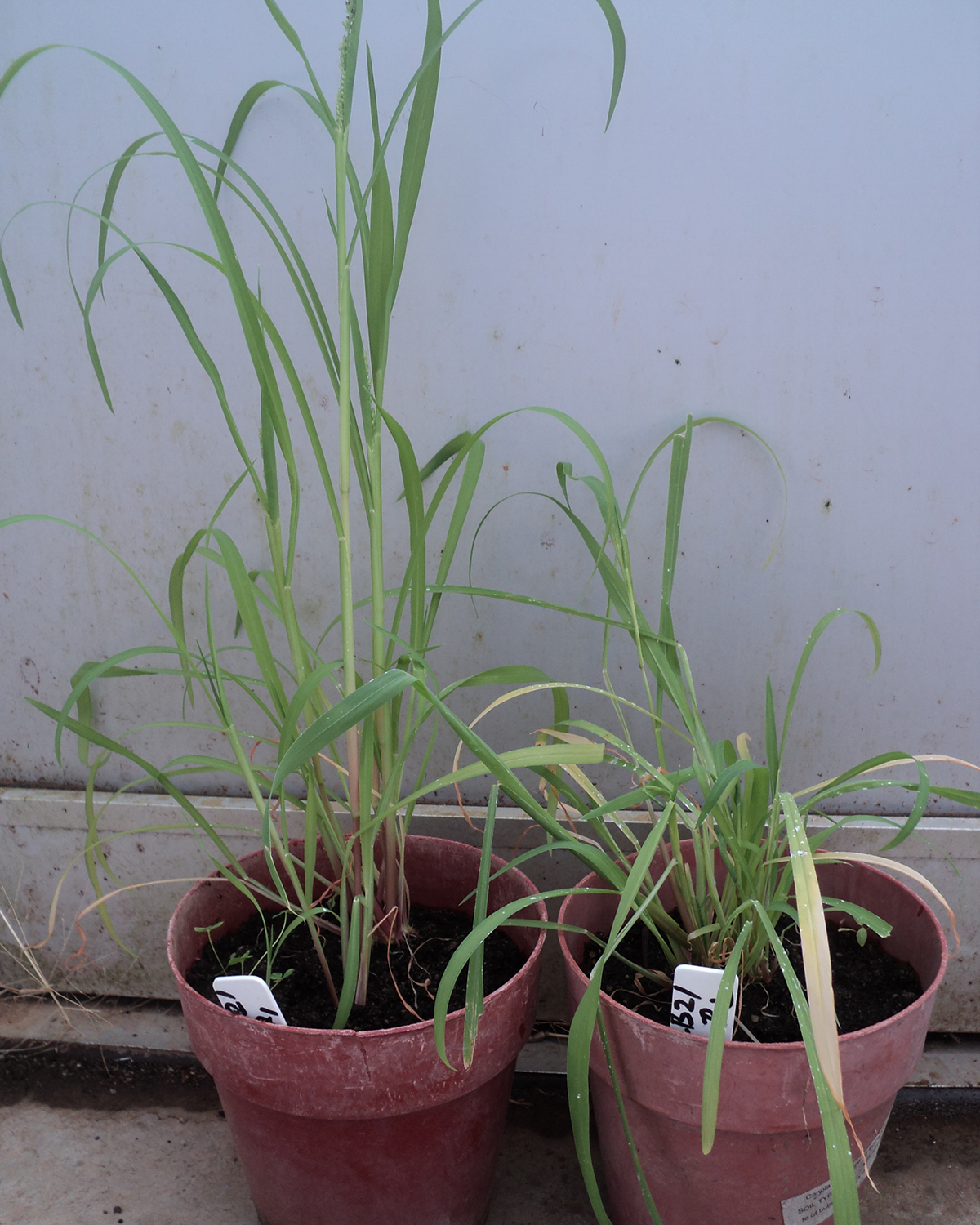
Caption: The hormesis effect in glyphosate-resistant awnless barnyard grass treated with a low-dose of glyphosate (left), compared to the nil-glyphosate control (right).
In contrast, the glyphosate-resistant ABG plants produced more biomass for longer, extending through to the reproductive stage. Spikelet production peaked at doses of 100 to 540 g a.i/ha, where the glyphosate-resistant population produced 20 to 40 per cent more spikes per plant than the no-herbicide control.
Weed control is essentially a numbers game…
“In practice, glyphosate-resistant awnless barnyard grass growing in a field situation would be less competitive than susceptible weeds in the paddock if no glyphosate is applied. However, if glyphosate is used and the dose that reaches the target is less than the label rate, the resistant biotypes would eventually gain the upper hand, aided by hormesis boosting seed production,” he says.
“It’s a different story on the field edges, where glyphosate-resistant plants may be exposed to low-dose applications from spray drift or sub-optimal fence-line glyphosate applications. These plants could express a hormetic response and rapidly produce a large quantity of glyphosate-resistant seed that is easily spread by machinery into the cropped area.”
Dr Asaduzzaman, Charles Sturt University conducted dose-response experiments on paraquat-resistant tall fleabane, where paraquat application doses ranging from 62.5 to 125 g a.i/ha, applied at the 4–6 leaf stage, stimulated a hormesis effect.
“The exposure to a low dose of paraquat stimulated these resistant tall fleabane plants to produce 30 to 60 per cent more buds/plant than untreated paraquat-resistant plants,” says Asad. “Even when label rates are applied in a field, paraquat can stimulate a hormetic response, possibly due to in-field dose variation due to plant or stubble shading or from spray drift.”
Fence line management continues to be a frontier in the evolution of herbicide resistance. These non-crop areas can allow weeds to flourish with full access to soil moisture and sunshine. While growers concentrate their efforts on effective in-crop spraying and herbicide selection, the crop borders are often given a lower priority in terms of timeliness and optimal spray application.
Spray drift is an environmental risk and can damage susceptible crops; however, the threat of spray drift causing low-dose application on weeds is often overlooked.
“As we know, weed control is essentially a numbers game,” says Eric. “Any practice that leads to an increase in seed production is a genuine risk to long-term profitability and herbicide sustainability in cotton and grain production systems.”
The WeedSmart Big 6 is an integrated weed management strategy that applies to both crop and non-crop areas on and around farms. Glyphosate and paraquat resistance often enters cropping fields from the borders, and prevention requires a dedicated fence-line management program that includes herbicide and non-herbicide tactics where possible.
Read the original article on WeedSmart »
Evolving Technology, Market Needs Driving Corteva Split-Up
By John Dobberstein
Published October 2, 2025 on No-Till Farmer
Global ag giant Corteva will separate into two independent, publicly traded companies after the decision to split up was made unanimously by the board of directors.
The two new companies will be New Corteva, comprising the company’s crop protection business, and SpinCo, representing Corteva’s seed business.
Corteva said the move will “unleash two distinct market leaders” that are farmer-centric and with technology and innovation at their core, “with operating models and capital allocation priorities tailored to support their respective growth outlooks, strategic directions and value propositions.”
Upon separation, current Corteva Chairman Greg Page will become chairman of New Corteva, and current Corteva CEO Chuck Magro will become CEO of SpinCo.
The transaction is expected to be completed in the second half of 2026. The split must still win final approval by Corteva’s board, legal counsel and the U.S. Securities and Exchange Commission. Legal liabilities, including historical DuPont pension plans and PFAS obligations, will be retained by New Corteva.
Corteva officials said New Corteva aims to be a market leader “differentiated by its innovative solutions,” in crop protection, including biologicals, and they envision SpinCo being a leader in advanced seed genetics, pushed forward by the advances in AI tools coming online.
Magro said Corteva over the last 6 years has simplified the company’s portfolio, reduced costs, invested in “high-return” endeavors and ensured its product pipeline would serve farmers and provide returns to the company.
The split, he says, is about positioning both businesses to win in their respective markets. “This gives both businesses freedom to operate without having to look out for the other,” Magro said. “We have a history of moving before the market, and we believe we are doing that again.”
SpinCo, as home to the Pioneer brand, it will launch from a position of strength, the company said, due to Pioneer’s track record of advanced breeding, market leadership and financial strength.
SpinCo will also leverage the strength of its regional anchor brands such as Dairyland Seed, its partnership with retailers through brands like Brevant, and a growing presence in the out-licensing market.
This gives both businesses freedom to operate without having to look out for the other…
It may be too early to tell for sure how the split will affect products and management for growers, although Corteva insists the new companies will be releasing farmer-centric that are effective and provide farmers choices that they’ve asked for.
In terms of how products will be sold and distributed with the two new companies, Magro said the crop protection and seed channels are fundamentally different, as crop protection is mostly sold through retail distribution and seed relies more on direct and regional suppliers.
During an investor call Tuesday where the company split was discussed, Magro said being an integrated agricultural company has tradeoffs and the crop protection market has shifted to a point where differentiated products are valued but integration may hurt value more than it helps.
Magro sees a pure-play crop protection company providing the flexibility to optimize the company’s manufacturing and supply costs and develop deeper collaborations in the industry.
With plant genetics, “we know more about it today than in any time in history,” Magro said. AI tools, paired with advanced genetics and breeding techniques, will help accelerate new innovations, and Magro sees a point where SpinCo could expand beyond its corn and soybean core into wheat, cotton rice or other products where genetics play transformational role.
The next generation for soybeans at Corteva is HT4 — a fourth-generation herbicide-tolerant soybean that has resistance to five unique herbicides — which will launch in the early 2030s, Magro said. The product includes technology from Corteva and other companies.
“Looking ahead 10-15 years to the next generation, tomorrow’s systems will be open with multi-source licensing agreements with multiple modes of action,” Magro said. “Farmers will need these systems due to crop resistance, and insects, weeds and disease proliferating due to changing weather patterns.”
Read the original article on No-Till Farmer »
A Healthy Conversation About Food Starts With Sound Science
By Per-Ola Olsson
Published October 2, 2025 on The Global Farmer Network
My farm is near one of Sweden’s largest producers of neurotoxin. It’s also one of the world’s most familiar brands: Absolut Vodka.
I have nothing against alcohol. In fact, I’m quite fond of it.
Although alcoholic beverages have given me much enjoyment, they’re still depressants and dangerous in large doses. Alcohol impairs judgment and slows reaction times. Long-term use damages the brain and liver. The World Health Organization puts it in the same category of carcinogen as tobacco and asbestos.
That’s why I laughed when I read an article about glyphosate and wine. Barely traceable residues of a low-toxicity crop-protection tool—we’re talking parts per billion—made the headlines.
Meanwhile, people drink beer, wine, vodka, and more without thinking that their alcohol content is a proven carcinogenic neurotoxin.
Farmers like me are understandably tired of the “poison” debate. Nobody who works hard to grow food for others wants their profession reduced to the language of toxins. And they certainly don’t want the crop-protection tools they use to defend their fields from weeds and pests portrayed as if they were dangerous by default.
Yet many consumers and journalists assume that anything synthetic in agriculture must be suspect, that residues end up on their plates, and that “natural” or organic foods are, by definition, safer than other kinds.
For me, “poison” is a scientific and technical term, not a rhetorical one. A fundamental rule of toxicology is that dosage matters more than origin. A molecule isn’t dangerous just because it comes from a factory, and it isn’t harmless just because it comes from nature.
Farmers are understandably tired of the “poison” debate…
What matters is our level of exposure.
Coffee is a perfect example. The plant produces an alkaloid pesticide to defend itself against insects and other predators. In humans, high doses of it can trigger anxiety, palpitations, and sleeplessness. In extreme cases, it can cause seizures or even death.
Yet we harvest coffee beans because we want the toxic effect from the plant’s own pesticide—which in everyday language we call “caffeine.”
Chocolate contains theobromine, a natural alkaloid that wards off insects. In high doses, it can make humans nauseous or shaky. And still we love chocolate for the mild stimulant effect.
Chili peppers use capsaicin as a deterrent: It burns the mouths of mammals. In large amounts, it can damage tissue. Even so, humans seek it out for the thrill of the taste.
Garlic releases allicin when it’s crushed. This compound is toxic to microbes and irritating in excess but celebrated for its flavor and even its “health” benefits.
Fruits like cherries and apricots hide compounds that release cyanide. The only thing standing between the children munching cherries in the garden and death by poison is that they don’t chew the pits.
Plants protect themselves with thorns or chemical warfare because they can’t run away from predators. We love them for it—and so natural toxins are part of our daily diet.
The late toxicologist Bruce Ames once made the point sharply. In a famous analysis, he showed that more than 99.9 percent of the pesticides we consume come from the plants themselves. On average, people eat about 1,500 milligrams of natural pesticides each day, compared to less than one—tenth of a milligram of synthetic residue.
We must appreciate this context as we consider pesticide residues in food. The legal limits of exposure are set with massive safety margins. Regulators base them on the concept of an Acceptable Daily Intake. Toxicologists first determine the highest dose of a substance that shows no observable effect in animals. That’s effect, not harm. Then they divide that figure by at least 100 to build in a huge margin of safety.
Let’s keep a sense of proportion. Barely measurable residues of crop protection do not threaten our health.
I use crop-protection tools on my farm to protect the plants, the soil, and ultimately ourselves. They help me grow the best and safest wheat, barely, sugar beets, and oilseed rape.
Farmers deserve better than to have their work reduced to toxic clichés about “poison.” And consumers deserve better than headlines driven by ignorance and fear.
I’m going to keep drinking coffee, which I prefer strong and black each day. I will also continue to eat chocolate, chilis, cherries, and garlic. And I’ll have vodka from time to time as well.
If we want healthier conversations about food, we must start with sound science and its simple truth that crop protection is not the enemy of safe food but the reason we have it.
Read the original article on The Global Farmer Network »