
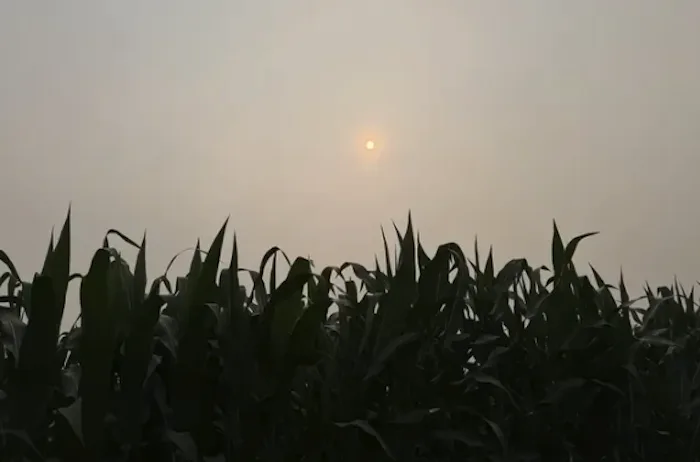
In recent years, air quality alerts triggered by wildfire smoke have become a recurring part of summer weather forecasts. A study across several agricultural areas in the U.S. found that wildfire smoke events have increased over time, affecting approximately 20% of growing season days, especially in July and August (1). While the adverse effects of wildfire smoke on human health are well documented, people can generally seek shelter indoors. Crops, however, remain fully exposed to smoke and poor air quality (Figure 1).
So, how does wildfire smoke affect crops? This seemingly simple question is difficult to answer because the effects of smoke result from complex interactions among smoke plume components, plant species, crop developmental stage, and environmental conditions. Wildfire smoke can simultaneously alter solar radiation, light quality, temperature, and atmospheric chemistry, leading to both beneficial and detrimental effects on crop growth. Consequently, the net impact of smoke exposure varies among crops and environments and can be difficult to predict, even within the same growing season. Below, we explore some of the potential outcomes of wildfire smoke exposure on plants.

What is in a smoke plume from burning vegetation?
Wildfire smoke is a complex mixture of gases, particles, and biological materials. Key components include:
- Gases: Wildfires release carbon dioxide (CO₂), carbon monoxide (CO), methane (CH₄), nitrogen oxides (NOₓ), sulfur dioxide (SO₂), and ammonia (NH₃).
- Volatile Organic Compounds (VOCs): These carbon-containing compounds vaporize at room temperature and can undergo chemical reactions to form ground-level ozone; however, ozone production is highly variable and depends on the availability of nitrogen oxides (2). Wildfire plumes can elevate ozone levels, especially when they mix with urban NOₓ sources (2).
- Particulate Matter (PM): Wildfires generate fine particles (PM₂.₅) and coarse particles (PM₁₀) (3). PM₂.₅ includes black carbon, soot, ash, metals, nitrates, sulfates, and secondary aerosols from VOC oxidation. Examples of PM₁₀ include dust, plant debris, pollen, spores, and silica. The toxicity of PM₂.₅ from wildfires varies depending on its composition compared to PM from other sources (4).
- Bioaerosols: Wildfire smoke can carry viable bacteria and fungi (5). However, the distance these microorganisms can travel from the source is still under debate and requires further research (6).
Light-Smoke interaction
Plants rely on water, nutrients, and solar radiation for growth. Smoke plumes alter both the quality and quantity of sunlight reaching the canopy. Particles suspended in the smoke plumes scatter incoming radiation, increasing the proportion of diffuse light, which reaches plant surfaces from multiple angles rather than directly from the sun (1,7). Furthermore, the size and composition of smoke particles can alter the wavelengths of light available to plants, potentially affecting photosynthetic processes.
In terms of crop production, the interaction between smoke and light can be both beneficial and detrimental:
- Potential Benefits: Diffuse light can penetrate deeper into the canopy, potentially enhancing photosynthesis in shaded lower leaves (7). As a result, the crop canopy may use available light more efficiently, improving the ability of plants to convert intercepted solar radiation into biomass and yield (radiation use efficiency).
- Potential detrimental effects: Dense wildfire smoke can reduce light intensity, limiting the energy available for photosynthesis and potentially slowing plant growth. Although increased diffuse light under smoky conditions can improve radiation use efficiency, these benefits may not fully offset the reduction in total light availability when smoke or cloud cover is substantial (1, 8).
Crop growth stage is a critical factor that influences the result of smoke exposure. Crops generally tolerate moderate reductions in radiation during vegetative growth better than during reproductive stages. The potential consequences of reduced solar radiation have been demonstrated in corn shading studies. In corn, Yang et al. (2019) showed that a 50% reduction in solar radiation after silking decreased grain yield by 34.7% to 63.5%, a response that depended on hybrid and plant population, and demonstrates the importance of adequate solar radiation during reproductive growth (9). Accordingly, simulation studies have predicted yield reductions in corn exposed to elevated particulate matter concentrations during the early reproductive stages, highlighting the importance of adequate light interception during critical periods of kernel development (10).
Temperature and rainfall
From an agricultural perspective, the cooler temperatures associated with wildfire haze may reduce crop water use by lowering transpiration rates. Under drought conditions, this effect could help conserve soil moisture and lessen crop water stress (11,12). However, these potential benefits may be offset by the adverse effects of smoke deposition on plant surfaces. Accumulation of particulate matter on leaves can interfere with normal plant function by promoting stomatal closure, reducing gas exchange, and limiting photosynthetic activity. Additionally, prolonged periods of haze may slow the accumulation of growing degree days (GDD), potentially delaying crop development and maturity. In northern production regions with shorter growing seasons, such delays could increase the risk of frost damage to crops before physiological maturity (13).
Furthermore, smoke particles can reduce the size of water droplets in cumulus clouds, increasing cloud reflectivity and potentially suppressing rainfall (14). Wildfire smoke can also cool surface temperatures while warming the upper atmosphere, creating more stable atmospheric conditions that trap pollutants and lead to persistent haze. This phenomenon was observed in several major metropolitan areas affected by wildfire smoke during 2023 (15); however, there is no information about how this process affected surrounding agricultural settings or if it increased the risk for pesticide drift.
Additional impacts of wildfire smoke
Some wildfire-emitted gases, such as CO, NO, and CH₄, act as signaling molecules in plant metabolism (16,17,18). However, at high concentrations, these gases may become harmful to plants (19). As mentioned earlier, ozone forms from reactions between VOCs and NOₓ. A recent study found that over the past 40 years, average yield losses due to ozone were 6.1% for soybean and 3.5% for maize, with soybean being more sensitive (20). Ozone enters plants through stomata and can damage plasma membranes (21). Plant responses vary depending on ozone concentration, genotype, growth stage, and exposure duration (21,22).
Wildfire smoke can affect plant health and disease dynamics through both chemical and physical pathways. Ozone may alter disease severity in a host-pathogen and growth stage-specific manner (23), while particulate matter deposited on leaf surfaces can injure tissues, potentially increasing plant susceptibility to pests and diseases (24,25).
Nevertheless, smoke deposition can also provide nutrients, particularly nitrogen, that become available to plants following deposition (26). The net effect appears to depend on smoke concentration: low levels may benefit plant growth, while high levels can be detrimental, as demonstrated in studies of coniferous species exposed to dense smoke (26).
Wildfires and the smoke they generate have far-reaching impacts beyond the direct damage caused to vegetation. Smoke can transport trace metals and other contaminants through the atmosphere, potentially affecting air quality, water resources, environmental health, and human well-being (4). Wildfires can also disrupt ecosystems and negatively affect biodiversity by altering habitat structure and ecological processes (4).
Observations from the field
During the summer of 2023, wildfires burned millions of acres across Canada, sending extensive smoke plumes into several U.S. states and raising concerns about the potential effects of the resulting haze on crop growth, solar radiation, temperature, delays in crop maturity, and yield.
Reductions in solar radiation of up to 32% during the last week of June were reported in Indiana (11). Similarly, in Ohio, reductions in daily photosynthetically active radiation (PAR) ranged from 2.7% to 9.1% in June and from 0.8% to 3.6% in July (27). Studies conducted by Lindsey et al. (2024) in Ohio indicated that wildfire smoke had only a limited effect on air temperature. The authors estimated that increased aerosol optical density reduced daily maximum temperatures by 0.4% to 1.4% relative to the 10-year average at a location in western Ohio and reduced accumulated growing degree days by only 9% to 12% of the total observed. Consequently, the cooler temperatures experienced during the growing season were more likely associated with persistent northerly surface wind flow than with smoke alone. These cooler conditions may have contributed more directly to delays in corn drydown.
Despite concerns about the potential impacts of wildfire smoke on crop productivity, above-average yields were reported for corn, soybean, and wheat in 2023 (27) and for wheat, canola, and corn in Canada (13). One possible explanation is that the most significant smoke events occurred primarily during corn vegetative growth stages and early soybean flowering, when these crops are generally less sensitive to reduced sunlight. In addition, wheat had already reached physiological maturity before the most severe smoke episodes occurred. As a result, the overall impact of wildfire smoke on crop yields appears to have been minimal under the conditions observed in 2023 and 2025 in regions of the United States and Canada.
Conclusion
One of the greatest challenges in understanding wildfire smoke impacts on agriculture is that smoke can create both beneficial and detrimental conditions simultaneously. The ultimate crop response depends on smoke intensity, duration, crop species, growth stage, and the prevailing weather conditions before and during exposure. Smoke may reduce heat stress and improve light distribution within the canopy, yet it can also decrease total solar radiation, alter plant water relations, and delay crop development. As a result, predicting crop responses to wildfire smoke remains difficult, and observations from one season or location may not apply universally.
Reviewed by Dr. Greg Roth, MSc. Arthur Person, and MSc.Kyle Imhoff, Penn State.
To see the full list of cited references click here.