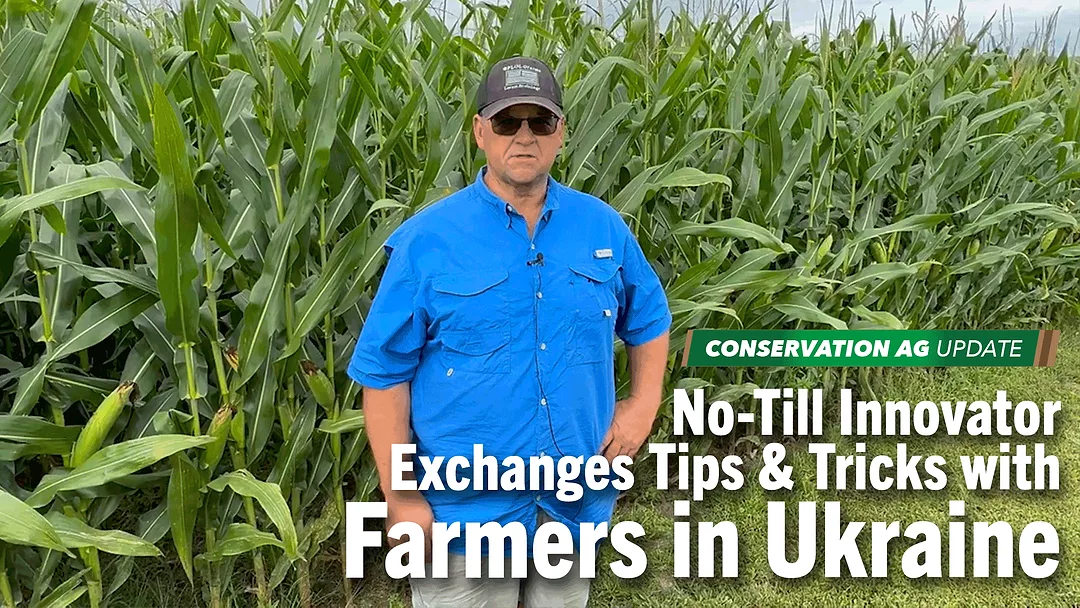
On this episode of Conservation Ag Update, brought to you by Bio Till Cover Crops, West Union, Iowa, No-Till Innovator Loran Steinlage shares what he’s learned from farmers in Ukraine.
2025 Conservation Ag Operator Fellow Michael Thompson checks in from his farm in Almena, Kan., with a look at his planter setup and unique approach to starter fertilizer applications.
In the Cover Crop Connection, no-till and cover crop expert Blake Vince delivers new insights at the Pennsylvania No-Till Alliance Field Day.
Plus, we go “ahead of the curve” with Greenfield Robotics co-founder Clint Brauer for a look at how his autonomous bots are ideal for no-till and strip-till systems.
In the Video of the Week, USDA natural resources specialist Amanda Roberson shows the impact 4 years of no-till has had on previously unhealthy soils. And finally, Sparta, Wis., no-tiller Jim Leverich explains why he keeps coming back to the National No-Tillage Conference.
This episode of Conservation Ag Update is brought to you by Bio Till Cover Crops.
Bio Till cover Crops, a pioneer and leader in cover crop seeds, represents a complete lineup of seeds suitable for use in diverse soil types and growing conditions. Our focus on cover crop and regenerative forage seeds sets us apart from suppliers invested in other markets. Dealers in our distribution network are committed to your success by providing local resources, education and guidance to ensure you have the correct foundation for success. With over 50 years of experience in production, processing, packaging, and shipping, you won’t find a better fit for your farm.
TRANSCRIPT
Jump to a section or scroll for the full episode...
- No-Till Innovator & Farmers from Ukraine Exchange Conservation Ideas
- Getting No-Till Crops Started with ‘Natural’ Starter Fertilizers
- Staying Motivated to Keep Planting Cover Crops & Practicing No-Till
- Autonomy in Action: Greenfield Bots Take Chemicals out of No-Till
- Video of the Week: Busting Through Compaction with No-Till & Covers
No-Till Innovator & Farmers from Ukraine Exchange Conservation Ideas
We’re kicking the show off in West Union, Iowa, where No-Till Innovator Loran Steinlage recently opened his doors to no-tillers and ag leaders from all over for a private farm tour.
The event was hosted in conjunction with the Sand County Foundation, Practical Farmers of Iowa and others. Three farmers from Ukraine were in attendance. Steinlage has hosted several Ukrainian farmers in recent years. He says he’s impressed by their spirit and desire to learn about conservation practices.
“And I go back to the last time I was in Ukraine, the last night I was there, the one I remember the most, the conversation I remember most is the guy lost four combines that fall due to landmines. This is before the current war started. These guys have been dealing with it since 2014. This is not new. They're seasoned veterans, but it's pretty scary when you can get numb to war and that's almost what I'm seeing right now. With that said, the biggest thing I'm starting to watch is several of the guys that I've been in contact since the war started or escalated is you can tell fatigue is setting in.
Their demeanor is changing. They're tired, they need help, and I'm more than willing to do whatever I can help them. Just helping them give ideals and access to knowledge. That's the best way we can help them right now and that's why they're coming over here to help learn and educate their people. On the flip side though, the group last week, some of the guys that were with us, we were learning as much more than we were teaching.”
Steinlage says iron sharpens iron, and he’s learned a lot from the hardened veterans from Ukraine.
Getting No-Till Crops Started with ‘Natural’ Starter Fertilizers
Let’s check in with our 2025 Conservation Ag Operator Fellow Michael Thompson out in Almena, Kan. Thompson gives us an up-close look at his no-till planter setup and explains why he’s cautious with starter fertilizer.
“It’s just a liquid in furrow system. It comes out and runs right out behind these closing discs. It’s in furrow with the seed. What my goals are for this is I’m not running any fertilizers, it’s just row support, some biologicals, some compost and things of that nature. What we’re trying to do is just give that plant the best start we can. Give it a happy, healthy place when it puts the roots out so it hits the ground running and tries to do as much as it possibly can for us. It’s about giving it a nice strong start. A lot of starters get high in salts, where we don’t have a 2-by-2 system on this planter, we’re doing it in furrow, that’s where I’m more comfortable putting these biologicals down to keep the salts in control. I don’t want a high salt fertilizer close to that seed. I’d prefer to see a natural process out there to get that seed started.”
We’ll check back in with Michael soon to see how harvest is going so far after a flash drought. Now let’s send it over to Mackane for today’s Cover Crop Connection.
Staying Motivated to Keep Planting Cover Crops & Practicing No-Till
A few months ago, Canadian no-tiller Blake Vince gave a presentation at the Pennsylvania No-Till Alliance’s 20th Anniversary Meeting. And while the topic of his presentation was about conserving farm land with cover crops and the importance of bio diversity, there’s an anecdote that Blake told the audience about the future of no-till and cover crops that has stuck with me. Take a listen.
“This is another gentleman, Rolf Derpsch from Paraguay, a longtime extension officer helping farmers adopt no-till practices and methodologies and I was on one of the longest no-till farms in Paraguay, the beans were up to about my rib cage and I got down, pulled the beans apart and I started filming and narrating a little video and when I got up, Rolf has tears in his eyes and says ‘that was beautiful.” And to this day I don’t really know what I said. And I said Rolf, I’ve gotten to meet guys like Dave Brandt, Carlos Crovetto, Dwayne Beck and yourself. What happens when all of this human intellect is no longer with us — all of this legacy of experiential learning is gone?
And he looked at me with tears streaming down his cheeks and he said ‘that’s why you’re here. That’s why you are here.’”
Some good motivational words from Blake Vince and from No-Till Legend Rolf Derpsch on why it’s so important to keep practicing no-till and keep planting cover crops and continue to share that knowledge with your neighbors and peers.
Autonomy in Action: Greenfield Bots Take Chemicals out of No-Till
Time now to go ahead of the curve with Clint Brauer, the co-founder of Greenfield Robotics. Brauer’s goal with the autonomous bots is to find a safer, chemical-free solution for weed control. And he says the bots, which are also capable of nutrient microspraying, are perfect for no-till and strip-till systems.
“I’ve been building tech for a very long time. My co-founder has been doing machine vision for 35 years. So, we know a lot. And sensors are something waiting to break. Believe it or not, as a robotics company, we try to not use sensors wherever we can. Our system doesn’t identify each plant; it doesn’t need to. We identify the rows. The current robots run between the rows and get as much as they can between the rows, and that’s it, and they have to move at a high speed to do that. The way that we’re fixing the in-row problem is this next robot that basically mulches the cover crop and injects the seed into the mulch. There is no need for hyper-precision identification of every single weed. We simply don’t care. For a strip-till situation, for contextual awareness here, what we like to see is you strip-till into the cover crop and we just maintain the cover crop in between rows, we’d love to do as much of that as possible, especially if moisture isn’t a problem.”
The Greenfield bots are running in 11 different states. They’re currently sold out for 2026, but Brauer expects the technology to be more mainstream and more widely available within the next 18 months. Catch our full conversation on No-TillFarmer.com.
Video of the Week: Busting Through Compaction with No-Till & Covers
Let’s check out some soil for our Video of the Week. Amanda Roberson, a natural resource specialist for the USDA, shows how unhealthy soil is transforming after just 4 years of no-till and cover crops.
“You’re talking about aggregates. What we’re looking for in a good aggregate, it’s like a grape vine. You’ll get a bunch of little clods that are sticking to the roots. It’s really creating those open structures for stuff to infiltrate. What’s that allowing is the faster infiltration. With this only being 4 years, you can see there’s a little bit of compaction. But it really shows that it’s breaking up pretty nice. Compaction is kind of one that takes a little bit longer to address if you’re going to go to the straight regeneration. Having 4 years, 5 inches is usually a good indicator before you hit a compaction layer. But the longer that you’re doing the no-till and the cover crops, allowing those roots to go deeper and deeper each year, you address it a little more.”
That was from the Racine County Watershed Field Day in Rochester, Wis.
That’ll do it for this week. Got something you’d like to feature on the program? Shoot me an email at Nnewman@Lessiter Media.com. Thanks for tuning into Conversation Ag Update. Until next time, for more stories visit no-tillfarmer.com, striptillfarmer.com and covercropstrategies.com.