On this episode of Conservation Ag Update, brought to you by Yetter Farm Equipment, the team pays a visit to No-Till Innovator Jim Leverich for a look at some of his new equipment in Sparta, Wis.
In the Cover Crop Connection, associate editor Mackane Vogel gets an up-close look at No-Till Innovator Jim Hershey’s new cover crop plot in Elizabethown, Pa.
Later in the episode, we stop by the Flickner Innovation Farm in Moundridge, Kan., where the no-tiller and strip-tillers are testing new Deere precision technology. Plus, agronomist Brian Hefty shares his biggest no-till success story on the Conservation in Action Tour, and finally in the Video of the Week, Iowa State’s Rebecca Vittetoe gives us the scoop on the upcoming Strip-Till Field Day.

This episode of Conservation Ag Update is brought to you by Yetter Farm Equipment.
Since 1930, Yetter Farm Equipment has been providing farmers with profitable solutions. From residue management and fertilizer placement to seedbed preparation, our equipment is designed to maximize your inputs, save you time, and deliver a strong return on investment. Explore our full line of planter attachments, precision fertilizer placement options, strip-till units, and stalk rollers at yetterco.com. Let Yetter help you prepare your equipment lineup for success today.
TRANSCRIPT
Jump to a section or scroll for the full episode...
- No-Tiller Showcases New Sidedress Applicator
- Jim Hershey Plans for Sudan Sorghum Cover Crop Live Planting Demo
- Precision Specialist Shares Big Takeaway from See & Spray Trial
- Brian Hefty’s Biggest No-Till Success Story
- Video of the Week: Strip-Till Field Day Preview
No-Tiller Showcases New Sidedress Applicator
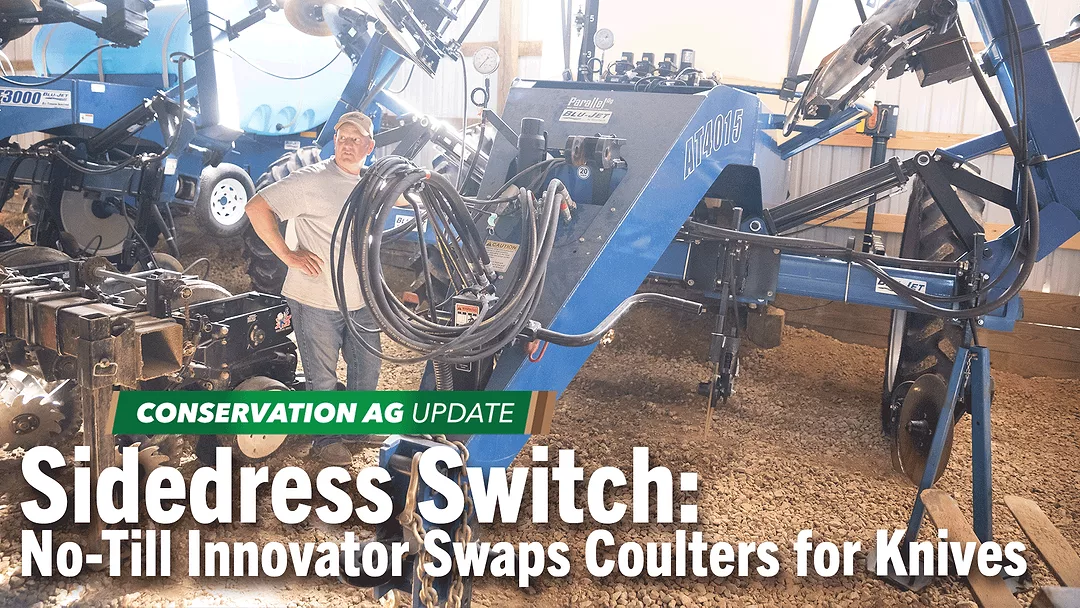
Welcome to Conservation Ag Update! Great to have you with us. Hard to believe we’ve reached the halfway point of June, which means sidedressing time for many of you. That’s what No-Till Innovator Jim Leverich is doing this week in Sparta, Wis., and he’s switching things up with a new Blu Jet liquid fertilizer applicator. Let’s check it out.
“I used to have an injection coulter, but I went to the knives, I like the knives. I don’t know if they’ll plug in cornstalks. They work fine in bean stubble. I have some corn on corn this year, but we’ll see. If we get into trouble well just put the spray injector back on there, but the knife is so much better because if you’re sidedressing with a spray injector, every night you have to wash the applicator, it splatters too much and ends up all over the place. I hung on to my anhydrous bar a year and a half or two and then I finally sold it, traded it for this unit.”
Leverich is using it to inject fertilizer about 2-3 inches deep around V3-V4, and he might try mixing in some ATS with 28.
Now let’s check in with Mackane Vogel on his East Coast ag tour for today’s Cover Crop Connection.
Jim Hershey Plans for Sudan Sorghum Cover Crop Live Planting Demo
Mackane Vogel here with this week’s cover crop connection and as i said before we are in Elizabethtown Pennsylvania at Jim Hershey’s farm and why don’t we see what Jim Hershey has been working on this year with cover crops.
“This barley here will be harvested in two weeks and then we want to plant some sudan sorghum to try and get some green cover and we are going to do a live planting demo the day of the event. It still looks a little — well I think that would plant on top. Hmm — we might have to consider that here. Hey — it’s plenty moist enough but I think just for shallow no-till, I wouldn't wanna plant all my crop in that wet of a soil but I like that. It’s plenty wet down lower but I think there's enough dry soil on top and it crumbles well enough, but just look at the root development there just from the barley. It goes down there 3 or 4 inches just from the barley. Thats great, i am glad thats drying out enough to get some planting done here in this area for the soil pit.”
Alright well there will be lots more content from my East Coast farm trip to come in the coming weeks but that’s all for this week’s cover crop connection.
Precision Specialist Shares Big Takeaway from See & Spray Trial
From Pennsylvania to the Flickner Innovation Farm near Wichita, Kan. Local Deere dealer PrairieLand Partners is testing See & Spray on Ray Flickner’s no-till and strip-till fields.
Product Innovation specialist Bryan Berggren explains why this kind of tech is set to take off.
“John Deere changed their strategy as far as the pricing structure. Right now, this season and moving forward, you’re only getting charged for the savings, which means you’re getting charged for the acres it does not spray. What that does is, is that gets the price way down to an acceptable price point. People want this technology, they want to be able to use this to save money on chemicals and to be responsible a little bit with what they’re doing with the land. Nobody wants to spray chemical all the time. This is gaining a lot of traction in the industry as a whole. There are lots of other companies developing this type of technology. Personally, I was very skeptical from the beginning because I ran a sprayer for 20-30 years and worked for some commercial applicators. It never ceases to amaze me how sensitive it is. It sees more than we can see with our own eyes and even moving 12-15 mph through the field, recognizing a crop vs. a weed, it’s unbelievable.”
Brian Hefty’s Biggest No-Till Success Story
An All-Star panel discussed the future of conservation ag during last month’s Conservation in Action Tour. Our Mike Lessiter served as moderator for the session. He asked the panelists for their biggest no-till success stories. Brian Hefty shared a personal one of helping his dad move away from full tillage in north central Iowa.
“Now, for my dad, it I think physically hurt him every time he had to drive past the field and see that the field didn't look perfect all the time. He could not stand the residue out there in the spring. It drove him nuts. But as we looked at it throughout the next couple of years, we had a lot less erosion.”
“And the other thing that I mentioned right away with my grandpa is we have the technology today that he didn't have. So, herbicides were mentioned, the equipment, there was no no-till planter, no-till drill, there's no way you could do it back then.”
“And the other big thing I talk an awful lot about is drain tile properly placed. I'm not saying draining duck ponds, but when it's out in a normal field situation to keep the water table down, well, now we don't have to do the tillage to dry the field out. That top two feet is dry and now it gives us more opportunity to do strip-till and no-till and those kinds of things.”
“So, when I step back and I think about, like for my dad, that was a massive change. And without my brother and me here, I don't know that he would've made that change. I mean, he's a smart guy and wants to do good things and everything else, but if you look at why did soil organic matter decrease in the United States for like 100 years in a row, it's because of the massive tillage we did.”
“We have to figure out, how do we reduce tillage? Doesn't necessarily have to be no-till. Strip-till is a great compromise, I think, but we have to reduce tillage somehow, some way.”
“And the big thing anymore that I talk to farmers about is soil organic matter is good. If we have good soil organic matter or the soil's more spongy, less likely to compact, we have more nutrient release, we just raise better crops and our ground is worth more.”
Great story from Brian there. The panel also featured Carrie Vollmer-Sanders, president of Field to Market, and Brian Chatham, agronomy manager for Ducks Unlimited. Listen to the full conversation on No-TillFarmer.com
Video of the Week: Strip-Till Field Day Preview
Time now for our Video of the Week. I caught up with Iowa State’s Rebecca Vitettoe for a preview of the upcoming Strip-Till Field Day, taking place ahead of the National Strip-Tillage Conference, July 30. Check it out.
Noah Newman: And do you know how many strip-till toolbars will be out here?
Rebecca Vitettoe: Yeah. So we've got 10 confirmed strip-till toolbars as of right now. So that'll be awesome to have different manufacturers, different strip-till bars here for people to take a look at. We've got about 40 acres that we can work around in to do some of those different demos in. And then in addition to the strip-till bar demos, we've also got some companies that will be joining us just having more of a static display, and whether it's the live demos or the static displays, there'll be opportunity for people to visit with those different companies that are here.
Noah Newman: Now, I know our attendees have been asking you for an event like this for quite some time. They want to see equipment in action, and just what can you say about the value of an event like this where people, maybe some beginner strip-tillers or veteran strip-tillers or even people thinking about getting into strip-till can see this equipment in action?
Rebecca Vitettoe: Yeah, I think anytime you can get out and just see something, get your hands on, it's a great learning opportunity. Whether you're totally new and you're just thinking about maybe exploring strip-till and just wanting to know what's even out there, or maybe you're a more seasoned veteran and you've been doing strip till, just to see and learn from different people and even share expertise.
Noah Newman: And free to attend, but you're asking people to RSVP so you can get a head count for lunch.
Rebecca Vitettoe: Yep. The strip till field day is free to attend. We are just asking that people do register ahead of time. That is more so to help us, like you mentioned, get a head count for lunch. So we're working with our local pork producers. They're going to be grilling some pork burgers for us, so-
Noah Newman: I'm hungry just hearing that.
Rebecca Vitettoe: We want to make sure we have enough pork burgers for everybody.
Would love to see you there and at the Strip-Till Conference. Visit StripTillConference.com for more information.
That’ll do it for this week. Got something you’d like to feature on the program? Shoot me an email at Nnewman@Lessiter Media.com. Thanks for tuning into Conversation Ag Update. Until next time, for more stories visit no-tillfarmer.com, striptillfarmer.com and covercropstrategies.com.