On this episode of Conservation Ag Update, brought to you by Martin-Till, Leopold Conservation Award recipient Jim Hershey shares some of his latest conservation tips and tricks from his Elizabethtown, Pa., farm.
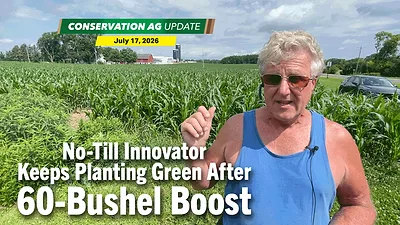
Fellow no-tiller Joseph Kern describes how planting green has transformed his operation in Mariah Hill, Ind.
In the Cover Crop Connection, associate editor Mackane Vogel catches up with Iowa farmer Rick Matt for a preview of his upcoming National Cover Crop Summit presentation and some tips on how to unlock the benefits of cover crop grazing.
Later in the episode, contributing editor Dan Crummett goes 1-on-1 with 2025 Conservation Ag Operator Fellow Michael Thompson for a recap of his dry growing season in Almena, Kan.
Plus, in an exclusive interview with No-Till Farmer, Elizabeth Burns-Thompson explains how Modern Ag Alliance is helping no-tillers ensure access to the critical crop protection tools they depend on.
Finally, in the Video of the Week, a pair of Wisconsin farmers describe their experience with using See & Spray targeted sprayer technology with no-till.
This episode of Conservation Ag Update is brought to you by Martin-Till.
Since 1991, Martin Industries has designed, manufactured and sold leading agriculture equipment across North America and the world. Known for Martin-Till planter attachments, the company has expanded to include a five-step planting system including our floating, air or hydraulic and frame mounted row cleaners along with closing wheel systems, twisted drag chains, fertilizer openers, weight transfer systems and more in their lineup. Their durable and reliable planter attachments are making it possible for more and more farmers to plant into higher levels of residue & cover crops.
|
|
TRANSCRIPT
Jump to a section or scroll for the full episode...
- Inside Jim Hershey’s Systems Approach to No-Till
- Indiana No-Tiller Unlocks Planting Green Benefits
- Rick Matt Shares Preview of Upcoming National Cover Crop Summit Presentation
- No-Till Lessons Learned from a Challenging 2025
- Ensuring Access to Critical Crop Protection Tools
- Video of the Week: Does See & Spray Work in No-Till?
Inside Jim Hershey’s Systems Approach to No-Till
We begin with big news out of Elizabethtown, Pa., where No-Till Innovator Jim Hershey has received the prestigious Leopold Conservation Award for land stewardship.
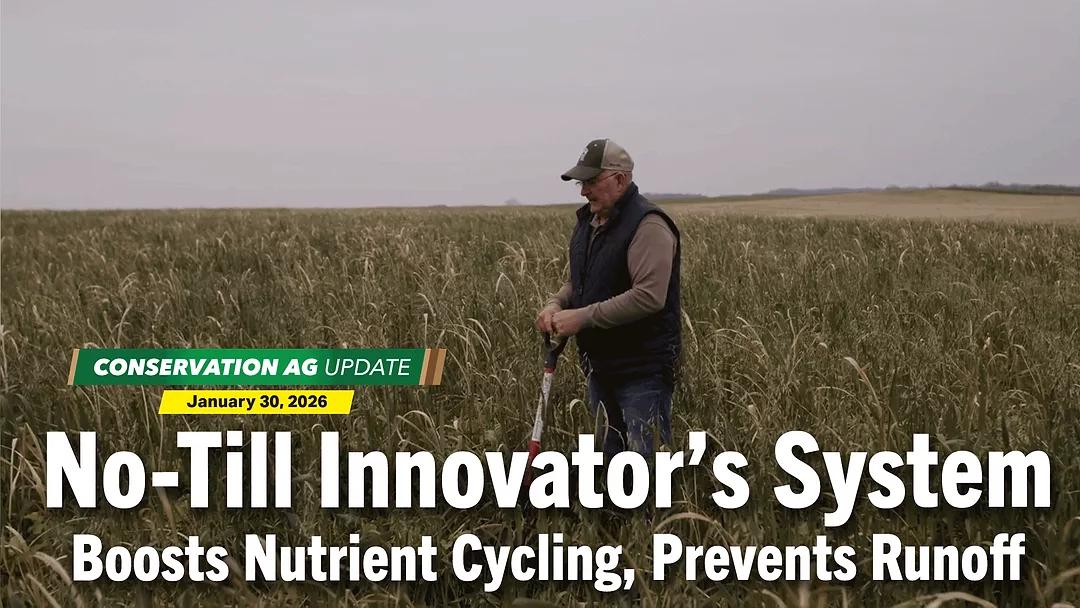
Jim and his wife Shirl started no-tilling in the early 1980s to reduce fuel and labor costs. It helped them overcome high debt and soaring interest rates at the time. Just about every year since, Jim’s added something new to his bag of tricks like cover crop mixes and planting green. And today, Jim’s no-till system helps prevent erosion and runoff while saving him big money on nutrients and herbicides.
Jim Hershey, No-Tiller, Elizabethtown, Pa.: “So, we’re capturing all the nutrients that this cover crop has provided and it’s also helping to hold the nutrients from running off into our streams and waterways.”
“Look at all the roots there that’s helping to hold the soil together, giving food to microbes and helping to recycle all the nutrients that are available in the soil.”
Lamonte Garber, Stroud Water Research Center: “You might ask, why would we need a riparian buffer? When Jim planted these trees with the USDA CREP program, these trees working with the great soil management that he has on his farm are really the ingredients to restore this stream into a much more biologically rich ecosystem.”
“That (the water) looks really good right? This water that we just pulled right out of this stream here that’s flowing through Jim’s farm is perfectly clean. That’s a great thing for the stream. We know then that the soil that’s on Jim’s fields is staying on his fields growing healthy crops and not ending up in the stream.”
Jim co-founded the Pennsylvania No-Till Alliance in 2005. He also leads the state’s Regenerative Ag Research Foundation and serves on the State Conservation Commission Board.
Indiana No-Tiller Unlocks Planting Green Benefits
Mariah Hill, Ind., no-tiller Joseph Kern is riding high after his Indiana Hoosiers won the national championship. And he’ll continue to stack wins this spring when he plants green into living cover crops, something he’s been doing since 2015. Kern credits networking and educational events like the No-Till Conference for steering him in the right direction.
“We used to spray the cover crops at a short height because we were scared to plant into it and made some mistakes along the way like spraying it when it was really tall. We finally broke free and listened to our friends at the No-Till Conference, and decided we were going to plant green. Once we did that in 2015-2016, we decided we’d never go back. It’s the best thing. It works on our bottom ground, good ground and HEL ground. It made our farm profitable. We’d probably have to rent our farm out or do something different if we were going to try and fight the old ways.”
Rick Matt Shares Preview of Upcoming National Cover Crop Summit Presentation
Iowa no-tiller Rick Matt will be presenting at this year's National Cover Crop Summit. In this video, he gives a short preview of what audience members can learn from his session titled "Covers & Critters: Integrating Livestock on Summer Annuals."
Mackane Vogel: “I'm joined with Rick Matt, one of our growers who's going to be on the Cover Crop Summit program. And Rick, why don't you just tell everybody a little bit of a preview about what you're going to be talking about at the summit this year?”
Rick Matt: “I'm just sharing my experience with adding covers and then various forms of livestock, and growing summer annuals as our little niche, and how that fits in with that. Try to touch on a little microbes deal, but usually when it gets too technical, my brain goes blah, blah, blah. So, hopefully it's pretty layman's terms.”
Mackane Vogel: “I was just at our national No-Tillage Conference in St. Louis and talked to a lot of different farmers from different backgrounds, and regions out there. But one thing I heard over and over again is folks saying, "Man, I've been doing cover crops and no-till for a long time, but grazing and the livestock part of it is something that a lot of folks want to add to their system, but just haven't quite figured out the logistics." I guess what's your advice to beginners trying to get into that part of it?”
Rick Matt: “Take it slow, on growing it, especially with cattle right now. It's pretty risky to jump into that, and add it, but when it corrects, I think it'd be a really good time to bring it in. But start on a small level, see what works. Sheep's a little easier just for manhandling them and moving them around, it's just a little easier. And then, I guess, to me, the benefits we've seen is just starting to diversify your crop rotation, has started to enhance your crop growth, and to me, that's a big plus if you could even start doing that ahead of the livestock.”
Mackane Vogel: “Absolutely. Well, we're looking forward to your presentation, and those of you listening, feel free to go to covercroftstrategies.com and you can find out more about the Cover Crop Summit there and sign up for free”.
To view his full presentation, plus several other videos from various cover crop experts, sign up for FREE at covercropstrategies.com.
No-Till Lessons Learned from a Challenging 2025
It was a challenging year for Conservation Ag Operator Fellow Michael Thompson. Our Dan Crummett caught up with the Almena, Kan., no-tiller to chat about some of his top takeaways from a very dry growing season.
Dan Crummett: “What did you learn from 2025?”
Michael Thompson: “There is resiliency in the system. It doesn’t take a lot of moisture to grow a crop. It takes a lot of moisture to grow a *good* crop. With that resiliency piece in there, that soil really wants to yield for you.”
Dan Crummett: “That resilience — explain again what you’re talking about there.”
“The stuff that we’ve done with long-term no-till, trying to keep soil covered as much as possible. Every little bit of moisture you get goes that much further.”
“What were your yields like?”
Michael Thompson: “Soybeans were anywhere between 28-38, and we didn’t even figure that we were going to harvest soybeans at all, that it was a total loss. But we did get some rains there in August that they did go ahead and green back up. Corn was all over the board depending on where it rained and where it didn’t.”
“Looking back on it, for the spotty rains we had, we were lucky that we had a harvest because a lot of those acres were corn on corn. When we don’t have a soil profile and we don’t get the rains, it’s hard to make anything yield because there wasn’t much moisture to be had this year.”
Big thanks once again to Michael Thompson for giving us a peak behind the curtain throughout the year.
Ensuring Access to Critical Crop Protection Tools
Over 100 ag organizations from coast to coast have come together to make sure farmers continue to have access to those critical crop protection tools they depend on. It’s called the Modern Ag Alliance, and its executive director, Elizabeth Burns-Thompson says conservation and chemistry go hand in hand. Our Mike Lessiter sat down with Elizabeth to talk about the progress her team made in 2025.
“Modern Ag has been working on policy solutions — this will now be going into our third year at the state level. Last year, we were involved in policy proposals in about 12 states, ranging everywhere from Idaho down to Florida and a handful in between. Very pleased to say we were able to get a few of those across the finish line, up in North Dakota as well as down in Georgia. Those landmark bills were not only passed bipartisan but also signed into law by the governors in those respected states, which is a huge step forward in this industry.”
“We’re hoping to take that momentum going into 2026. We anticipate working in 8 states at this time. There are some states where that legislation will be carryover from 2025, so places like my home state of Iowa, North Carolina, Tennessee, where we made it through a chamber and we’re going to continue to work on finishing through the next chamber. There are other places where this legislation is being teed up for the first time, so these legislations are going to be having new conversations. Through the mountain west all the way down to southeastern part of U.S., there’s going to be a robust conversation on pesticides, pesticide labeling and providing certainty for farmers in those states.”
Burns-Thompson says you can learn more and make your voice heard at ControlWeedsNotFarming.com.
Video of the Week: Does See & Spray Work in No-Till?
More crop protection talk in our Video of the Week. This one comes to us from a roundtable at Wisconsin John Deere dealer Riesterer & Schnell. Jackson Remer and Ryan Miller talked about their experience using See & Spray targeted spraying technology, and if it worked with no-till.
Jackson Remer, Remer Farms, Omro, Wis.: “It seems that the system works and now it’s in your hands (to adapt it to your system). Every farm is going to be different. There are a lot of different factors that come into every operation, there are different ways to make it work if you want to use it.”
Ryan Miller Miller Farms, Pickett, Wis.: “On our ground that we do minimal till or no-till on, it seems that’s where the largest savings are. If you were out in spring doing a burndown and you went in later on, that stuff was 10-15% less spray coverage on that than stuff we do tillage on, which I thought was crazy to see the number difference. There were some more savings on that. Him (farmer friend in Palmyra, Wis.) down there doing a lot of no-till, he really saw the benefit of it right away.”
That’ll do it for this week. Got something you’d like to feature on the program? Shoot me an email at Nnewman@Lessiter Media.com. Thanks for tuning into Conversation Ag Update. Until next time, for more stories visit no-tillfarmer.com, striptillfarmer.com and covercropstrategies.com.