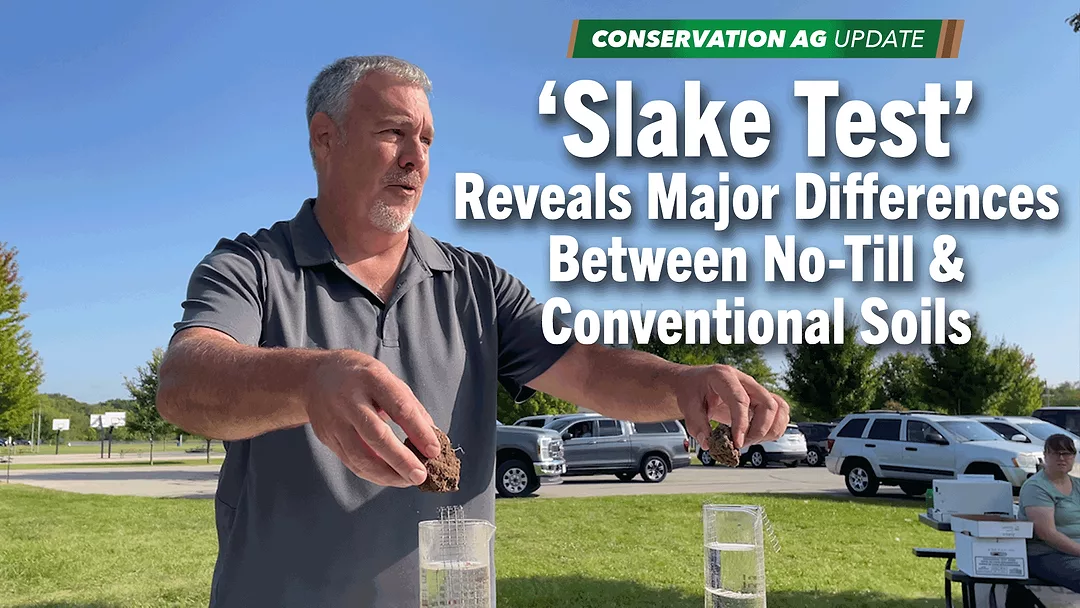
On this episode of Conservation Ag Update, brought to you by Yetter Farm Equipment, we head inside the Watershed Protection Committee of Racine County’s annual field day in Rochester, Wis., for a look at the latest takeaways from their no-till vs. conventional research plots. A ‘slake test’ reveals eye-opening differences between no-till and conventional soils, and independent research agronomist Jim Stute shares his big economic takeaway from the test plots.
In the Cover Crop Connection, associate editor Mackane Vogel gets the scoop on a new Great Plains drill for no-tilling fall cover crops.
Later in the episode, we stop by Tanner Schoff’s farm in Walnut, Ill., to check out the "Rezidue Reaper" combine attachment he invented to manage heavy residue in his no-till and strip-till system.
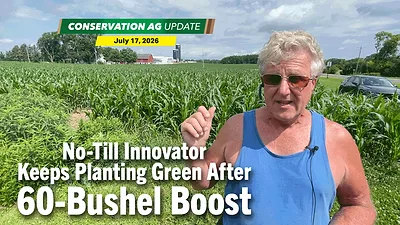
Plus, Cody Boeck from Boeck Farm Outfitters explains how Greeneye Technology is helping Corn Belt farmers slash herbicide costs. In the Video of the Week, Jason Webster shares why banding has the advantage over broadcasting at Precision Planting’s PTI Research Farm. Finally, No-Till Innovator Mike Starkey delivers a special message about a “can’t miss” no-till event coming up.

This episode of Conservation Ag Update is brought to you by Yetter Farm Equipment.
Since 1930, Yetter Farm Equipment has been providing farmers with profitable solutions. From residue management and fertilizer placement to seedbed preparation, our equipment is designed to maximize your inputs, save you time, and deliver a strong return on investment. Explore our full line of planter attachments, precision fertilizer placement options, strip-till units, and stalk rollers at yetterco.com. Let Yetter help you prepare your equipment lineup for success today.
TRANSCRIPT
Jump to a section or scroll for the full episode...
- ‘Slake Test’ Shows No-Till Benefits at WPCRC Field Day
- Rethinking Cost Share Programs to Further Assist No-Till Transition
- New Great Plains BD7510 Drill Perfect for No-Tilling Fall Cover Crops
- No-Tiller, Strip-Tiller Builds Combine Attachment for Heavy Residue
- Corn Belt Farmers Slash Inputs with Greeneye Sprayer Technology
- Video of the Week: Banding vs. Broadcasting at PTI Farm
‘Slake Test’ Shows No-Till Benefits at WPCRC Field Day
Welcome to Conservation Ag Update! With harvest season quickly approaching, now is the perfect time for a late-summer field day. The Watershed Protection Committee of Racine County kicked off their annual event in southeast Wisconsin with an eye-popping visual comparison between no-till and conventional tillage. Check it out.
“They’re both the same soil but this is because of the regenerative agriculture and the conventional that’s been going on up there (in the test plots), this is only 4 years now of difference. We’re going to take the darker, healthier soil that we’re creating doing this research and compare it to the conventional. I haven’t done this yet, so hopefully this works. When we talk water quality, that’s why Eagle Lake donated to us. They say we don’t want this (runoff) in our lake; we want that (no-till soil) in our lake.”
“The nitrogen, the phosphorus, things that promote algae growth, weed growth, things that are costing these lake associations money. They want to see this where there’s not a lot of that incorporated in the surface runoff from the farm fields.”
Perfect way to kick off the field day, as attendees next got an up-close look at the test plots comparing conventional tillage to no-till and cover crops. It took less than a minute for a cup of water to infiltrate the no-till plot, whereas the water was still standing in the conventional plot at the end of this 40-minute presentation.
Rethinking Cost Share Programs to Further Assist No-Till Transition
Meanwhile, independent research agronomist Jim Stute shared new economic data from the two plots. Here’s his big takeaway from the study so far.
“Our takeaway in studying the differences between conventional and regenerative is that we do have a definitive transition slump in the regen, we saw a yield reduction. Our 3-year reduction in yield and income equated to almost $300 per acre, which is a huge hole to dig out of. There are a lot of reasons behind it that’s site-specific here, like just a lack of precipitation during our growing seasons and we haven’t been able to supercharge our soil biology to get them working their magic on the regen system. The take-home is if you’re transitioning, look at using cost share programs for both cover crops and no-till, and you’ll get closer. What we recommend is maybe we need to rethink cost share. Instead of cost sharing programs and specific practices, let’s cost share transition so that people have a chance to transition to regen on rental ground without having an economic penalty.”
Stute will explore the economic benefits of cover crops during a classroom presentation at the 2026 National No-Tillage Conference. Head to NoTillConference.com for more information.
New Great Plains BD7510 Drill Perfect for No-Tilling Fall Cover Crops
Mackane Vogel here with this week’s cover crop connection. Well Fall is just about here and many no-tillers might be wondering what their best options are for no-tilling Fall cover crops. Here’s Tony Wisker, Vice President of Sales with Great Plains, to tell you about one new option that would be a great fit for no-tilling Fall covers.
“The 7510 is a new model for us, available in 15 feet or 20 feet working width. And it transports, no matter what you're working with, it transports under 10 feet wide. So today, here at the show, it's displayed in that transport position. So one remote lever, you fold that out to your full working width, has a no-till coulter, a nice heavy machine. So any conditions, it's going to be able to get the job done and get the seed in the ground. The standard, what you would expect from a Great Plains row unit with a double disc opener with a leading edge, a no-till coulter in front of that, a variety of press wheel choices. So a great option, whether you're no-till in cover crops in the fall, no-till in your soybeans in the springtime, it's a well-rounded machine no matter what the use.
The biggest takeaway with this machine is the meter. So now it has the same seed meter, the BD meter that our BD7600 has. So that's something that we haven't had on the smaller size drills or on the no-till drills yet. So that meter has the ability to meter small seeds, large seeds, at a variety of rates. It's all controlled by the speed of the meter, not necessarily the width of the opening. So it meters very smooth, very steady, and very accurately.”
And as you heard Tony say it transports at UNDER 10 feet — a very impressive and popular feature.
No-Tiller, Strip-Tiller Builds Combine Attachment for Heavy Residue
The other day, I paid a visit to Tanner Schoff, a young farmer who no-tills and strip-tills in Walnut, Ill. Tanner was struggling with heavy residue in his system. So, he invented a combine attachment called the Sharp Harvest Rezidue Reaper to cut through stalks. Let’s see how it works.
“This is a 15-inch diameter blade. It has about a 4.5-inch-wide footprint. Even if you’re not quite centered to the stalk when combining, that’s a wide enough footprint to consistently cut up the root balls and stalks. These kind of act as a gauge wheel as well. They’re welded 2 inches from the bottom of the blade. So, the blade is going to go in 2 inches plus a little more. You’re getting a consistent depth of about 2.5-3 inches. We’ve noticed these also help with flowing trash as well, grabs the ground, keeps trash flowing within the arm there. The whole blade design does make the product, that whole structure there.”
Tanner says the tool has really sped up the residue decomposition process in his system, and his fields look much healthier in the winter now.
Corn Belt Farmers Slash Inputs with Greeneye Sprayer Technology
If you’ve been to any of the farm shows lately, you might’ve come across the new Greeneye Technology kit for sprayers. We caught up with Cody Boeck, whose dealership, Boeck Farm Outfitters, sells the systems in Exeter, Neb. He says the technology is paying dividends for farmers who are looking to slash their inputs.
“Greeneye is an aftermarket see and spray boom setup that a customer can take their current boom off and we can put it on. It’s got 2 different lines where we can spray residual herbicide, and we have cameras set up to identify weeds and spot spray at the same time. Two different tanks and two different sprayers in one that we’ve got for this setup.
“What’s fun to see as this grows is just different geographies now adopting this technology. Every corner of the Corn Belt is completely different in how they manage things, what they spray with, their weed issues. Hearing stories about how people manage things in different corners of the Corn Belt and the success stories coming out of this is really fun to see.”
Boeck’s dealership was the first in the U.S. to sell and service Greeneye Technology.
Video of the Week: Banding vs. Broadcasting at PTI Farm
Continuing with the theme of managing inputs, in our Video of the Week, Jason Webster of the Precision Planting PTI Research Farm, explains why banding fertilizer has proven to be more efficient than broadcasting.
“We’ve been banding fertilizer at the PTI Farm with the use of strip-till and we’ve seen that we can reduce the amount of fertilizer that we put on since we’re so efficient, and being in that band right under that plant, we’ve seen that we can reduce 50% of some of our applications right now. Some of that is we’ve got sufficient soil test levels, we’ve built up over time, we feel good about that. The other part of this is just the high cost of fertilizer where it’s not giving me the best bang for my buck. DAP right now — $900 a ton, I just don’t know that that’s going to be real profitable. We put on 250 pounds of DAP, 250 poudns of potash, we need over 50 bushels of corn just to break even. With the budgets we’re lokoing at today, I just don’t see how that’s plausible. So, we’re strip-tilling and banding, and I feel comfortable that we can shave that rate of fertilizer on most soils where we have good test levels in half, and I think that’s considerable savings for farmers.”
That’ll do it for this week. Got something you’d like to feature on the program? Shoot me an email at Nnewman@Lessiter Media.com. Thanks for tuning into Conversation Ag Update. Until next time, for more stories visit no-tillfarmer.com, striptillfarmer.com and covercropstrategies.com.