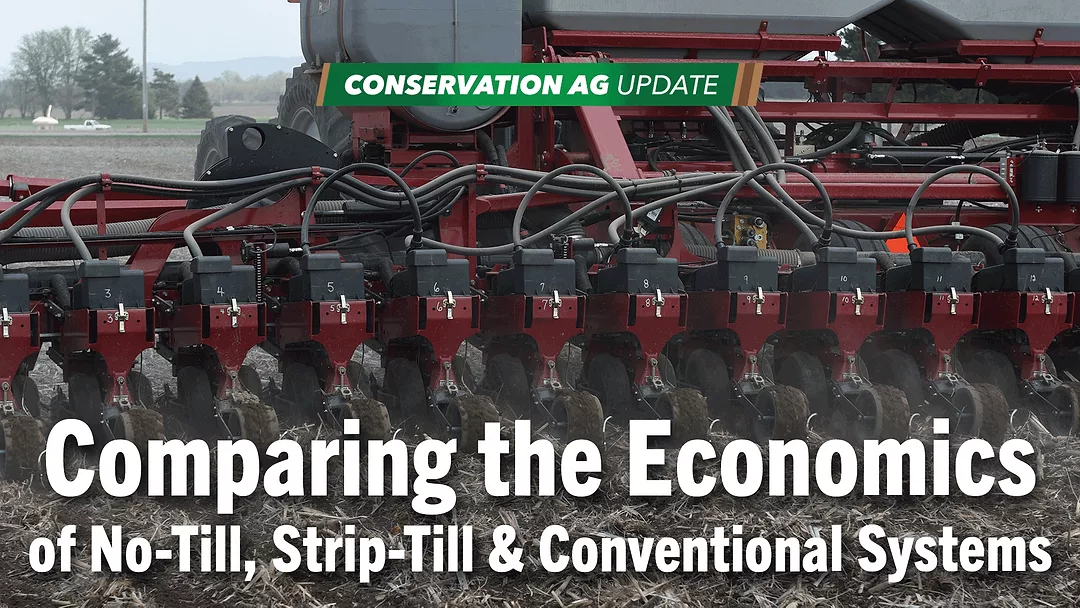
On this episode of Conservation Ag Update, brought to you by Bio Till Cover Crops, Univ. of Illinois analysts dive into new data from the Precision Conservation Management program, comparing the economic differences between no-till, strip-till and other tillage systems.
Plus, we head to Washington County, Wis., for an update on two farmers who dealt with historic flooding over the summer. Blake Basse credits strip-till and cover crops for helping his cash crops survive the “1,000-year” rain event, while Ross Bishop says his no-till fields are more resilient than his neighbor’s conventional fields.
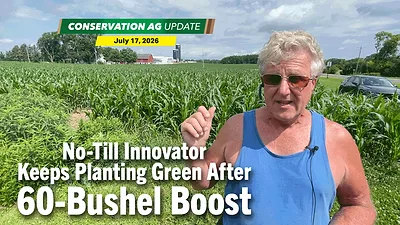
In the Cover Crop Connection, No-Till Innovator Rick Clark explains why cereal rye can sometimes be a double-edged sword when it comes to weed control.
Later in the episode, we ask the audience if they’re delaying corn harvest to cut down on drying costs, and if so, how will that affect their cover crop strategies?
We stop by the World Dairy Expo in Madison, Wis., and hear from a manufacturer who’s cautiously optimistic that 2026 will be a nice bounce back year for agriculture.
Finally, in the Video of the Week, Beck’s agronomists share new insights about higher plant populations at Becknology Days in Atlanta, Ind.

This episode of Conservation Ag Update is brought to you by Bio Till Cover Crops.
Bio Till cover Crops, a pioneer and leader in cover crop seeds, represents a complete lineup of seeds suitable for use in diverse soil types and growing conditions. Our focus on cover crop and regenerative forage seeds sets us apart from suppliers invested in other markets. Dealers in our distribution network are committed to your success by providing local resources, education and guidance to ensure you have the correct foundation for success. With over 50 years of experience in production, processing, packaging, and shipping, you won’t find a better fit for your farm.
TRANSCRIPT
Jump to a section or scroll for the full episode...
- PCM Dives into Conservation Economics
- Historic Flooding No Match for Cereal Rye & Strip-Till
- No-Till Outshines Full Tillage After Heavy Rainfall
- Treating Your Cover Crop Like a Cash Crop
- Are You Delaying Corn Harvest to Cut Down on Drying Costs?
- Manufacturers Share Optimistic Outlook at World Dairy Expo
- Video of the Week: How Plant Populations Affect Root Size
PCM Dives into Conservation Economics
Let’s kick things off with some new economic data from the Precision Conservation Management program in Illinois. They’re comparing all the field passes in no-till, strip-till and multi-pass systems to see which one gives farmers the most bang for their buck.
Right now, no-till is leading the pack on cornfields with high soil productivity ratings (SPR).
“No-till here in that full data set actually makes up a little less than 20% of all of the high SPR corn acres, but we see it being used more and more in recent years. It has performed really well in those 3 most recent years. And since we think that 2025 and 2026 are likely to be more similar in terms of price and input costs, we would say that no-till was more profitable than expected in 4 out of 10 years. This is notable, since 3 of the most recent years are years that no-till performed really well.”
Higher machinery costs over the last 3 years factor into the equation. The data also showed that strip-till performed the best in fields with low soil productivity ratings.
Historic Flooding No Match for Cereal Rye & Strip-Till
Back in August, we covered a historic storm that dumped a foot of rain on the Milwaukee area in less than a day. Basse’s Farms in Colgate, Wis., was right in the middle of it.
As we check out some footage showing the aftermath of all that rain. But fast forward to October, and their pumpkins turned out great. Blake Basse credits his switch to strip-till and cover crops for helping the pumpkins survive and thrive.
“A rain event of that magnitude in the past, we would’ve seen at least a 50-60, even 70% loss in our fields. We were shocked, and during the flooding event we were quite worried because we knew what happened in the past. We came out after that historic rain, we had a foot of rain in a 2-day window. If it wasn’t for all our pumpkins sitting on rye, and strip-tilling and getting them off to such a great start to sit on the rye and stay on the rye, and disease pressure is down, we would’ve had a much different outcome. That’s the only thing I can chalk it up to because these are the big differences we just made.”
They just switched to this system in 2024 after years of conventional tillage. Once soybean harvest wraps up, Blake will drill in a heavy rate of cereal rye. Then he’ll make strips through that rye in the spring before planting the pumpkins.
No-Till Outshines Full Tillage After Heavy Rainfall
Ross Bishop, who farms about 13 miles down the road from Blake., also dealt with all that flooding. Whenever it rains, Bishop’s no-till fields hold up better than his neighbor’s conventional fields. And he’s got the visual evidence to prove it.
“By doing no-till, you can see the difference here. This was on a Sunday, I was going to church, and the neighbor had planted winter wheat that fall. This was in April when this 3-inch rain happened. You can see all the brown coming off his field. I had corn stubble no-tilled and water was coming off clear. It looks a whole lot better. I’ve had people say to me, ‘you know you still have nutrients coming off.’ I understand that. It’s not a perfect world yet. But I think the good Lord want s us to be good stewards and we’re doing our best. This is what we’ve got now.”
Now, let’s send it over to Mackane Vogel for today’s Cover Crop Connection.
Treating Your Cover Crop Like a Cash Crop
Mackane Vogel here with this week’s cover crop connection. No-Till Innovator and Williamsport, Ind., no-tiller Rick Clark knows just how important it is to manage your cover crops as if they were your cash crops. Let’s take a listen to Clark’s advice about the nutrient sequestration powers of cereal rye, and the positive and negative impact it could have on weeds and corn.
“So now if you want to plant corn into cereal rye, you need to move your nitrogen program further forward to offset what the cereal rye has sequestered nutrient wise. So now the same thing is happening with the weeds. We're buckling the weeds at their knees. The broad leaves are pretty much gone. But now what's happening is now we're to my 70 30 rule. So that cereal rye has suppressed those weeds for 70% of what it needs to be done. If you haven't reached canopy though, now that cereal rye is releasing those nutrients back out, guess what? Just in time for when grass comes on, foxtail is a late emerging weed in the season, we are now dumping all of those nutrients for the foxtail. And here it comes and it comes. If you don't have that good suppression of the biomass from the cover crop and in cash crop canopy, you're going to have foxtail. And we've got foxtail in certain fields, and I can always attribute it back to what I'm just describing.”
Some wise words as always from No-Till Innovator Rick Clark.
Are You Delaying Corn Harvest to Cut Down on Drying Costs?
With harvest season in full swing, we asked our audience — Given the low corn prices, are you leaving corn in the field longer to dry so your drying costs aren’t as high? If so, are you going to plant covers crops later or just skip them?
Robert Rabideau, Clifton, Ill. “My cover crop is sown with a drone over cash crop in early September, and yes, I'm waiting for a dry down. It’s not uncommon for me to run into November with corn harvest.”
Blaine Baker, Clayton, Mich.“My cover crops are already planted. We use a high-boy in late August. We just started harvesting corn October 13, time to shell. Things can get bad fast if you wait any longer and good drying days are far and few.”
Let us know what you think, join the Email Discussion Group at No-TillFarmer.com.
Manufacturers Share Optimistic Outlook at World Dairy Expo
We had boots on the ground at the World Dairy Expo earlier this month in Madison, Wis. There was a lot of buzz from people there that 2026 is going to be a bounce back year for ag. But Steve Pesik from Zimmerman Manufacturing says let’s wait and see.
“There is a lot of crop in storage that needs to go somewhere before we can get through this glut. And I think also, what are the yields going to be this year and how is that going to affect things? We hope that things improve and that incomes improve. One of the things that we do is we make equipment to make farmers more efficient on the manure side, we get the nitrogen in the ground so it doesn’t all get evaporated into the air. On the tillage side, strip-till can certainly reduce your input costs. If you’re not going to get more for your product that you’re producing, you have to find a way to reduce the amount that it’s going to cost you to grow your best crop.”
Video of the Week: How Plant Populations Affect Root Size
Let’s wrap things up with our Video of the Week. This one comes to us from Becknology Days in Atlanta, Ind. During a root reveal, Beck’s agronomists revealed some key insights about the impact of higher plant populations on roots.
“For every 1,000 plants we increased plant populations, individual root size decreases 2.5%. What have we been doing to plant populations for the last 20 years? About 400 plants per year. If that’s true, if you do the math, 1% per year individual plant root sizes has been decreasing the last 20 years. That’s 20% smaller roots. How might that impact fertility placement or population management? For every 1,000 plants we increased population, individual root size decreased 2.5%. That may help us make other decisions as well.”
That’ll do it for this week. Got something you’d like to feature on the program? Shoot me an email at Nnewman@Lessiter Media.com. Thanks for tuning into Conversation Ag Update. Until next time, for more stories visit no-tillfarmer.com, striptillfarmer.com and covercropstrategies.com.