Takeaways
- Seeds need to be surrounded by a mixture of water and air.
- With no-till, soil disturbance is confined to the row area.
- Seeds need soil after germination, but not for germination.
In a recent No-Till Farmer “No-Till Discussion” message, this question was asked:
“What if you could use only mass-produced major line farm equipment on your farm?”
This question was asked to help our grower audience better understand the importance of shortline manufacturers in today’s no-till operations.
Amoung the responses, the following comment from an educator located in the heart of Pennsylvania no-till country caught the eye of John Baker, the New Zealand inventor of the Cross Slot low-disturbance no-tillage system, who started research on this concept back in 1967 at Massey University.
Here are their comments.
— Frank Lessiter, Editor, No-Till Farmer
A Pennsylvania No-Till Educator...
I’m not a farmer, but as an outside observer it seems that the goal would be to have an implement that is designed to be modified. Knowing that the larger manufacturers can’t possibly build equipment that meets everyone’s needs in every corner of America (and beyond), maybe they should focus on implement development that easily allows for and accommodates modifications and changes.
— Brian Sneeringer, Agricultural Conservation Technician, Adams County Conservation District, Gettysburg, Pa.
John Baker’s Response...
I'm sorry, but I have to disagree with Brian Sneerinnger. If you take the trouble to examine what seeds require scientifically (as my university team did for 20 years). you will find that the key assumption that we have all been making about what seeds need and want when sown into soil (tilled or untilled) has been flawed. But sadly, this assumption has dictated how many engineers have designed no-tillage seeding tools.
The basic assumption that seeds need to be surrounded by soil in order to germinate is flawed. They need to be surrounded by a mixture of water and air.
They need soil after germination, but not for germination.
Certainly contact with soil at germination time does no harm, but the pore space air between individual soil particles in undisturbed soils is also a largely-unrecognized source of both water and air. This pore-space water is in the form of humidity (RH) within the pore-space air, and at above 90% can be enough to germinate most seeds without the seed having any contact with liquid water or soil at all.
When we disturb (aerate) soils, either by tilling a whole field in preparation for sowing seeds, or in rows during no-tillage, we allow most of the RH to escape from the disturbed-soil zones. The only source of water that is left to germinate the seeds is the liquid water films that cling to the soil particles.
During general tillage, there is no way of avoiding disturbing the soil, which is often done to kill weeds. But during no-tillage, the soil disturbance is confined to only the seeded rows. But this disturbance allows the in-row soil RH to escape and thus removes it as a water-source for both germinating the seeds and energizing soil biology in the zone where this would have been of greatest benefit.
The challenge for no-tillage has been to find a way to implant seeds into the undisturbed high-RH soils in rows without allowing the pore space air and water escape from the disturbed rows themselves.
“Most no-tillers have not learned how to harness the soil’s precious pore space and its relative humidity ...”
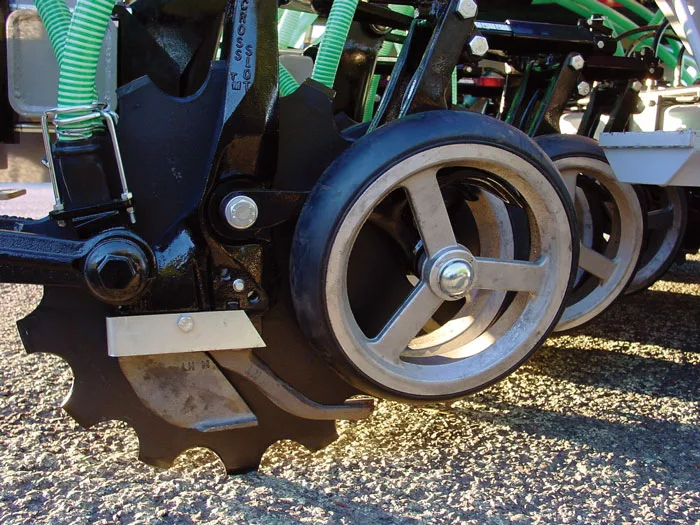
Only one brand of no-tillage seed drill opener (Cross Slot) has been designed to do specifically that. Most other brands have ignored it. And no amount of mechanical modification or after-market add-ons can turn an already-disturbed soil zone into an undisturbed soil zone.
It is no accident therefore, that very few (if any) owners of Cross Slot low- disturbance no-tillage seed drills have found the need to alter the designs of, or attach after-market add-ons to their no-tillage openers, since these devices were already designed to retain as much in-row soil pore-space RH as possible when sowing seeds into undisturbed soils. Most people do not realize that the pore space RH of all undisturbed soils is always at 100% prior to seeding (i.e. the pore space air is always saturated with vapor water) even when the soil particles themselves feel dry. In that respect, the more surface residues such soils support, the better because such residues resist evaporation like hair on a cat’s back.
The sad thing is that most no-tillers have not yet learned how to harness this precious pore space RH, which also underpins the micro-biological regeneration of soils. They unwittingly destroy it every time they try to emulate what mankind has been doing wrongly, by tilling the soil in rows and calling it “strip tillage.”
Surely the fact that few (if any) owners of Cross Slot low-disturbance no-tillage seed drills have found it necessary to modify their Cross Slot openers between season, tells us something.
— Dr. John Baker, Cross Slot, Fielding, New Zealand
Here’s How to Join the No-Till Discussion Group
The No-Till Discussion Group gives you an easy way to connect with other no-tillers from around the world to seek advice and exchange ideas about no-till systems, equipment, nutrient management, crop protection, soil health, water management, cover cropping and more. The greatest asset of this email discussion group is the knowledge and ideas generously shared by the community.
How do email discussion groups work exactly? You simply send and receive messages like regular emails. You can choose to respond to the individual sender, the whole group, or just watch and read. You can also choose to receive messages immediately as each is sent or as a daily digest recapping the day’s activity in just a single email. The discussion group activity is managed by No-Till Farmer staff, and it is easy to join or unsubscribe at any time.
Click here to learn more about this group, group rules and the civility commitment.
To join the No-Till Discussion Group, please fill out the form directly below and click the "Sign me up" button. You will receive a welcome email to confirm that you were successfully added to the group.
Please Note: Our editors monitor the email discussion groups for article and story ideas. By joining the email discussion group, you agree to have your name and comments used in print and online articles. By agreeing you share your insights, you're helping no-tillers across the world better their own operations. We appreciate your participation!