 Premium content is for our Digital-only and Premium subscribers. A Print-only subscription doesn't qualify. Please
No-Till Farmer
Get full access NOW to the most comprehensive, powerful and easy-to-use online resource for no-tillage practices. Just one good idea will pay for your subscription hundreds of times over.
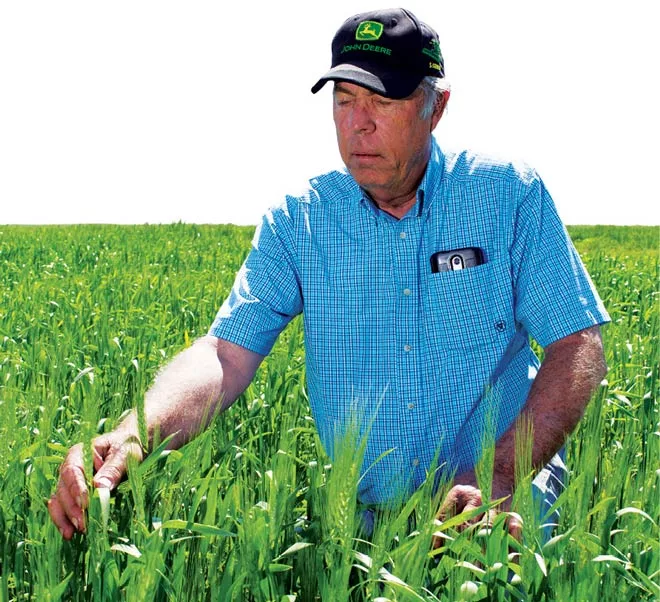
MORE VIABLE. Leon Sowers says adopting no-till practices 18 years ago allowed him to grow a more diverse rotation, which now includes corn, soybeans, winter wheat and milo, as well as specialty crops like sunflowers, canola and sesame. Although prices aren’t very good, he keeps wheat in his rotation because it produces plentiful residue to protect his soils from the elements.
There was a time when Leon Sowers felt killing weeds and preparing a seedbed were logical reasons to till fields. But in his family’s case, he eventually realized that approach wasn’t working.
“We were killing the weeds, but tearing up the best seedbed we had, and we’d work all summer to work it back down to have the seedbed we started with,” he recalls.
After going to a farm tour hosted by Dakota Lakes Farm manager Dwayne Beck 18 years ago in South Dakota, Sowers came home with a different outlook. His big Versatile tractor and other tillage equipment was sold off and the money was used to switch out his John Deere 455 drill, which he says produced mediocre no-till stands, for a Deere 750 no-till drill.
“That was when I decided if they could do it, I could do it,” he says. “No-till is as much a state of mind as it is a farming practice.”
Sowers no-tills a wide variety of cash crops on 3,700 acres near Murdock in central Kansas, and grazes 85 head of cows on 700 acres of grass.
His rotation includes no-till corn, soybeans, winter wheat, milo, sesame, canola, sunflowers, oats, triticale and forages, and he also seeds cover crops on some acres for grazing and soil improvement.
In his early no-till days, one big decision Sowers faced was what crops to raise on his thin, high-clay soils. He decided to plant cereal crops in those fields and raise corn, soybeans…

Get full access NOW to the most comprehensive, powerful and easy-to-use online resource for no-tillage practices. Just one good idea will pay for your subscription hundreds of times over.
Download these helpful knowledge building tools

We have engineered and developed the most advanced concave system that threshes all crops, eliminates rotor loss, improves grain quality, gives you a cleaner sample – all with one set of XPR concaves.

At Titan International, our product portfolio reflects our commitment to innovation and high-quality products. Titan International offers a full line of solution-focused wheel, tire, and undercarriage products for a wide variety of off-the-road equipment in agriculture, construction, forestry, mining, power sports, high-speed trailers, and outdoor power equipment segments. As one of the largest North American manufacturers, with a network of dealers all over the world, Titan is an industry leader that original equipment manufacturers and operators can count on for durable products and quality service.

Provide expert analysis and decision support to increase productivity and profitability.