 Premium content is for our Digital-only and Premium subscribers. A Print-only subscription doesn't qualify. Please
No-Till Farmer
Get full access NOW to the most comprehensive, powerful and easy-to-use online resource for no-tillage practices. Just one good idea will pay for your subscription hundreds of times over.


The carefully calculated and measured rate of glyphosate that goes in the spray tank is the same deadly dose that makes it to weed leaves, right?
Not necessarily, says Murray State University chemistry professor Scott Brown, who’s spent 4 years studying issues that surround the effectiveness of glyphosate.
Raised on a Kentucky farm, Brown began to investigate herbicide molecules and their activity while working on his degrees and managing his own farming operation.
He’s found that no-tillers with hard water may be losing some, or even most of their glyphosate activity before they even head for the fields — and those that think they’re already addressing the issue might still be missing the mark.
Essentially, no-tillers with hard water may be unknowingly spraying a lesser rate and getting a reduced response because of how glyphosate interacts with the minerals in the water, says Brown, who earned an undergraduate degree in chemistry and agriculture from Western Kentucky University and a doctorate from the University of Alabama.
Besides being a wasted herbicide investment, this interaction can be a recipe for weed disaster.
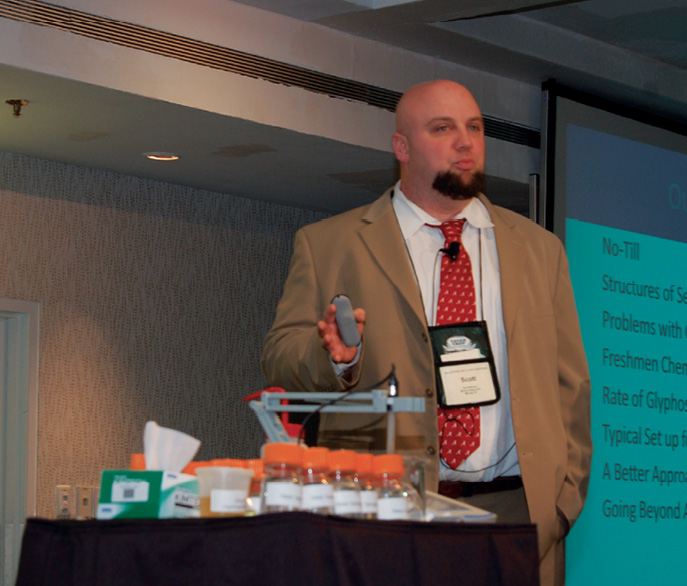
“The trend I’m seeing is that regions with hard water are having higher incidence of glyphosate-resistant weeds,” Brown told no-tillers at the National No-Tillage Conference earlier this year. “I’m not promising you that I can kill resistant pigweed or resistant marestail by addressing hard-water issues. But we’re losing activity right out of the gate.”
Brown became aware of the lack of knowledge about hard water, and its impact on the…

Get full access NOW to the most comprehensive, powerful and easy-to-use online resource for no-tillage practices. Just one good idea will pay for your subscription hundreds of times over.
Download these helpful knowledge building tools

We have engineered and developed the most advanced concave system that threshes all crops, eliminates rotor loss, improves grain quality, gives you a cleaner sample – all with one set of XPR concaves.

At Titan International, our product portfolio reflects our commitment to innovation and high-quality products. Titan International offers a full line of solution-focused wheel, tire, and undercarriage products for a wide variety of off-the-road equipment in agriculture, construction, forestry, mining, power sports, high-speed trailers, and outdoor power equipment segments. As one of the largest North American manufacturers, with a network of dealers all over the world, Titan is an industry leader that original equipment manufacturers and operators can count on for durable products and quality service.

Provide expert analysis and decision support to increase productivity and profitability.