Check The Specs...
NAME: John Young
LOCATION: Herndon, Ky.
YEARS NO-TILLING: 50
ACRES: 3,200; 4,500 harvested
CROPS: Corn, soybeans and winter wheat
My father, Harry Young, wasn’t a shy fellow. If he was going to do something, he’d do it out in the open and let the chips fall where they may.
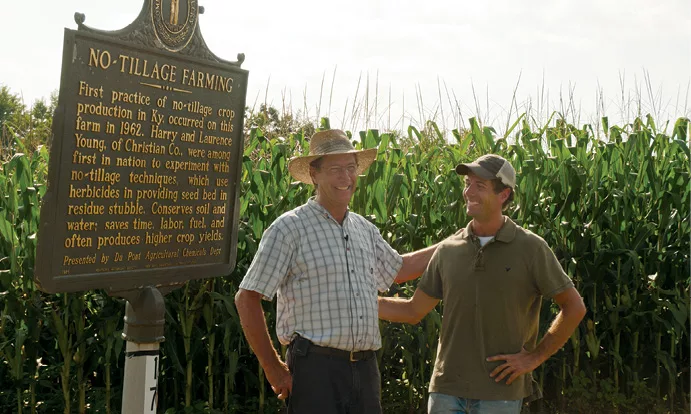
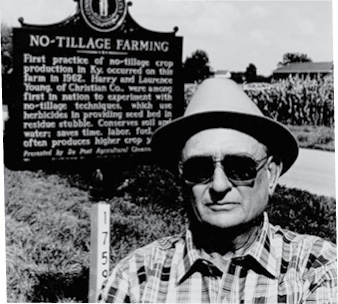
That’s why he planted what’s believed to be the very first commercial no-till field in the U.S. right on the highway, not back in the woods. And there’s a historical marker there to commemorate that original 7/10 of an acre, planted in 1962.
I was only 11 at the time. The first crop was corn, and that field has been in no-till ever since.
Dad worked with Shirley Phillips, a University of Kentucky agronomist, to try and perfect the system over the years. While Dad passed away in 1988, the fifth and sixth generations of his family — myself and my son, Alexander — continue to no-till the farm to this day.
This spring will be the 50th no-till crop to be planted in that original field. When Dad first started no-tilling, my mind was on other things like football and basketball, but I do remember there being a lot of activity over the next few years.
People would come by to look at the field, and there were tours and a lot of phone calls. Curiosity ran high.
It all started with a neighbor and county agent, Reeves Davie, who urged Dad to go with him and a small group of other people to see a tiny no-till plot at a field day in Dixon Springs, Ill., put together by University of Illinois agronomist George McKibben.
Dad said he thought he could do it and brought the idea home. I’m sure he never envisioned the extent to which no-till would catch on.
His training as an agricultural economist, though, told him it would save labor, fuel, machinery and soil, and it was well worth trying.
The first crop was planted with an old modified two-row planter that had once been pulled by mules. After that, Allis-Chalmers got in the game with a no-till planter and our next few planters were ACs.
There were a lot of equipment changes in the first few years. We went from flat chains to a bicycle chain, from small seed boxes to larger ones, and from single coulters to double coulters. I remember that one of the front coulters was used for placing in-row insecticides. That practice stopped here years before Bt hybrids rendered it obsolete elsewhere.
Herbicides were definitely a problem in the early days of no-till. Phillips worked with Dad a lot on that aspect.
I remember that they once used at least 5 pounds per acre of atrazine. That’s a lot of atrazine, but before the days of GMO and our modern herbicides, there wasn’t any other choice.
Now the vast majority of our area is no-till and we even have some local innovators that helped move the practice along.
Howard Martin is our neighbor in the next county over. His Martin-Till row cleaners have added a lot of ability to no-till in different soils and conditions. We use them on all our planters. Along with Keeton seed firmers, row cleaners are probably the greatest advancements in no-till technology that I can think of.
Continuing The Tradition
Though farming is what I knew, I went to the University of Kentucky with my heart set on becoming a history teacher. It took about 2 years to realize how boring the professors were and that it wasn’t what I wanted to do with my life. So I switched my degree to agriculture.
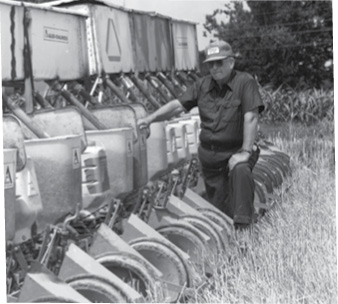
I was thankful I made the switch and was able to tell my grandfather before he passed away that I was coming back to farm our family’s land. Now my son, Alexander, farms with me and he’s carrying on the family tradition.
When I first came back to the farm, I was a little skeptical about no-till, but skepticism is part of my nature. Any system needs to prove itself and we need to be flexible as farmers.
The ‘four Ps’ for farmers should be Profit, Production, Progeny and Posterity. To have the last three, you must have profit, and no-till proved to provide that.
Once I got over my skepticism, I learned from my Dad to pay close attention to small details. He believed one small change could make a huge difference in an experiment we were doing, and he was right.
I remember him being adamant about sprayer boom height and not overlapping spray materials. We don’t have to worry about overlap anymore with swath control on our sprayer, and auto-steer on the sprayer and tractors.
Our fields are amoeba-shaped and range from a quarter acre to 400 acres. There’s no such thing as a square field on our farm. It’s enough to make you want to move to Illinois — almost.
With swath control, we probably save 10% on our spray bill. That really can add up, since we spray 19,000 to 20,000 acres per year when you include liquid fertilizer, herbicide, insecticide and fungicide applications.
Refining Planting
Our rotation is corn, winter wheat and double-cropped soybeans. This allows us to get 4,500 acres of crop production per year out of 3,200 actual acres, and provides us with winter cover on half of our acres.
We have a lot of planter options now that weren’t available when Dad started no-tilling. Our John Deere 1790 16-row planter is set up with Martin row cleaners, Keeton seed firmers and wavy coulters.
A Precision Planting air kit with down-pressure airbags on each row unit and 20/20 SeedSense monitor gives a better picture and control over ground contact and gauge-wheel pressure. That’s helped because without the Precision Planting equipment, we didn’t realize we were getting extra gauge-wheel pressure that was causing sidewall compaction.
On our clay soils — especially on a slope — if we planted when it was just a little bit wet, we were getting sidewall compaction. The trench would close, the soil test was great and everything appeared fine. But the corn would be stunted.
With the sidewall compaction, the roots were growing along the trench instead of down. The monitor and pressure control have helped us avoid that problem.
The double-disc openers are kept in good condition to open a true “V” pattern, and Keeton seed firmers place the seed in the bottom of that V.
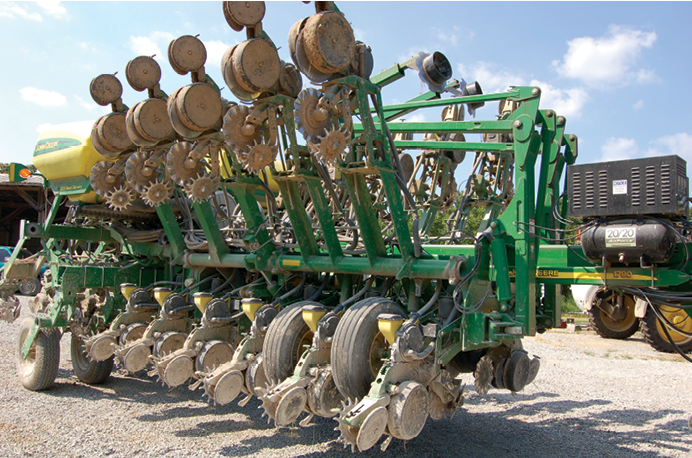
Running one rubber and one spiked closing wheel is the final step to getting a good corn stand in widely varying soil conditions. The rubber wheel packs loose or dry soil, and the spiked wheel keeps wetter soils from sealing. It’s a combination that has worked well for us.
Residue issues have driven us to make several changes in our planting strategy.
For one, we used to use the drill to plant double-crop soybeans. But the straw from our wheat crop was an ongoing problem. We switched to planting soybeans with our corn planter so we could use a row cleaner.
There just isn’t a row-cleaner option for drills and we needed it to get through the straw. Now we use splitters on our planter to seed soybeans in 15-inch rows. We have even tried corn in 15-inch rows, but didn’t get a yield bump with that practice.
I liked the narrower rows we could get with the drill, but we couldn’t get a consistent stand like we’re getting with the planter. That consistency allows us to drop the populations on our short-season soybeans to 165,000 when most people around here put down 180,000 to 200,000.
Working In Wheat
When I was a kid, wheat was planted and forgotten until the end of winter. Then you threw some nitrogen at it and hoped for the best.
Now, we go over each acre of wheat at least six times before harvest, and our yields show the difference.
There was a time we thought 40 bushels per acre was good, but now I’m disappointed if we can’t make 75 bushels. At times, we’ve harvested more than 100-bushel wheat.
The first trip over the field is to lay down some fertilizer ahead of planting. Sometimes we need to do some aphid control in the fall so we don’t have yellow-dwarf problems the following spring.
In January or February, when the wheat is just coming out of dormancy, we put down about half of the 50 to 60 units of nitrogen that wheat needs. The second 50 to 60 units of nitrogen goes on in early March at full tiller.
Streaming on 28% nitrogen works for us. It gets into the soil more quickly than urea and is usually cheaper and more uniform.
Italian ryegrass has been a major thorn in our side for wheat production. Years ago, we used Hoelon in the fall, but have now switched to Axial in the spring to get rid of it. Lately we’ve been tank-mixing Axial and Harmony in the spring to take care of all of our weed problems in one pass.
We carefully monitor for disease, especially around late boot stage and right at flowering. More often than not, we end up applying a fungicide or a mix of fungicides, depending on the issue.
The window for application is tight, but if you can apply fungicides it makes a huge difference in yield.
Fungicides in corn are a little less certain. We use them on our irrigated acres with mixed results. Sometimes it boosts yields, and sometimes it seems to hurt yields.
However, across the board, fungicides provide a payback every year on our double-crop soybeans. We just use whatever fungicide is cheapest and tankmix it with insecticide for an R2 application. There may or may not be an economic threshold, but we put it in the mix because it’s cheap insurance. Without the insecticide, those insects would thrive. We’ve tested it out and it paid off.
As with the soybean system, it took some trial and error to figure out how to no-till wheat. In the late 1980s, we broadcasted the seed and disced it in, which was a departure from no-till. We still need to disc some ground, especially in a wet fall. But we try to limit that practice.
I liked to have the corn stalks on top, so we use no-till on land that doesn’t need discing for leveling. Now we use a John Deere 1890 disc drill with 7½-inch row spacing.
This setup is not without its problems. Harvesting corn in August or September, and then planting wheat in early October, means residue doesn’t have any time to break down before we no-till wheat.
To help with this situation, we don’t chop our stalks. The strategy is to leave more residue standing so there’s less for the drill to have to cut through to place the seed.
Our disc openers take a beating, even with the standing residue, so we don’t run old equipment in this system.
If the disc openers wear and get too small, there are problems getting through the residue. So we trade disc openers every 2 years, or trade drills.
Fertility Evolves
In the first years of no-till, we assumed spreading urea or ammonium nitrate on top of the soil was the only way. Now we use anhydrous ammonia for corn and stream liquid nitrogen on the wheat.
We tried nitrogen stabilizers with anhydrous in the 1970s, but weren’t pleased with the results. Now we realize it’s more important to carefully time the applications so the nitrogen is in place when the corn needs it.
We’ve experimented with liquid nitrogen for corn, but find that side-dressing anhydrous is cheaper.
Applying nitrogen at the right time is cheaper, too. Putting down anhydrous ahead of planting meant putting down higher rates so the right amount of nitrogen would be available when the corn was ready to use it. Now, we’re able to cut back on our nitrogen rates and still get the same results.
Some nitrogen goes down when we apply granular phosphate or potash in the winter, and there’s some liquid nitrogen with the atrazine that we sometimes apply right after planting. But most of the nitrogen goes down as we sidedress at the 4- to 6-leaf stage.
For sidedressing, we recently switched to a John Deere anhydrous system with a disc opener in front of a steel shoe to insert the nitrogen, and a sealing wheel to close the trench.

Compared to the previous knife system, this allows us to apply anhydrous faster. And the closing wheel does a better job of sealing, so more nitrogen stays in the ground where it belongs — even when soils are wet.
Another way we save on nitrogen is to vary rates based on soil types. We soil test each acre every year to create management zones.
This may seem excessive, but we still find variation due to what’s been removed by the crop. We practice modified site-specific farming so we determine what every zone needs and respond to those variations.
Soil testing starts as soon as fields are harvested. We use that data to apply variable-rate granular fertilizer with our John Deere 1890 grain drill ahead of planting.
I don’t like to put fertilizer on top of the soil. We have a lot of rolling hills, so if we do that, there’s a good chance it could end up in the river.
That’s bad for the environment and a loss of an expensive input.
The variable-rate drill applies fertilizer with a disc opener. A single closing wheel keeps the fertilizer in the ground. We started doing it this way in 2008 when phosphorous and potash was around $1,100 per ton.
At that price, it just made no sense to lose 5% to 10% of it from runoff.
Running the drill over all of our wheat acres twice is tough on the rubber gauge wheels, though. I’m anxiously waiting for a dedicated machine that serves this purpose so I can give my drill a break.
Soil-type and fertility maps are also used for variable-rate seeding corn and soybeans. After some experimentation, we settled on four corn populations.
Rocky, high ground gets a population of 25,000 to 27,000 seeds per acre. Higher, productive dryland acres get 32,000 and irrigated acres get 34,000 to 36,000. We tried ramping up to 44,000 with a fixed-ear hybrid on our irrigated ground, but the difference didn’t pay for the seed. Maybe we’ll find a variety that can produce those extra bushels.
Variable-rate seeding and fertilizer has been our practice for the last 3 years. We’re realizing savings in seed costs and it’s improved yields.
If I can make the same investment on 100 acres, but allocate more money to the areas that are more highly productive, I get more bushels and profits.
Another practice adding to our bottom line is buying fuel and fertilizer — including anhydrous — in bulk.
The price difference between our local nurse-tank-sized purchases and the semi-loads we have delivered to our bulk tank are significant. I picked that idea up from my father-in-law, J.C. Webber, a farmer in Lucerne, Ind., who’s had a bulk anhydrous tank for more than 40 years.
Managing Water
My father-in-law also taught me about the importance of tiling. There wasn’t a foot of tile on this farm until I came back from getting my master’s degree from Purdue. It’s really helped improve the drainage on our wet soils.
My wife, Beth, and I even ran a custom-tiling business for a few years in the late 1970s. That helped us get off to a good financial start and continue our tradition of improving the farm’s soil.
My great grandfather treated one of our fields by draining a swamp with a small hand-dug ditch in the 1870s.
My grandfather drained it a little better using mule power in the 1920s, and then my father drained it completely with bulldozers in the 1960s. Despite all that work, there was still a subsurface water problem and it never produced a good crop.
Tile was my contribution to that piece of land, and now it’s some of the best-producing ground we farm.
In no-till, the more uniform your soil, the better. So if you’ve got dry soil that you can irrigate, and wet soil you can tile, you can manage water and it gives you a tremendous advantage.
We developed irrigation on our farm over the last 4 years by creating a 6-acre lake that irrigates 200 acres.

When Alexander and I saw the potential of the system, we decided to invest in renting or buying land on the river. In the last couple of years, we’ve rented some acres and added center pivots on long-term land leases.
Looking back 100 years, I can’t imagine what my grandfather would have given to get water on his tobacco or row crops during the Depression. Having that control could be the difference between financial survival and death when tight times come.
If we get another decade like the 1980s, I firmly believe the last man standing will be the one producing at the lowest cost per bushel. No-till and water management — whether tiling or irrigation — adds to that.
No-Till Lessons
You’d think for as long as my family and I have no-tilled that we’d know everything, but we don’t. No one has all the answers. There are many excellent farmers that I try to learn from.
There are always new products, practices, hybrids and technologies out there. No one has the corner on the whole no-till package. Sharing information is essential to succeeding in no-till.
The 2024 No-Till History Series is supported by Calmer Corn Heads. For more historical content, including video and multimedia, visit No-TillFarmer.com/HistorySeries.