 Premium content is for our Digital-only and Premium subscribers. A Print-only subscription doesn't qualify. Please
No-Till Farmer
Get full access NOW to the most comprehensive, powerful and easy-to-use online resource for no-tillage practices. Just one good idea will pay for your subscription hundreds of times over.
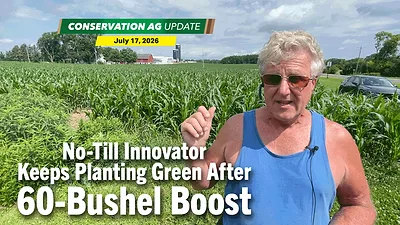
Like many no-tillers, Mike Starkey got his start with soybeans. But after struggling to make no-till corn work, he practiced rotational tillage for more than a decade.
While he feels poor hybrids not suited to working in colder, no-till soils were part of the problem, the Brownsburg, Ind., no-tiller told attendees at the 2008 National No-Tillage Conference that poor planter setup and improper placement of nitrogen were major issues.
“We really didn’t have the confidence or the mindset for no-till corn,” Starkey says. “We had inconsistent stands and the big reason for that, I feel after looking back at those years, was insufficient placement of my nitrogen.”
With 3,400 acres of corn and soybeans, along with some winter wheat he added this past fall, Starkey no-tills on deep, poorly drained silt or silty clay loam soils.
There is high yield potential on that land with proper management of nitrogen. Today, he applies 50 pounds less total nitrogen with consistent yield increases.
Changed Planter Setup. Starkey has removed the no-till coulter from his John Deere 1770 planter, instead opting to go with just row cleaners and double-disc openers.
“I gradually got away from that coulter,” Starkey says. “If you’re thinking about going into no-till, throw away that no-till coulter. It’s just going to do more harm than good.”
He uses spader closing wheels, reduced inner-diameter gauge wheels and drag chains. He’s applying 70 pounds of nitrogen with the planter through 22 gallons of 28% and 5 gallons of Thiosol (12-0-0-26). He…

Get full access NOW to the most comprehensive, powerful and easy-to-use online resource for no-tillage practices. Just one good idea will pay for your subscription hundreds of times over.
Download these helpful knowledge building tools

We have engineered and developed the most advanced concave system that threshes all crops, eliminates rotor loss, improves grain quality, gives you a cleaner sample – all with one set of XPR concaves.

At Titan International, our product portfolio reflects our commitment to innovation and high-quality products. Titan International offers a full line of solution-focused wheel, tire, and undercarriage products for a wide variety of off-the-road equipment in agriculture, construction, forestry, mining, power sports, high-speed trailers, and outdoor power equipment segments. As one of the largest North American manufacturers, with a network of dealers all over the world, Titan is an industry leader that original equipment manufacturers and operators can count on for durable products and quality service.

Provide expert analysis and decision support to increase productivity and profitability.