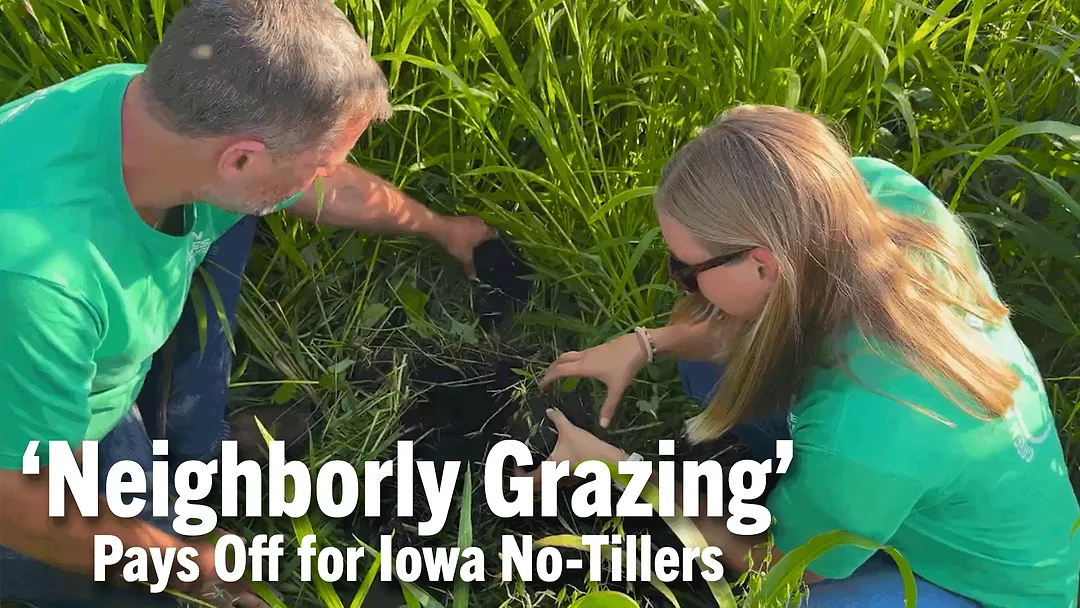
Let’s kick things off in Latimer, Iowa, where Landon and Anne Plagge are coming off a Leopold Conservation Award-winning year in the Hawkeye State.
They no-till corn, soybeans and food-grade oats across 4,000 acres, and use diverse cover crop mixes between each of those cash crops.
Their neighbor brings his cattle over and grazes the covers on fields following small grains for about 100 days, something that’s paying off big time in more ways than one.
Landon Plagge, No-Tiller, Latimer, Iowa: “It speeds up the cycling of nutrients. Our cover crops are growing. Cattle eat them and fertilize it. Then it’s available for our corn to use the next year.”
“Our best cover crops are after small grains because we can plant a 7-way mix of grazing just a variety of different things that really changes soil structure.”
“Our typical rotation is corn, soybeans, oats as the cash crops with a cover crop in between every single one of those. We’ve had a lot of successes and failures.”
Dr. Anne Plagge, No-Tiller, Latimer, Iowa: “If you’re a doer, there are things that are going to not work along the way and that’s part of trying something new is just being willing to experience that failure and learn something from that.”
Since switching to 100% no-till and cover crops, Landon estimates they’ve lowered input costs by about $170 per acre of corn.
Watch the full Video of this episode of Conservation Ag Update.