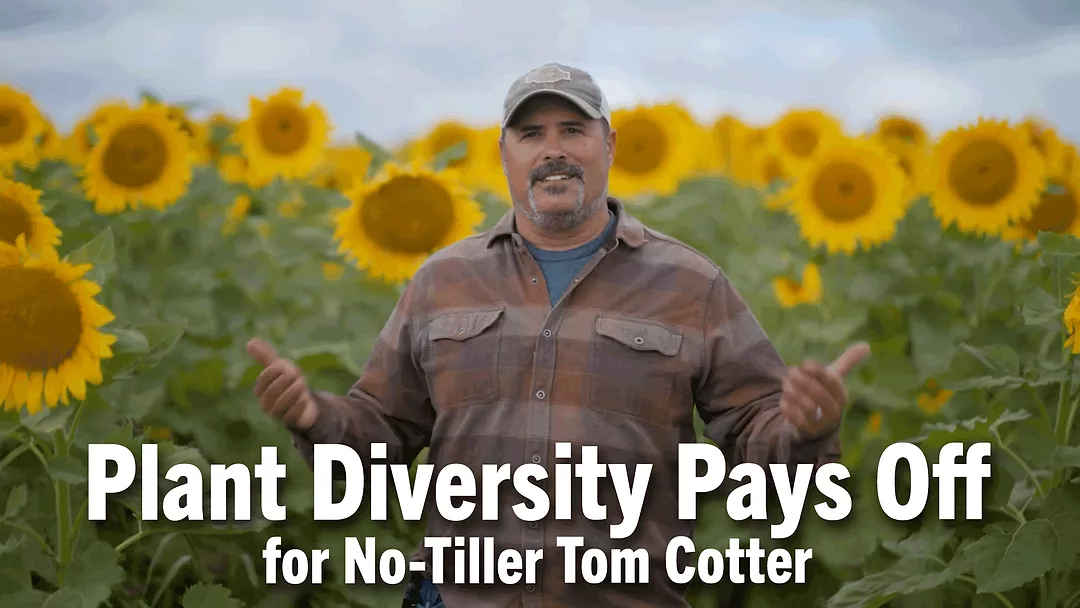
Let’s begin in Austin, Minn., where you could say Tom Cotter took a risk several years ago transitioning to no-till in a cold climate with wet soils. But it’s paid off big time, and this week he received the 2025 Leopold Conservation Award Cotter says the combination of no-till, cover crops and livestock grazing has been a game-changer for his farm.
Tom Cotter: “I’m all about biology. I really like what it gives to me. These sunflowers bring in pollinators, hummingbirds, bees and monarch butterflies.”
“I’m 40% organic and 60% no-till. I really like that because I get to see both sides. Most no-till guys just think tillage is bad. Tillage guys on the organic side think chemicals are bad. It’s not a battle of which is worse. It’s a battle of trying to limit everything, all disturbance, it doesn’t matter if it’s physically or chemically. I try to reduce everything and do as much as I can with plants. Control weeds with plants. Control tillage with plants.”
Kris Nichols: “He’s got some fields where he has strips of sunflowers and then a strip that he’ll use for grazing a mix of cover crop species and another mix of sunflowers. When we’re looking at how we can regenerate the soil and put carbon below ground, we’re looking at these things that are actually going to help to increase carbon flows. Having plants growing as much as possible, and stimulating activity by the plant to get the carbon going below the ground through grazing and the management that he’s put in place is amazing to me.”
Cotter says, “If you can be happy, loved and take care of the land, that’s priceless. We’re not doing this for awards; we’re doing this because it matters.”
We’re looking forward to learning more from Cotter and Nichols during their sessions at the upcoming National No-Tillage Conference in St. Louis.
Watch the full version of this episode of Conservation Ag Update.