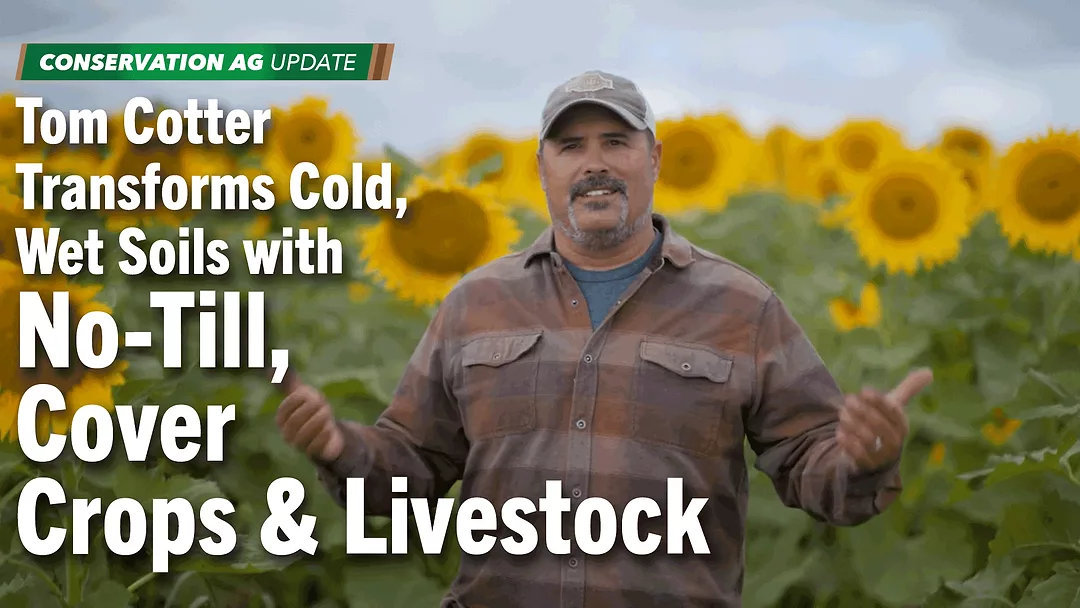
On this episode of Conservation Ag Update, brought to you by Bio Till Cover Crops, Austin, Minn., no-tiller and Leopold Conservation Award recipient Tom Cotter shares the building blocks of his no-till system.
Hickory, N.C., no-tiller Russell Hedrick reveals results from his on-farm biologicals trials and also details the program he uses to test new products.
In the Cover Crop Connection, associate editor Mackane Vogel catches up with Ryan and Matt Heiniger for a conversation about their new custom farming business.
Later in the episode, we go ahead of the curve with Solinftec for a look at the company’s new refill station for the solar-powered autonomous Solix sprayer robot.
The episode wraps up with an exclusive tour of the TerraMax facilities and an up-close look at how biological products are made.
This episode of Conservation Ag Update is brought to you by Bio Till Cover Crops.
Bio Till Cover Crops, a pioneer and leader in cover crop seeds, represents a complete lineup of seeds suitable for use in diverse soil types and growing conditions. Our focus on cover crop and regenerative forage seeds sets us apart from suppliers invested in other markets. Dealers in our distribution network are committed to your success by providing local resources, education and guidance to ensure you have the correct foundation for success. With over 50 years of experience in production, processing, packaging, and shipping, you won’t find a better fit for your farm.
TRANSCRIPT
Jump to a section or scroll for the full episode...
- Plant Diversity Pays Off for No-Tiller Tom Cotter
- Russell Hedrick’s On-Farm Biologicals Trials
- A Father-Son Cover Crop Business
- Solar-Powered Autonomous Sprayer Gets New Refill Station
- ‘1 Billion Microbes per Milliliter’: How Biologicals are Made
Plant Diversity Pays Off for No-Tiller Tom Cotter
Let’s begin in Austin, Minn., where you could say Tom Cotter took a risk several years ago transitioning to no-till in a cold climate with wet soils. But it’s paid off big time, and this week he received the 2025 Leopold Conservation Award Cotter says the combination of no-till, cover crops and livestock grazing has been a game-changer for his farm.
Tom Cotter: “I’m all about biology. I really like what it gives to me. These sunflowers bring in pollinators, hummingbirds, bees and monarch butterflies.”
“I’m 40% organic and 60% no-till. I really like that because I get to see both sides. Most no-till guys just think tillage is bad. Tillage guys on the organic side think chemicals are bad. It’s not a battle of which is worse. It’s a battle of trying to limit everything, all disturbance, it doesn’t matter if it’s physically or chemically. I try to reduce everything and do as much as I can with plants. Control weeds with plants. Control tillage with plants.”
Kris Nichols: “He’s got some fields where he has strips of sunflowers and then a strip that he’ll use for grazing a mix of cover crop species and another mix of sunflowers. When we’re looking at how we can regenerate the soil and put carbon below ground, we’re looking at these things that are actually going to help to increase carbon flows. Having plants growing as much as possible, and stimulating activity by the plant to get the carbon going below the ground through grazing and the management that he’s put in place is amazing to me.”
Cotter says, “If you can be happy, loved and take care of the land, that’s priceless. We’re not doing this for awards; we’re doing this because it matters.”
We’re looking forward to learning more from Cotter and Nichols during their sessions at the upcoming National No-Tillage Conference in St. Louis.
Russell Hedrick’s On-Farm Biologicals Trials
From one Leopold winner to another now, Russell Hedrick is always an open book when it comes to sharing the keys to his success. On-farm trials are a must for the Hickory, N.C., no-tiller, especially when it comes to biologicals.
“We're talking about some of the trials we did on our farm. This is the way we set it up where we do check strips. So, we had a check strip, Pivot Bio with the 40 units of nitrogen minus the 40. We had Holganix. There's a product out there called Fish Shit. You can't say that on TV, we learned. All right, you all are still with me. There's Ensoil Algae and then we had another check strip and then Concept Agrotech had a product called Soil Revive. But this is how we figure out what we do on our farm. Don't get me wrong, there's a lot of trial data out there. There's a lot of good information, but if you're not setting something up like this, you're missing a lot of good information. But essentially, did it make bushels or lose bushels and what was our net return? That's how we decide what we move to the farm the next year when it comes to biologicals.”
“How many of you in here use biological products? How many of you test them before you put them on your farm? That's way more than I thought it was going to be. So, one of the things we do with Rhize Bio is we send our soil, our seed, and our biological product. We just sent them some and they're going to run it here in the month of January. But if we're going to try a new biological product, they'll actually test it in our environment with our seed and we'll know, ‘Is there a chance for a positive return before we actually buy it in bulk and get it to the farm?’”
“This stuff is not cheap. We're going to spend thousands of dollars a year on a biological product. Why wouldn't we spend 200 bucks and test it in the laboratory before we get it to the farm? Some of the stuff that we're seeing, so polymer degradation, that's for residue breakdown, phosphorus release, nitrogen cycling. There's a lot of good management decisions that we get from this testing for 200 bucks.”
Hedrick set the dryland corn yield record with 459 bushels per acre in 2022.
A Father-Son Cover Crop Business
Many of you are familiar with Iowa no-tiller and Executive Director of the Conservation Technology Information Center, Ryan Heiniger. Recently I had a chance to chat with Ryan and his son Matt - who is currently a senior in high school — about the new cover crop business they started this summer called Clear Water Cover Crops. The company is a custom farming business meant to remove barriers for other farmers to adopt cover crops and accelerate their soil health efforts. Let’s listen to Matt and Ryan as they describe the most fun and the most challenging parts of the father-son business so far.
Matt Heiniger: “The funnest part would be just riding in tractors and going to see new fields and just cover new ground. It’s always exciting when you can pull up to a new field and unfold and just go. One of the more challenging things — when we first bought the cover crop seeder, there was a valve in one of the hoses that wasn't assembled right. So just trying to get that figured out and squared away took quite a few tries and a few calls to Unverferth to get that squared away but we got it figured out and was able to then get it working correctly”
Ryan Heiniger: “You stole my answers —On the frustrating part, just like if you need new pieces of equipment, getting things figured out so when it is go time, things are operating as efficiently as possible and thankfully we did get that accomplished really before the peak of the season hit in late September. On the rewarding side, I think just watching him in his element and getting these life experiences to be a successful entrepreneur and to be able to be a little bit of a support system for him but also just moving that relationship now that he’s an adult and going from father-son to just business partners — I think that’s something that both right here and now has been rewarding but also just once a couple years tick by, looking back it will be even more rewarding as something that we did together.”
Matt says it can be tough to juggle all the responsibilities that come with being a senior in high school and running a business at the same time, but he tries to get his school work done during the daytime so he can spend more time in the tractor when he gets home. And of course if you want to hear the rest of my conversation with Ryan and Matt Heiniger you can check out the latest episode of the Cover Crop Strategies Podcast at CoverCropStrategies.com.
Solar-Powered Autonomous Sprayer Gets New Refill Station
Let’s talk tech now and go ahead of the curve with the solar-powered Solix sprayer robot from Solinftec. The company says 50 of its robots in Indiana and Illinois reduced herbicide volume by up to 98% last year. And Taylor Wetli says a brand-new refill station could make it even more practical for farmers.
“One item that we’re excited to launch next season is our autonomous refill station. This auto refill station will be stationed in the field. Solix will back up to it. Actuators and cameras will zero in on the back of the robot, and it will automatically refill the unit. It’s a very important feature of the technology and very helpful for the growers as they look to optimize their time. We’re very excited to be scaling this across our customers in the coming season. In addition to that, we’ll be in around a dozen states in the Midwest, mostly in the U.S., but continuing to broaden that reach.”
‘1 Billion Microbes per Milliliter’: How Biologicals are Made
Our team got an up-close look at how biological products are made during an exclusive tour of the TerraMax facility in Eagan, Minn. From R&D to quality control and manufacturing, Brian Kibble Kisely takes us behind the curtain.
“Everything starts with the single isolated microbial species. So if you are a farmer, depending on what you're growing, we have a exact microbe to grow your crop. It all starts with the incredible work by our R&D team with a single isolated microbial species. Everything starts with this isolated culture right here, and then it's brought through our fermentation system where we do large batch fermentation to get you guys the microbial species that you need for your crop.”
“Each one of those isolated microbes in the culture tubes I showed you before is then grown on a large scale fermentation system called the bioreactor. Each one of the vessels you see over here on either side of the room is a different microbial species. Each microbial species is grown for a specific crop. Here we have Azospirillum brasilense. This is a nitrogen fixture for the corn crop. And inside here, it looks like a bunch of pink liquid, but the fascinating part about this is the high number of bacteria in this liquid. Inside this liquid, you have one billion microbes per milliliter. And that volume of microbes increases your crop potential and boosts your yield.”
“Now, something at TerraMax we take very seriously is quality control. We want to make sure the microbes that are stated on the label have the highest counts for the farmer and the optimal yield potential is secure. So, the microbes are growing on a large scale fermentation and we want to do that quality check like I talked about. So in order to do that, our R&D scientists are plating them out on these media plates, you can see here. And depending on what crop you're growing, whether it's a corn or whether it's a soybean, we are making sure that the microbes that are stated on the label come in your final products and those alone.”
Catch the full tour onNo-TillFarmer.com. That’ll wrap this episode up. Story ideas? Email me at Nnewman@LessiterMedia.com. Thanks for watching. Before we go, here’s No-Till Farmer editor Frank Lessiter with a special message about the upcoming National No-Tillage Conference.“Now that we've gone through the laboratory, we're moving on to manufacturing. And here we have our dry manufacturing process where we take our liquid ferment, we stabilize it to make sure it lasts on your shelf for up to two years.”
That’ll do it for this week. Got something you’d like to feature on the program? Shoot me an email at Nnewman@Lessiter Media.com. Thanks for tuning into Conversation Ag Update. Until next time, for more stories visit no-tillfarmer.com, striptillfarmer.com and covercropstrategies.com.