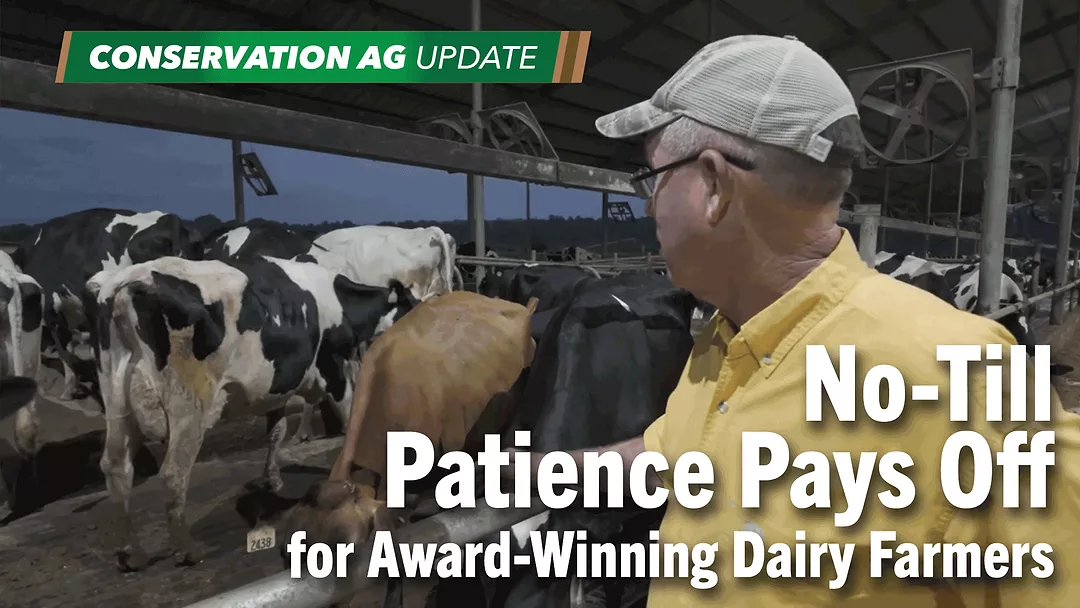
On this episode of Conservation Ag Update, brought to you by Bio Till Cover Crops, we head inside Jimmy and Andy Gray’s Leopold Conservation Award-winning operation in Stony Point, N.C.
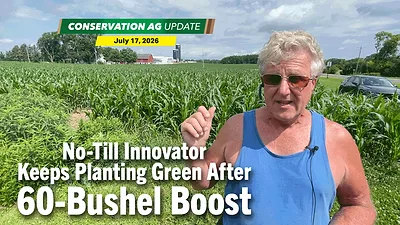
Jon Stevens takes us along for the ride as he harvests a no-tilled corn-on-corn field in the challenging soils of Rock Creek, Minn.
Associate editor Mackane Vogel reports form AGRITECHNICA in Hanover, Germany, where new technology from Weed-It could help no-tillers save big on chemical inputs.
Speaking of technology, Trevor Balthazor from John Deere dealer Riesterer & Schnell reveals the popular tool that’s making life easier for farmers this harvest season.
Later in the episode, Jason Webster, PTI Farm Manager, shares the top takeaways from Precision Planting’s Phantom Yield Loss Study.
In the Video of the Week, No-Till Innovator Ray Archuleta explains the science behind no-till drills. And last but not least, Marion Calmer checks in from his farm in Alpha, Ill., with a preview of his upcoming National No-Tillage Conference presentation.
This episode of Conservation Ag Update is brought to you by Bio Till Cover Crops.
Bio Till Cover Crops, a pioneer and leader in cover crop seeds, represents a complete lineup of seeds suitable for use in diverse soil types and growing conditions. Our focus on cover crop and regenerative forage seeds sets us apart from suppliers invested in other markets. Dealers in our distribution network are committed to your success by providing local resources, education and guidance to ensure you have the correct foundation for success. With over 50 years of experience in production, processing, packaging, and shipping, you won’t find a better fit for your farm.
TRANSCRIPT
Jump to a section or scroll for the full episode...
- No-Tillers Capture Carolinas Leopold Conservation Award
- Harvest Ride-Along: No-Tiller Breaks 260-Bushel Barrier
- AGRITECHNICA No-Till Tech Spotlight: Weed-It
- AutoPath Delivers Big ROI at Harvest
- Why Harvesting Corn at 26% Moisture is the Sweet Spot
- Video of the Week: Why Ray Archuleta Likes No-Till
No-Tillers Capture Carolinas Leopold Conservation Award
Welcome to Conservation Ag Update. We’ll check back in with Mackane here in a minute. But first we’re kicking things off in Stony Point, N.C., where Leopold Conservation Award recipients Jimmy and Andy Gray are reaping the benefits of no-till and cover crops.
Jimmy Gray: “Conservation has been tremendous for the success of our dairy. I’ve got two (conservation practices) that I feel like are heavy hitters — no-till farming and stream exclusions.”
Andy Gray: “I think with no-till, just stick with it, you may not see the rewards the first year or two, but just building up your soil health will have some long-term advantages that you’ll see in 2-3 years and years to come.”
Jimmy Gray:“If you don’t till that ground, last year’s plants that are dead and gone, their roots are dying out and there’s an area that water can go and recharge ground life. That soil heals itself. Soil health is all about that. Then that vegetation is there not only to make the stream banks stop eroding, but if you have a large rain event, that vegetation will lay over like shingles on a roof and protect the soil.”
Read more about the Grays’ conservation practices on SandCountyFoundation.org.
Harvest Ride-Along: No-Tiller Breaks 260-Bushel Barrier
Let’s head out to Rock Creek, Minn., now where Jon Stevens continues to prove no-till can work in even the toughest conditions. Jon’s Yield Monitor tells the story of a successful growing season as we hop in the cab with him.
“Corn-on-corn is not very common here in east central Minnesota, let alone corn-on-corn with no-till. We’re carrying 260 (bushels) for a little bit of a ways, that’s phenomenal. Just think, you could win a plaque or National Corn Growers Award in other parts of the country for 300-bushel corn. Nobody recognizes east central Minnesota for growing good crops. On forums, I’ve read where people come over here to laugh at us and how we do stuff.”
“For our area, to have a monitor just sit like that, I’m proud, let’s say blessed. God has very much blessed this field.”
Stevens says that field received a foliar feed with drones around V5.
AGRITECHNICA No-Till Tech Spotlight: Weed-It
Mackane Vogel here in Hanover, Germany at Agritechnica, where there is lots of ag technology and innovation on display. Why don't we send it off to the Cover Crop Connection segment right now and see what cover crop technology we have going on here in Germany?
“This is a small spray system. We have sensors that we mount on the spray booms, and what the sensor does, it'll basically talk with the chlorophyll in your plants and it'll be able to detect the weeds. It can do that up to really fast speeds and really high precision. We have a nozzle every 10 inches, and it will fire just that 10 inches of nozzle spacing if it's a small weed. It can detect up to pinky-size weeds and it's high accuracy, but it also has ... it does your whole broadcast spraying, full cover spraying. It can detect rows in the row recognition.”
“Also what it does is it can map biomass. If you're doing any in-crop spraying or just full cover spraying, it can live-map the biomass, and that way those maps will be sent to the cloud and can be used later on. For no-till farming, the biggest issue is probably weed control when there's no crop, and the green on ground detection in this system is probably the most stable one on the market.”
Well, as you can see, there is some conservation agriculture on display here, even in Germany.
AutoPath Delivers Big ROI at Harvest
Sticking with the technology theme, I tagged along with the precision crew at John Deere dealer Riesterer and Schnell in eastern Wisconsin the other day. And they told me there’s one technology in particular that’s really paying off for farmers this fall.
“Big one we’re utilizing here into harvest is AutoPath. That would be something we set up in the spring with putting a receiver on the planter and mapping every single corn row through the field. That basically sets up for our application passes and harvest passes to where that equipment pulls into the field, knows where every single corn row is in the field, to be the most efficient through the field as possible. The customer doesn’t have to count rows when they’re getting in with the sprayer or the combine or the sidedress machine. It automatically knows where they need to be in that field, and it continues to put those passes in the same exact spot if you’re pulling in multiple times with an application piece. There’s been a huge take rate on that. Once customers utilize it, they often question why they didn’t do it earlier.”
Why Harvesting Corn at 26% Moisture is the Sweet Spot
Moving on, how dry should your corn be before you start harvesting? Jason Webster’s tackling that question at Precision Planting’s PTI Farm. He says 24-26% is looking like the sweet spot so far in their Phantom Yield Loss Study.
“I’m $7.64 an acre ahead at 26% then 24% corn. If I let corn get down to 19%, I’m over $10 ahead. There are a lot of folks that let their corn dry down because they don’t want to pay charges, but I’m actually losing $30 an acre by doing that.”
“The numbers say right now at the PTI Farm, granted it’s only been 2 years, if we have a grain dryer on the farm, 24-26% corn has been the sweet spot for us. And we’re going to stay there until the numbers prove us otherwise.”
“I do think it’s interesting looking at the overall dollar advantages of on-farm drying vs. going to my local grain elevator. I’m $54 to $66 ahead by drying my own corn and not paying the excess shrink charges. That’s pretty significant. Even letting it go down to 16% corn; that’s $11 an acre advantage by me drying corn up here at the farm.”
Webster says next year will be important because it will be the third year of the trial, which will give them a nice set of data to make a more definitive conclusion.
Video of the Week: Why Ray Archuleta Likes No-Till
And let’s wrap up the program with some no-till knowledge from soil health legend, Ray Archuleta. He explains the science behind no-till drills in our Video of the Week.
“Why are no-till drills so heavy? Many of said that’s because the ground is so compacted. That’s only partially true. The main reason, too, is they can actually plant into heavy residue, and you can plant into living covers. If you plant into living covers, you take care of the compaction and hard ground. Please understand, no-till without living covers is not an adequate system. No-till by itself is not regenerative. Why do I like no-till? Because it stops the disruption and destructiveness of the soil ecosystem. I want to lessen disturbance.”
That’ll do it for this week. Got something you’d like to feature on the program? Shoot me an email at Nnewman@Lessiter Media.com. Thanks for tuning into Conversation Ag Update. Until next time, for more stories visit no-tillfarmer.com, striptillfarmer.com and covercropstrategies.com.