On this episode of Conservation Ag Update, brought to you by Titan International, Latimer, Iowa no-tillers Landon and Anne Plagge describe the soil health practices that propelled them to the 2025 Leopold Conservation Award, including a unique cover crop grazing system.
Plus, young farmer Wade Yingling shares how he’s fighting erosion and weeds with cover crops, strip-till and no-till in Mt. Sterling, Ill.
In the Cover Crop Connection, Mackane Vogel visits Tony Peirick’s farm in Watertown, Wis., for a planting season update.
Later in the episode, Clayton Griffith explains why he’s converting his 5,600-acre farm in Alaska to no-till, and how he’s getting help from companies in Kansas and Texas to make it happen.
In the Video of the Week, Lake Mills, Iowa, farmer Zack Smith showcases his custom-built twin-row planter and details the #FarmWeird experiment he’s using it for this growing season.

This episode of Conservation Ag Update is brought to you by Titan International.
Titan International is a global leader in off-the- road wheels and tires, and is the maker of Titan Wheels, Titan Tires and Goodyear Farm Tires. Super Single Goodyear Farm Tires, featuring Titan LSW®️ technology help growers unlock greater performance.
Featuring a larger rim and smaller sidewall, LSW technology minimizes soil compaction and creates a smoother ride in and out of the field. Titan has you covered with a full lineup of tires to fit every application on your farm. Contact your local Titan and Goodyear Farm Tire dealer today and learn more about LSW Tire Technology.
TRANSCRIPT
Jump to a section or scroll for the full episode...
- ‘Neighborly Grazing’ Pays Off for Iowa No-Tillers
- Young Farmer Saves Soil, Crushes Weeds with Strip-Till & Rye
- Tony Peirick Shares his 2026 Planting Season Update
- No-Till, Last Frontier: Two Drills, One Mission, 6,000 Miles
- Video of the Week: Quintuple Biopass 2.0
‘Neighborly Grazing’ Pays Off for Iowa No-Tillers
Let’s kick things off in Latimer, Iowa, where Landon and Anne Plagge are coming off a Leopold Conservation Award-winning year in the Hawkeye State.
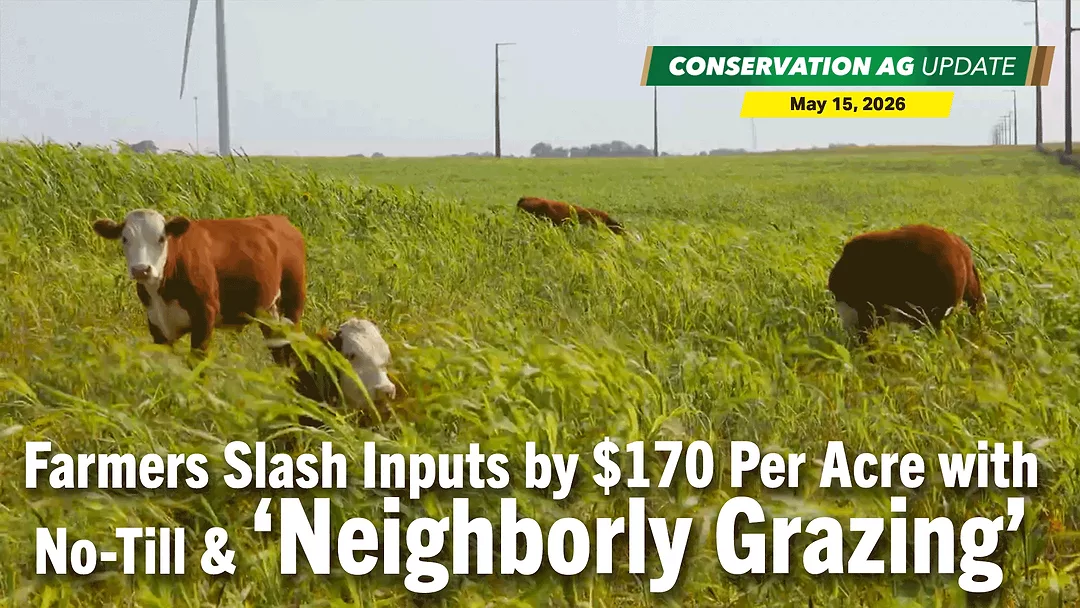
They no-till corn, soybeans and food-grade oats across 4,000 acres, and use diverse cover crop mixes between each of those cash crops.
Their neighbor brings his cattle over and grazes the covers on fields following small grains for about 100 days, something that’s paying off big time in more ways than one.
Landon Plagge, No-Tiller, Latimer, Iowa: “It speeds up the cycling of nutrients. Our cover crops are growing. Cattle eat them and fertilize it. Then it’s available for our corn to use the next year.”
“Our best cover crops are after small grains because we can plant a 7-way mix of grazing just a variety of different things that really changes soil structure.”
“Our typical rotation is corn, soybeans, oats as the cash crops with a cover crop in between every single one of those. We’ve had a lot of successes and failures.”
Dr. Anne Plagge, No-Tiller, Latimer, Iowa: “If you’re a doer, there are things that are going to not work along the way and that’s part of trying something new is just being willing to experience that failure and learn something from that.”
Since switching to 100% no-till and cover crops, Landon estimates they’ve lowered input costs by about $170 per acre of corn.
Young Farmer Saves Soil, Crushes Weeds with Strip-Till & Rye
Meanwhile, over in Mt. Sterling, Illinois, young farmer Wade Yingling and his dad, Bruce, are capturing success with strip-till and cover crops, with a little vertical tillage mixed in as well.
They use a 16-row Case IH strip-till bar with a shank setup to make strips and apply anhydrous in the fall. Then in the spring, they come back with a Yetter Strip Freshener coulter unit that dribbles UAN, ATS, humics and micros 2-by-2 on each side of the strip.
And they plant cover crops on just about every single field that’s going from strip-tilled corn to no-tilled soybeans.
“We have a Valmar seeder on our Accelerator vertical tillage tool. We chop, size residue and then blow on cereal rye. We typically do about 35-40 pounds of cereal rye, it’s what we’ve been doing the last few years. We really like it. We’ve got a lot of highly erodible ground, a lot less erosion. Erosion is just a big deal for us. Weed control is another big one (benefit). It just works really well, and it seems like the ground…takes the hard beating rains better. The ground doesn’t get as hard as quick, it seems like. We plant beans into it green when it’s 4-6, all the way to a foot tall or more. Try to terminate it within a few days, or a week or two. Just depends. Sometimes we let the beans get up.”
Make sure you marry the planter to the strip-till rig, that’s Wade’s big piece of advice if you’re thinking about strip-tilling.
Tony Peirick Shares his 2026 Planting Season Update
This week I’ve got another update from this year’s Conservation ag Operator Fellow — Wisconsin no-tiller Tony Peirick. Let’s take a listen as he gives us his official 2026 planting season update.
“We got started a little later this year with the moisture, as we know everybody has this year. Guess started like the first week in the first full week in May and we're moving right along. The conditions have really improved. They dried out considerably. I think a lot of it has helped because of our submoisture wasn't as wet and the infiltration of the water went down so we're able to dry off a little faster.”
“So we're pretty well on progress. I mean, it's a little bit behind this year, but I think with weather conditions cooler now, we'll have to see what happens this year. I mean, if we get some warm weather and everything cooperates through, we could have a good crop this year. I know the conditions are looking real good as far as the planting and the crops going in the ground, but mother nature is going to determine what's going to happen the rest of the year. So far as a little behind, but we'll get there. I think it's looking pretty good right now unless we get some torrential rains. I think we'll be in fairly good shape and we'll see what happens the rest of the year.”
Mackane Vogel: “And what can you say about covers and no-till and those two factors helping you get through any of this potential weather and rain?”
“Yeah, it's helped out. I know I did talk to a neighbor, a friend of mine, he's put some covers in on some of the land and he had to go out this spring and filling in all his washouts and he had commented back to me. H says, "You know where I put the rye?" He said hardly washed. But he said, "He didn't have any covers." It was kind of a mess out there. So he is seeing the benefits of it.”
“Everybody's kind of skeptical of planting covers and why we use covers and stuff. But that was an interesting comment I got from him that after being out on the land and filling the covers back in and had some covers on that field on the higher ground of it and different land he had that it did make a difference. And I got another farmer that I know well and he said he's 100% covers this next year. He said, "I'm not going to plant anything without covers." He said, "The covers were so important this year and keeping erosion." So I'm glad to hear that. Like I say, our group Dodge County farmers and Field of Cincinnati are out there to educate the farmers and that's what we're trying to do. We're trying to give them the education they need and show the projects we're doing to educate the farmers and say what we have to do in the future to protect our farmland.”
Always good to see cover crops and no-till doing what they do best and making life a little easier for farmers, especially during this busy time of the year.
No-Till, Last Frontier: Two Drills, One Mission, 6,000 Miles
Big news here. For the first time in the history of Conservation Ag Update, we’ve got a story about no-till in Alaska!
Sixth-generation farmer Clayton Griffith, who moved from Kansas to the “Last Frontier” 5 years ago to pursue his passion for hunting and fishing, is converting his 5,600-acre farm near Delta Junction, Alaska, to no-till, so he can produce small grains more efficiently and sustainably.
To make that happen, Wichita, Kan., based Quality Drills and Walt Pene Trucking out of Texas are hauling two John Deere air seeders and a Hagie sprayer 6,000 miles to its final destination. Our John Dobberstein caught up with Clayton to talk about his motivation for going no-till.
“A couple of reasons why … getting in the fields early, we have a short growing season. And currently right now, there's still snow sitting on the fields, so when it dries out, you can't have an actual target date for planting. So, it's very important that you get the seed in the ground as soon and efficiently as possible. And with that, we can do some variable rate seeding, herbicide applications, and fertilizer right with the seed and have better control of our crop and our growing conditions that way. But the mitigation tool that is to go no-till is get all of the seed in the ground as soon as possible. When you're conventionally tilling, we would have to till it all up, possibly spray it, and then go into till. So, it could be a three to four-week deal. With no-till, we're planning on less than a week.”
That’s just the tip of the iceberg. Listen to the full conversation on No-TillFarmer.com with Clayton and the people at Quality Drills and AlaskaAgro.
Video of the Week: Quintuple Biopass 2.0
Headed back to Iowa now for our Video of the Week. Zack Smith fills us in on his latest experiment with his custom-built twin-row planter.
“For those of you who’ve followed me for a while, you know I have this twin row planter that I’ve done different experiments with over the last couple years. Last year I did something called the quintuple biopass where I had twin row 60s and then I came in and put a single row 30 in between, so I had five rows in about a 68-inch footprint. I planted oats in between in a 15-foot lane essentially. And that worked really well compared to static 30-inch corn, there was about a 70-bushel advantage for this system.”
“Instead of doing it with oats, this year I decided I’m going to do the same thing, but I’m going to put two rows of beans in between so I have a crop that’s easier to harvest. I’ll harvest the corn first, and then I’ll come back and pick the beans off that are in between. The idea is it’s essentially three 30-inch rows with five rows and it’ll make more sense when you see the other planter. And then two rows of soybeans in between and then five rows on three strips over there.”
Be sure to follow Zack on social media to keep up with his #FarmWeird plots.
What do you think? Send me your thoughts and story ideas to Nnewman@Lessiter Media.com. Thanks for watching. Until next time, for more stories visit no-tillfarmer.com, striptillfarmer.com and covercropstrategies.com.