On this episode of Conservation Ag Update, brought to you by Titan International, we share a key takeaway from the USDA Prospective Plantings report, and catch up with Wisconsin no-tiller Kevin Klahn to discuss his state record-breaking soybean yield.
Planting season gets underway in Beaver Dam, Wis., where strip-tiller and cover cropper Ryan Nell checks in from an early-planted soybean field.
In the Cover Crop Connection, Mackane Vogel takes us inside No-Till Innovator Mike Starkey’s Landowners Meeting in Brownsburg, Ind.
Later in the episode, Syngenta AI expert Jeremy Groeteke delivers some advice about AI at the Farm Equipment Manufacturers Association Supply Summit and Showcase in San Antonio, Texas.
In the “Tip of the Week,” Loran Steinlage (West Union, Iowa), Michael Thompson (Almena, Kan.) and Jim Moseley (Clarks Hill, Ind.) share some of their biggest tips for no-till success.

This episode of Conservation Ag Update is brought to you by Titan International.
Titan International is a global leader in off-the- road wheels and tires, and is the maker of Titan Wheels, Titan Tires and Goodyear Farm Tires. Super Single Goodyear Farm Tires, featuring Titan LSW®️ technology help growers unlock greater performance.
Featuring a larger rim and smaller sidewall, LSW technology minimizes soil compaction and creates a smoother ride in and out of the field. Titan has you covered with a full lineup of tires to fit every application on your farm. Contact your local Titan and Goodyear Farm Tire dealer today and learn more about LSW Tire Technology.
TRANSCRIPT
Jump to a section or scroll for the full episode...
- Longer Rotation, Early Planting Key to 115-Bushel No-Till Soybeans
- #Plant26: Strip-Tiller Pushes Envelope with Early-Planted Soybeans
- Educating Landowners About Benefits of Cover Crops, No-Till
- Advice for Getting Started with AI on Your Farm
- No-Till Tip of the Week: ‘Failure is Not Fatal’
Longer Rotation, Early Planting Key to 115-Bushel No-Till Soybeans
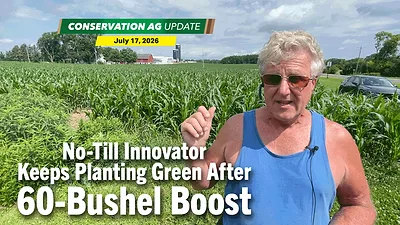
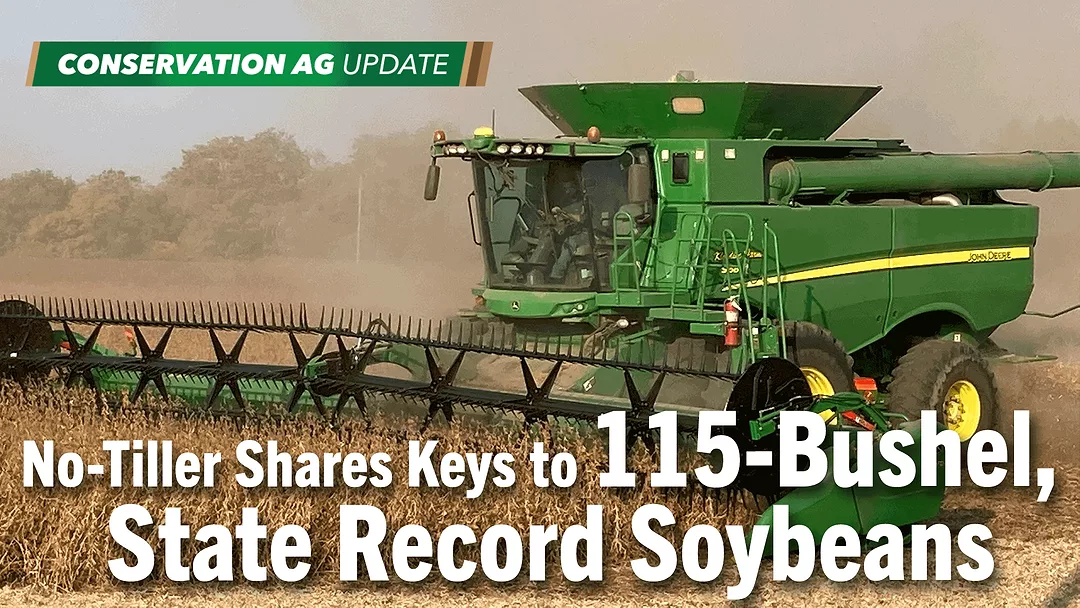
Farmers will plant less corn and more soybeans this spring according to the USDA’s Prospective Plantings report. Corn planting is projected to be down 3% and soybean planting up 4% from last year. A record-high soybean acreage is expected in Wisconsin, where no-tiller Kevin Klahn broke the state record with a 115-bushel yield on his 44-acre experimental plot last year. Let’s go to Kevin, LIVE in the cab now. Kevin — how’d you pull it off?
“We’ve divided that 44 acres into 4 sections. We run 3 corn plots and 1 soybean plot and then rotate that soybean plot through those 44 acres. So, it’s a 4-year rotation for soybeans on that. The longer we can go in between soybean plantings, the better potential we have.”
“Last year, everything worked out well. We planted early in dry conditions. That’s key. If you go to that custom work thing that we’ve worked on throughout our career, we’ve pushed the envelope on the early side, not necessarily because we knew it was good for the potential of the crop, but we just got more done so that we could be available to do the custom work that we had to get through and had a big workload to tackle.”
Kevin’s also seeing big ROI with NEXTA biologicals, which he says is like giving the plant ibuprofen when it’s not feeling well. We’ll have more details on Kevin’s championship formula in the upcoming No-Till Farmer Soybean Champs Special Report.
#Plant26: Strip-Tiller Pushes Envelope with Early-Planted Soybeans
Well, since we’re talking soybeans, let’s stay in Wisconsin and head north to Beaver Dam, where Ryan Nell has already planted over 5 acres. The strip-tiller likes to push the envelope with early planted beans, even with cold temperatures and heavy rain in the forecast.
“I looked at this as being a good test. Let’s see what the beans can handle. I want to keep pushing and see what we can do and what’s achievable. I still go back to April 3-6 2021 were by far some of the best beans we’ve ever grown. I have not been able to replicate those types of field averages. That year a quarter of our acres averaged somewhere between 85 and 88 bushels across 4-5 fields. Here’s to trying again. 5.48 acres in the ground.”
“There is fertility under these strips. I do have 60 feet where I didn’t put any fertility. That’s something to keep an eye on, we might tissue test as well just to see if there’s a difference with anything. We’re definitely not the first year. I know of other guys who have planted in the state of Wisconsin. Didn’t know if we’d get a shot, but we did it. Here’s to 2026 and hopefully safe spring and safe planting for everyone.”
Berg is the founder of the Pecatonica Pride Watershed Association, bringing together outdoors enthusiasts, farmers and landowners to improve the river and inspire others to embrace conservation practices.
Educating Landowners About Benefits of Cover Crops, No-Till
Last week I visited with Conservation Ag Foundation director and No-Till Innovator alum Mike Starkey on his farm in Brownsburg, Ind..
For the second straight year, Starkey was hosting an event where he invited landowners from all over the state to come and learn about no-till and cover crops and why it is in their best interest to encourage the farmers they rent land to, to switch to no-till and adopt cover crops and other conservation practices.
“Well, this was just strictly for landowners, but there were some farmers here also. And this is our second year of doing it. And two-thirds of the farm ground that I have is rented. And therefore, I wanted to build a relationship with my landlords of what we are doing to their soil and their water, their farm, and improving it, but also bring in others that own land so they can encourage their tenants to do the type of farming that we're doing. I also brought in a guy talking about research and development tax credits, which was kind of outside the box of conservation, but it was a topic that I felt that landowners can bring to their tenants information that they're not aware of. And with that, it's a better relationship between just a tenant paying the landowner a rent check. But in order to do that, to encourage them to do conservation practice on the farm, I wanted them to have some incentives to pass that on to them to look at doing this type of farming, kind of give other farmers the idea that they could do the same thing, especially the no-tillers that I know are my peers.”
“And to bring that relationship, it was an idea that I actually thought of last year thinking, "Hey, personally make these contacts to these landowners to attend this event." And as we had here, most of them are elderly and these elderly landowners want to make sure their land is taken care of and passed on better for the next generation that's farming their ground. So therefore, personal contacts helps. I worked with my local Swan and Water Conservation District to get those contacts. And of course, I made a personal phone calls or texts, let's put it that way, and Cinnamon Flyer to come to this event. And I thought I was well attended.”
If you want to hear some more of my key takeaways from the event, go check out my latest staff blog at covercropstrategies.com.
Advice for Getting Started with AI on Your Farm
While Mackane was with landowners in Indiana, I was hanging out with manufacturers in San Antonio at the Farm Equipment Manufacturers Association Supply Summit and Showcase.
AI was the hot topic in many hallway conversations and presentations. Jeremy Groeteke from Syngenta talked about the latest AI trends, and he tells us if you aren’t using AI on your farm yet, put it on your ‘To-Do List.’
“It's just get started, right? As simple as downloading the apps, using the free version, hit up a training course. There are tons of those out there, LinkedIn, YouTube, universities have programs, MIT. There's a bunch of programs out there you can do, so just dive in and get started. There's no going back. The quote I use is, "The individual that leverages technology will outcompete the individual that doesn't use technology." And so just get started and get going.”
Jeremy says many farmers are already using AI platforms like the ChatGPTs and Geminis of the world for quick fixes. But we still have a long way to go for AI and full autonomy.
No-Till Tip of the Week: ‘Failure is Not Fatal’
We usually wrap up the show with a Video of the Week, but let’s call an audible and go with a Tip of the Week. This one comes to us from the No-Till Innovators Panel at the 2026 National No-Till Conference. Loran Steinlage, Michael Thompson and Jim Moseley share some of their biggest tips for no-till success. Let’s listen in.
“You’re going to make mistakes, but being willing to learn from mistakes is one of the best things we did, and we’ve never been afraid to share it. Anybody that comes up here and says they know exactly what they did the whole way through, they probably lied.”
“Failure is not fatal. It’s only a failure if you don’t learn from it. It’s costly education sometimes, but it’s only failure if you fail to learn from it.”
“Mother Nature is illiterate. She can’t read your plans. Always have a plan B, C, D, E, all the way to Z. I think our record is we went 2 or 3 times around. Recognizing that potential to fail early has probably been some of the most profitable decisions we’ve made. I’ve eaten a lot of crow for some of the crazy things we’ve done. Go ahead, hit me. Because we’ve came around full circle quite a few times with the relay cropping. Seeing that failure and turning it into a double cash crop or something, just pulling the plug on something is the best thing you can do.”
“One last thing, really know your numbers. I hate numbers but I have a really good CPA brother. He does all the bookwork and the stuff I don’t like. If you don’t like it like me, find a good ag CPA that can really keep good records and know your numbers. Because if you know your numbers, you’re going to see some things you need to abandon, some things you need to tweak or change because there’s always something you can put on or try, but you still have to stay within that budget is what it boils down to.”
That’ll do it for this week’s episode. Story idea? Shoot me an email at Nnewman@Lessiter Media.com. Thanks for watching. Until next time, for more stories visit no-tillfarmer.com, striptillfarmer.com and covercropstrategies.com.