On this episode of Conservation Ag Update, brought to you by Yetter Farm Equipment, Mike Starkey shares something new he’s trying on his Brownsburg, Ind., farm to slash inputs. In southeastern Wisconsin, no-tiller Ross Bishop explains how farmers are dealing with historic rainfall, including a “1,000 year” flooding event.
In the Cover Crop Connection, Mackane Vogel spotlights more no-till innovations from his East Coast farm tour in Pennsylvania. Later in the episode, Conservation Ag Operator Fellow Michael Thompson crosses his fingers for timely rains after a flash drought in Almena, Kan. And in the Video of the Week, No-Till Legend Ray McCormick shares the eye-opening light bulb moment that occurred at a recent National No-Tillage Conference.

This episode of Conservation Ag Update is brought to you by Yetter Farm Equipment.
Since 1930, Yetter Farm Equipment has been providing farmers with profitable solutions. From residue management and fertilizer placement to seedbed preparation, our equipment is designed to maximize your inputs, save you time, and deliver a strong return on investment. Explore our full line of planter attachments, precision fertilizer placement options, strip-till units, and stalk rollers at yetterco.com. Let Yetter help you prepare your equipment lineup for success today.
TRANSCRIPT
Jump to a section or scroll for the full episode...
- No-Till Innovator Focuses on Slashing Inputs with New Products
- Historic Rain Event Hits No-Till Fields in Wisconsin
- Live Demo of Plant Right Minimum Disturbance No-Till Drill
- Conservation Ag Operator Fellow Deals with Flash Drought
- Video of the Week: Critical Lesson Learned at No-Till Conference
No-Till Innovator Focuses on Slashing Inputs with New Products
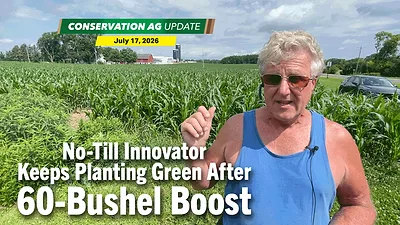
Welcome to Conservation Ag Update. Brownsburg, Ind., No-Till Innovator Mike Starkey stopped by our studio to talk about the 2025 growing season. He’s always looking for ways to improve his efficiency and slash input costs. I asked him, what’s something new you’re trying this year?
“I am trying different products to do that, and one product is called Source from Sound products. With that product, I have several little mini research applications on the farm to see what is the best product to not only increase my yield but to reduce inputs.”
“So that's the thing for me, because this weather has changed since I've been starting farming. We got to manage the weather as best as we can. It's either extreme one way or the other. And so I feel we're ahead of the game with no-till and the cover crops and the soil biology. And if we can get that soil to provide the nutrients as best as we can, I think we'll keep moving on, especially since we have corn and soybean prices below normal production input costs.”
Starkey does his own on-farm research. He’s trying multiple products to see which ones work best, and if any of them work well together.
Historic Rain Event Hits No-Till Fields in Wisconsin
And I’m glad he brought up that point about weather because there was historic flooding in the Milwaukee area a couple weekends ago. Jackson, Wis., no-tiller Ross Bishop got around 10 inches of rain in one day, putting the resiliency of his fields to the test.
“The water is going to affect the nitrogen that’s in the soil for feeding the crop. The soybeans, this will probably make them really good because in August they like to get a lot of rain. You can see in the field here it’s still sitting 3-4 inches, that’s going to take while. And we have another quarter inch of rain coming tomorrow, so this is going to keep us out of the field quite a while.”
The flooding in Milwaukee was classified as a 1,000-year event, meaning it has a 1 in 1,000 chance of happening in any given year.
There’s a 100% chance that Mackane Vogel has something good in today’s Cover Crop Connection.
Live Demo of Plant Right Minimum Disturbance No-Till Drill
Mackane Vogel here with this week’s cover crop connection. Well cover crops and no-till are a match made in heaven and a few weeks ago I had a chance to visit with Loysville, Pa. no-tiller and innovative no-till manufacturer Charlie Martin. He showed me the latest no-till innovation he and his team have been working on and I even got a chance to see a live demo of the machine in action. Cover croppers are going to want to pay close attention here to this unique Plant Right minimum disturbance no-till drill. Here’s Charlie in the field to explain some of the special features.
“So basically it goes in the soil, allows the soil to bubble up along the side of the disc blade, so that keeps our row compaction pretty much non-existent. And then we have our back wheel and closing wheel is all the same and it hits that and pushes most of the dirt in right behind the blade. The seed is dropped out right in front of the seed firmer and then there’s a reverse angle on the depth wheel, closing wheel to help close the trench, we can see that on the back side.”
“We have hydraulic down pressure on every row. This is a single acting cylinder on every row and they’re all tied together so we can set the pressure from 0 til we lift the machine up, which equals about 400 pounds of down pressure per row we can get until we get lift up. And we can also cut half the rows out and only put pressure on half of them which gives us 12-inch spacing. This is a 6-inch spacing drill and we have never built anything wider. We never had a request for — 6 inch spacing seems to be what they want.”
Charlie also notes that this is a narrow-transport machine that transports at just 8 and a half feet going down the road.
Conservation Ag Operator Fellow Deals with Flash Drought
While our friends in southeastern Wisconsin deal with that flooding, Michael Thompson is facing a different kind of challenge in Almena, Kan. The Conservation Ag Operator Fellow had his fingers crossed for some timely rains when we last visited him in late May.
“It’s been pretty dry since we planted. We had a lot of windy days. There have been 20-40 mph winds sustained since we planted. It’s drying out quite a bit, so hopefully the roots are going down and getting into moisture. We’re going to need some rains because it’s pretty dry for the year. We usually get a lot of rains in this May-June time period, and so far in May we haven’t gotten them. We hope that late May and early June are pretty wet.”
“When we pull the residue back, the top is pretty dry as you can see. But you get down 2-3 inches where the corn is planted and it’s still wet enough where you get some moisture. It’s wet enough that we should keep going. That’s some of the benefits of having some cover but eventually the wind seems to dry everything out, it doesn’t seem to matter how much cover you have.”
“We still have a shot but were going to have to have timely rains throughout the growing season to have much because we only have a couple feet of profile moisture below. Our soil moisture profile was very lacking coming into this crop.”
Looking forward to seeing how everything turns out during Thompson’s presentation at the 2026 No-Till Conference, Jan. 6 in St. Louis.
Video of the Week: Critical Lesson Learned at No-Till Conference
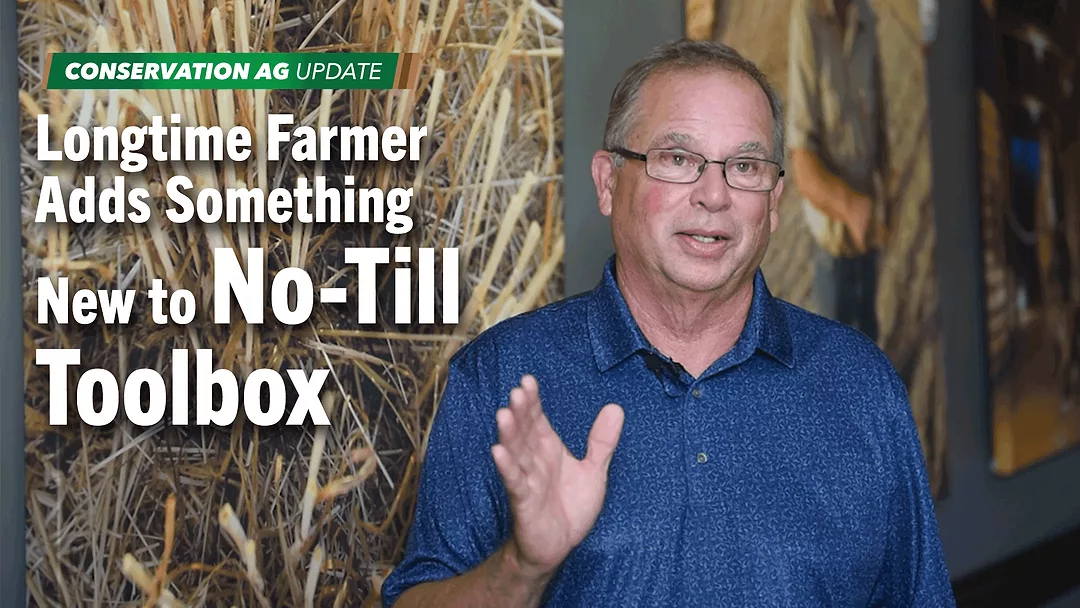
Speaking of that, in our Video of the Week, No-Till Legend Ray McCormick shares a valuable piece of information he picked up at the conference a few years ago that influenced how he seeds cover crops with the combine.
“This is why you want to go to the No-Till Conference. I’m sitting there and Marion Calmer is talking about if your fodder is going through the combine, you’re not picking the corn correctly. All of this should go through your head between the snapping rollers. You see farmers picking corn and there’s all this material coming out their chopper, and you drive behind me and it’s just flinging a leaf here and there, it’s not hardly throwing anything out of the chopper. It makes it easier for the corn to fall through but it also doesn’t dislodge all this. All your fodder material ought to go through the corn head not the combine.”
“I’m lying in bed in night, and thinking we can’t drill, it’s taking up my son, it’s during harvest and it’s chopping up the tires on it. I kept think there’s got to be a way to do it in one pass with the combine. I’m thinking about putting it here, putting it there, doing all different kinds of things. Then suddenly form Marion Calmer at the No-Till Conference, he’s saying the fodder needs to go down through the head. And I went bingo. We’ll run the air tubes to right in front of the snapper rollers so as all this goes through the snapper roller it’s mulching on top of the seed.”
That’ll do it for this week. Got something you’d like to feature on the program? Shoot me an email at Nnewman@Lessiter Media.com. Thanks for tuning into Conversation Ag Update. Until next time, for more stories visit no-tillfarmer.com, striptillfarmer.com and covercropstrategies.com.