 Premium content is for our Digital-only and Premium subscribers. A Print-only subscription doesn't qualify. Please
No-Till Farmer
Get full access NOW to the most comprehensive, powerful and easy-to-use online resource for no-tillage practices. Just one good idea will pay for your subscription hundreds of times over.

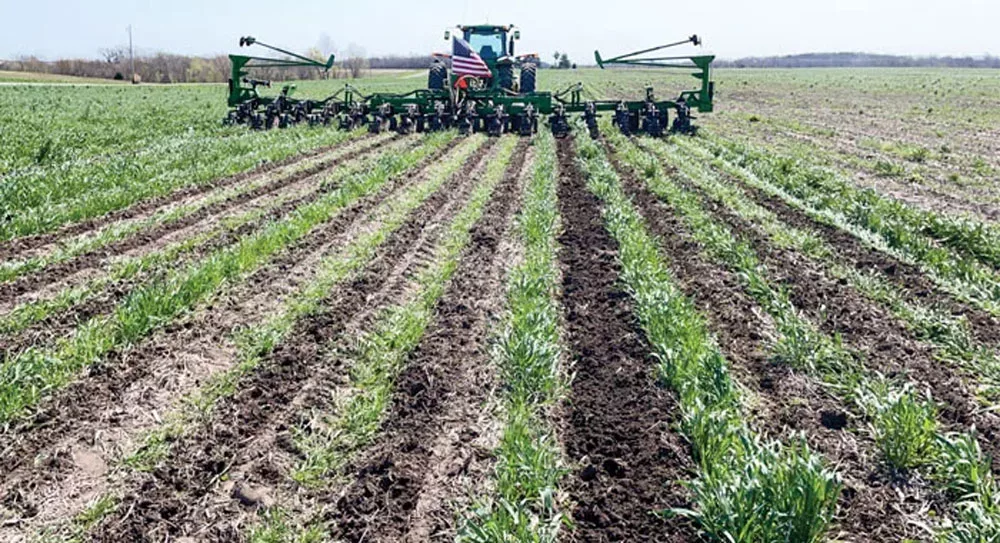
FALL & SPRING. Versatility is key for Golden, Ill., farmer Andrew Reuschel. He uses a custom-built strip-till bar to make fall strips with a shank. In the spring, he swaps the shanks for coulters and uses it as a strip freshener. Andrew Reuschel
Andrew Reuschel always tells people he has about 50 years’ worth of farming knowledge and experience even though he’s only in his mid-30s. He has his grandpa, Louis, and dad, Jeff, to thank for that. They started no-tilling in the 80s and cover cropping in the 90s.
“We have three generations of people failing,” Reuschel says. “That’s how we’ve become successful now with our system. Our family has put in the time — trying new things, failing and figuring out what works and why it works.”
When Reuschel returned to the family’s Golden, Ill., farm after serving in the U.S. Army a few years ago, he followed in his predecessors’ footsteps by trying something new — strip-till.
“When I returned, I went right back into cover crops and no-till, but I was having a lot of struggles,” the fifth-generation farmer says. “I was giving up yield by having to wait for the right moisture and temperature to plant. With strip-till, I knew I could start planting much earlier and get that corn up and out of the ground 3 weeks sooner.”
Like everything else they’ve tried in the past, Reuschel’s dad wanted to make sure strip-till would work for them before going all in.
“I like to say that we did poor man’s strip-till at first,” Reuschel says. “We’d put down anhydrous in the fall, and then in the spring, we’d plant right on top of it. The concept was working, and we liked it, but we…

Get full access NOW to the most comprehensive, powerful and easy-to-use online resource for no-tillage practices. Just one good idea will pay for your subscription hundreds of times over.
Download these helpful knowledge building tools

We have engineered and developed the most advanced concave system that threshes all crops, eliminates rotor loss, improves grain quality, gives you a cleaner sample – all with one set of XPR concaves.

At Titan International, our product portfolio reflects our commitment to innovation and high-quality products. Titan International offers a full line of solution-focused wheel, tire, and undercarriage products for a wide variety of off-the-road equipment in agriculture, construction, forestry, mining, power sports, high-speed trailers, and outdoor power equipment segments. As one of the largest North American manufacturers, with a network of dealers all over the world, Titan is an industry leader that original equipment manufacturers and operators can count on for durable products and quality service.

Provide expert analysis and decision support to increase productivity and profitability.