TAKEAWAYS
- Understanding the carbon pathway is a key to unlocking the benefits of regenerative farming.
- Have goals when you commit to changing systems — whether they’re economic, erosion-related, or conservation goals.
- Those new to conservation may want to seek out a safe, constructive place to learn by connecting with a local conservation district or soil health group.
Every year at the National No-Tillage Conference, individuals and organizations are recognized for their contributions to no-tilling and conservation practices through the No-Till Innovator Award program.
Selected by No-Till Farmer’s Advisory Board, recipients are chosen based on their experience with regenerative agriculture, community and outreach efforts, advocacy, innovation and more.
Sponsored by Calmer Corn Heads and No-Till Farmer, the 2025 No-Till Innovator Award honorees are:
- Northeast Iowa Dairy and Agriculture Foundation (Organization)
- Meadowbrook Farm (Crop Production)
- Kris Nichols (Research & Education)
- Saddle Butte Ag (Business & Service)
Northeast Iowa Dairy and Agriculture Foundation
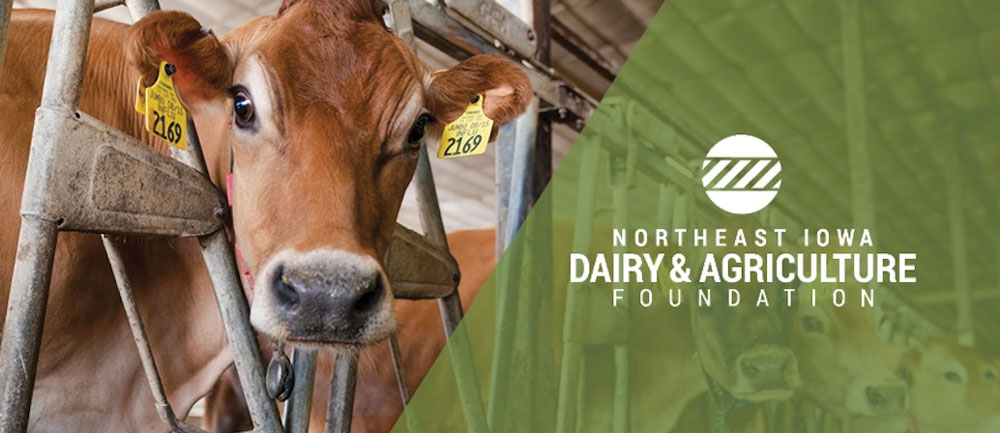
Northeast Iowa Dairy and Agriculture Foundation’s journey with no-till and conservation farming began just over a decade ago when the Northeast Iowa Community College (NICC) president, Liang Chee Wee, decided to make the campus and farm a place for conservation.
The foundation partners with NICC and operates the Iowa Dairy Center, a 220-cow dairy and 250-acre farm, which is located right next to NICC’s Calmar, Iowa campus. In 2014, Wee spearheaded the farm’s adoption of 100% no-till and cover crops for 180 acres.
Northeast Iowa Dairy and Agriculture Foundation
As reported in the Iowa newspaper, The Gazette, the intention was to improve soil health and promote innovative farming techniques. With the Iowa Dairy Center seeing more than 5,000 visitors annually, it was a chance to expose people to better ways of farming.
Eleven years later, Iowa Dairy Center Chairman Dave Lawstuen says the foundation appreciates the recognition for the efforts they’ve gone through, as it wasn’t an easy journey to get to where they are now.
“Those first couple of years were challenging,” he recalls. “It’s extremely rewarding to see the results today.”
Those results include higher soil organic matter and better water quality. Water quality is particularly important as the farm is located right by the town and campus, so whenever it rains that water runs off the streets and parking lots onto the farm.
While the foundation has also installed grass waterways, permeable pavers and infiltration trenches to divert water into the soil, a lot of runoff still enters the farm’s pond, yet the pond has a thriving fish population.
“There’s no question these practices work,” Lawstuen says.
“Know why you’re doing what you’re doing, learn from your mistakes and keep moving forward…”
In addition to the improvement in soil health and water quality, the farm is growing higher corn silage yields. While Lawstuen doesn’t have the exact yields from a decade ago, he recalls them originally being around 16-18 tons per acre — today they produce around 28 tons.
Education is a top priority for the foundation, which hosts several farmer workshops, events and training. With its partnership with NICC, the foundation also gives future farmers first-hand experience with these conservation practices and how to implement them on their own farms.
Additionally, NICC is part of C2A3, a network of community colleges that combine resources and expertise to strengthen ag education. Through C2A3, NICC has received a grant to use an invisible fence for the foundation’s fall-calving herd. This will allow the dairy center’s farm manager to use his phone to move the cattle to 10-acre paddocks without the use of fencing.
“I think that’s going to be a huge draw for farmers, that we can graze cover crops in the fall with the invisible fence,” Lawstuen says.
They will also be examining the differences where the soil was grazed or ungrazed, using Haney soil tests, water infiltration measurements and drones to collect data and study how grazing management impacts the soil.
Meadowbrook Dairy
Alex Udermann says the initial draw to conservation practices for his family’s farm, Meadowbrook Dairy in Sartell, Minn., was economic.
But since they began no-tilling 9 years ago and witnessed the effects of regenerative farming methods, the Udermanns’ motivation has shifted to improving the soil, protecting the environment and enhancing food quality.
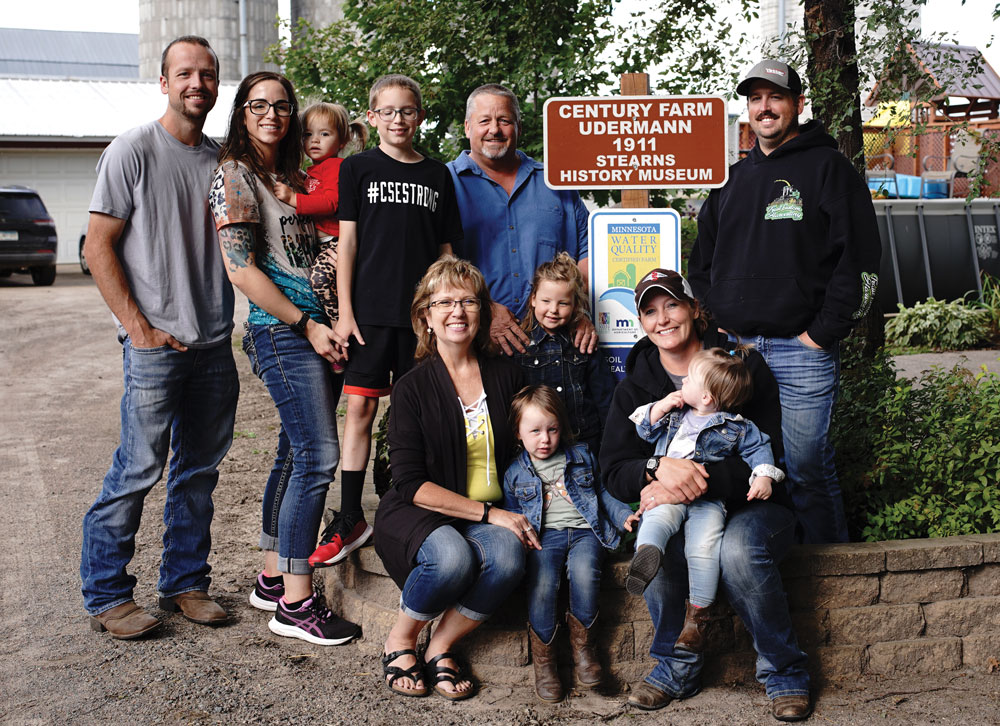
Meadowbrook Dairy
That commitment is evident in the many projects and practices they’ve implemented. Working closely with their local Soil Water and Conservation District (SWCD), they developed a Conservation Stewardship Plan that includes no-till, cover crops, irrigation management and nutrient and manure management.
They are also restoring 245 acres of wetland — with 100 acres already completed — and have expanded buffer strips along streams and ditches to capture any runoff from fields. These buffer strips have the added benefit of producing high-quality grass hay for their livestock.
The family also soil samples annually and applies manure at lower rates, prioritizing phosphorus (P) and potassium (K) needs over nitrogen (N). As a result, they haven’t applied commercial P and K fertilizer in several years.
Their progress has not gone unnoticed. Meadowbrook has received numerous awards, including First District Assn. Young Cooperator of the Year, Stearns County Century Farm Award, Catholic Century Farm Award, Stearns County SWCD Outstanding Conservationist of the Year. They were also a finalist of the Leopold Conservation Award.
Minnesota’s Department of Agriculture also offers an Agricultural Water Quality Certification Program, in which farms and landowners can receive endorsements for the following: integrated pest management, soil health, wildlife, irrigation water management and Climate Smart practices. In 2024, Meadowbrook became the first farm to receive all 5 endorsements.
Always seeking new ways to improve their soils, Alex has begun composting wood chips from the City of Sartell. With the help of a local mushroom farmer, he plans to inoculate the chips with mycelium to support a healthier bacteria-to-fungi balance in the soil.
“I think the biggest thing in the no-till movement has been pushing researchers to do more on-farm research, more long-term research, and really asking different questions…”
Kolby Hansen, conservation agronomist for Morrison SWCD, nominated Meadowbrook Dairy for the award and says, “In every way, the Udermann family exemplifies what it means to be champions of no-till and soil health.”
In addition to the strides they’ve made on their own farm, the Udermanns are committed to sharing their experiences — both the successes and challenges — to support others on their regenerative ag journey.
They value their partnership with the local SWCD, which has provided important financial assistance for practice adoption. To supplement this, they have also relied on farmer-to-farmer mentorship through the Minnesota Soil Health Coalition, a farmer-led organization that offers practical education and peer support for farmers, food processors and consumers.
“They readily acknowledge that regenerative agriculture is a journey, and in doing so they have created a safe, encouraging space for others to learn alongside them,” says Hansen.
Over the years, the family has hosted field days on no-till planter setups and planting demonstrations and have participated in farmer panels, conferences and other educational events.
“If I can help another farmer implement regenerative practices, it’s a win-win — for us, for them and for their communities,” Alex says. “Farming regeneratively benefits the soil, the water, the air, and ultimately, our food.”
Alex hopes to show other farmers that conservation is both worthwhile and achievable.
“Stick to the course,” he says. “All 5 soil health principles work in any location, any soil type, any climate. But you must have goals — whether they’re economic, erosion-related, or conservation goals. Set goals for your farm and make a plan. Just don’t give up. Know why you’re doing what you’re doing, learn from your mistakes and keep moving forward.”
He adds that their success at Meadowbrook Dairy is rooted in incorporating all five soil health principles and in the power of networking — especially through partnerships with the Minnesota Soil Health Coalition — which has helped elevate their operation to the next level of regenerative agriculture.
Kris Nichols
Farmers have always been at the heart of Kris Nichols’ career, so receiving the No-Till Innovator Award in Research & Education means a great deal to the world-renowned soil microbiologist.
Nichols is the founder and lead scientist of KRIS (Knowledge for Regeneration in Soil) Systems Education & Consultation, where she focuses on how to improve soil health and translate it into practical applications for farmers.
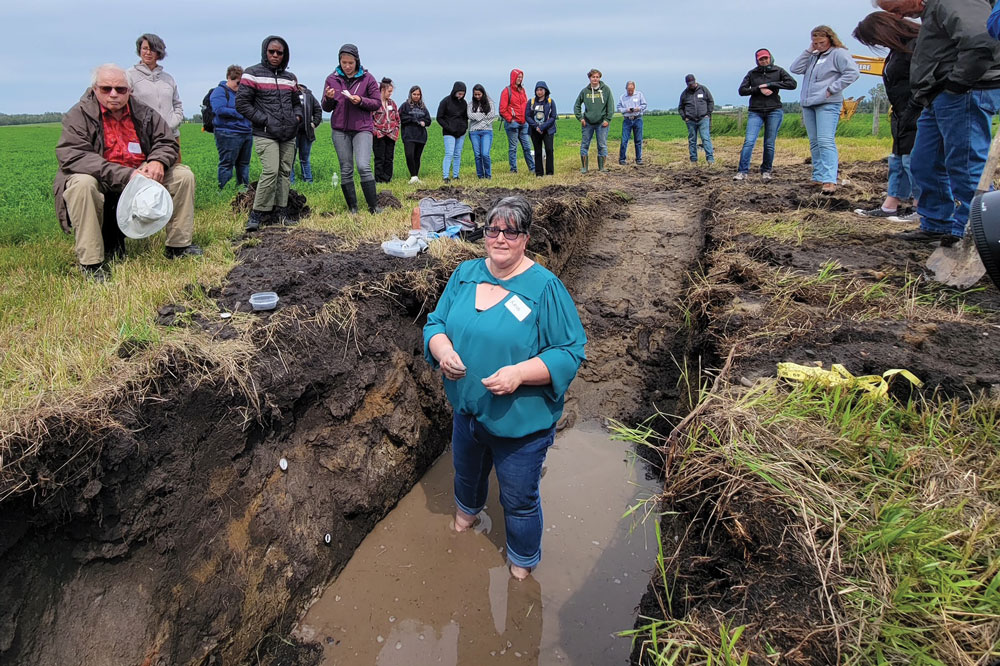
Kris Nichols
For instance, her Soil Regeneration Pyramid gives growers a step-by-step guide for building a resilient soil system that produces nutrient-dense food.
“Receiving this recognition really goes to show that I’m doing what I consider to be my job, which is being able to really help producers with their economic bottom line, while at the same time improving the overall system of agriculture and ability to continue to produce food,” she says.
In fact, Nichols credits growers for her contributions to no-till and the sustainable ag movement. After earning her doctorate in soil science and agronomy from University of Maryland, Nichols spent over a decade as a research microbiologist with the USDA in North Dakota. That role allowed her to work directly with farmers, who opened her eyes to seeing things beyond the typical researcher perspective.
“Having that relationship with the farmers and ranchers has really driven me to ask additional questions and try to find different answers than what I was taught in school,” she says. “I think the biggest thing in the no-till movement has been pushing researchers to do more on-farm research, more long-term research, and really asking different questions.”
Her work during this time was recognized by the Soil and Water Conservation Society, which honored her with the 2012 Conservation Research Award. Today, Nichols’ research focus is on better understanding how carbon moves through the system so farmers can build up their soils.
“We want to have more carbon and organic matter in our soils. How do we go about doing that?” she asks. “That’s one of my big drivers right now, is understanding more on how we can drive that carbon flow.”
Saddle Butte Ag
Saddle Butte Ag was founded in 2001 after Don Wirth traveled throughout the Midwest with the Oregon Ryegrass Commission and witnessed the soil health movement that was underway.
Recognizing that farmers needed not only a solid seed product, but the service and education to be successful with them, he brought on agronomist Ron Althoff to start the cover crop and forage seed company.
Saddle Butte Ag
Now 25 years later, the family-owned and operated company continues to meet that need and help farmers find success with conservation farming. Located in Oregon’s Willamette Valley, the “Grass Seed Capital of the World,” Saddle Butte Ag sells a variety of proprietary and common seed through its brands Bio Till and 360 Forage.
In reflecting on Saddle Butte Ag’s contribution to the cover crop movement, T.J. Kartes, a Minnesota-based sales rep for the company, says 2 products stand out: Bounty Annual Ryegrass and their proprietary brassica, Bayou Kale.
Bayou Kale is a forage brassica ideal for rotational grazing due to its excellent regrowth, is significantly more winter hardy than radishes and helps with erosion control, while Bounty Annual Ryegrass is non-allelopathic to corn and increases water infiltration by breaking up soil compaction physically and chemically.
Research conducted by the late Univ. of Illinois Extension educator Mike Plumer found that when grown with rapeseed, it significantly reduced soybean cyst nematode populations.
Today, the company continues to follow Wirth and Althoff’s vision of finding varieties and hybrids that are the right fit for the Midwest.
“We’re always looking to the future, but we keep our lineup very solid and try not to vary from it often…”
They’re currently working on developing a new diploid ryegrass that is stronger for overwintering, a dwarf cereal rye that growers will be able to control if they run into a wet spring, as well as some overwintering brassicas and legumes.
“We always look to the future, but we keep our lineup very solid and try not to vary from it often,” Kartes says.
The company’s vision is now guided by President Kate Hartnell, who Kartes describes as open-thinking and innovative, noting that she also puts a lot of trust in the team. “She really lets us go out and do things in our region,” he says. “She’s a great president.”
Saddle Butte Ag recognizes that delivering a good product is only the first step in helping farmers succeed. They’ve made it a priority to provide excellent service and education to their farmers, because they know if they have a bad experience, they’re not going to want to try it again.
“We want to be leaders in conservation to show this is a systematic approach,” Kartes says. “The cover crops that we sell are a major part of it, but it’s an entire system of what you’re changing on the landscape.”
That requires working closely with the growers so that not only does Saddle Butte Ag understand their needs, but the growers also understand what they need to do.
Kartes credits this focus on service and education to the team’s own farm background.
All of the representatives either grew up on a farm or are still farming. Wirth’s daughter and son-in-law, Lisa and David Goracke, run the company’s seed farm, and Hartnell also farms with her husband.
“We’re a very grassroot, farmer-oriented type of business,” he says. “We all have the same passion. We want to see a farmer succeed. We want to see a dealer succeed. I think that’s what really drives all of us to keep what Don and Ron started going forward.”
To be recognized for their service and contribution to the regenerative ag movement with the No-Till Innovator Award is a huge honor to the company, Kartes adds.
“Getting an award like this is a really great tribute to Don and Ron, for what they’ve built and how we’ve carried it on as employees going forward,” he says.