With no-till as a practice having been around for 60 years now, and No-Till Farmer for 50, we wanted to find out if we had readers who have been using the practice consistently for that long.
So in the summer of 2021, we emailed our readers to find out how many — if any — have been no-tilling since the early 1970s. We were pleasantly surprised to get a small handful of responses and ended up following up with four of them.
In the following pages, we share details of the operations of Jim Eshelman (New Enterprise, Pa)., Bill Drury (Clarion, Iowa), Andy Hawley (Stockton, Ill.) and Don Wirth (Tangent, Ore.), including what got them no-tilling in the first place, what’s changed over the years and the challenges they want to tackle in the coming years.
The No-Till Way: Doing More with Less
When passing a farming operation from one generation to the next, the continuation of no-till practices is hardly a guarantee. But a proven track record of needing less labor and equipment to produce improved yields was a great foundation for an expanded no-till system.
By Jim Eshelman As interviewed by Martha Mintz
MY SON-IN-LAW, Rick Bowman, and his brother, Chris Bowman, are the third generation to no-till the fields of our hilly and stony farm ground in south-central Pennsylvania. And they’re lucky for that legacy in my opinion. When my father and I farmed together in the 1960s, it was a lot more work.
Before no-till, we’d plow, disc the field twice and then pick the rocks we dug up in the process. Going no-till in 1972 did away with all that work, which was good because it was just me and Dad at the time and he wasn’t in great health.
Even when he was in top shape, though, he always willing to do a job with less work. When I brought up the idea of no-till after reading about it, he wanted to give it a try.
Check The Specs...
NAME: Jim Eshelman (retired farmer, ag sales now)
FARM: Bowman Brothers
LOCATION: New Enterprise, Pa.
YEARS NO-TILLING: 50
ACRES: 460
CROPS: Corn grain, corn silage and alfalfa/orchard grass
It started with no-tilling alfalfa fields in 1970 using a Tye 3-point hitch no-till drill. We were in a rotation of 3 years of alfalfa then 3 years corn. Two years later we no-tilled a field of corn using a neighbor’s Allis-Chalmers corn planter after taking the first cutting of haylage off. It went well so we got brave and no-tilled everything in 1973. We haven’t tilled anything since.
We went along fine for a few years, then following corn silage harvest I drilled my first cereal rye cover crop using a Haybuster no-till drill I purchased together with my two neighbors. The cover came on good. I harvested it for forage to feed my dairy heifers. I then no-tilled corn into those fields.
NO-TILL TAKEAWAYS
- No-till, cover crops, well-adjusted equipment and aligned goals keep no-till a lasting legacy.
- In challenging environments, no-till alone isn’t enough. Cover crops and creative planting help hold soil in place.
- Admit to your mistakes. If you buy a piece of equipment that doesn’t work out, don’t continue to run it just because you spent money on it.
- The nutrient and soil health value of leaving straw in the field is worth far more than what selling a bale might bring.
On July 20 we got 2 inches of rain overnight. Then, it turned out to be very dry the rest of the corn growing season. The fields I no-tilled into killed sod fields did not hold that rain as well as the rye stubble and roots did. The corn planted into the cereal rye cover was the best on my farm that year. The ground mellowed by the cereal rye and covered by the stubble and the rye roots had absorbed a significant amount of that moisture and held it in place for the plants.
I never quit using cover crops. I now work for a company that sells cover crops and understand the soil health benefits and why we need to keep a living root in the soil all year round.
My son-in-law has improved on the system my father and I started and now raises multi-species cover crop mixes. Soils are extremely mellow and thriving. They no longer have issues with penetration when planting into hard soils like I used to.
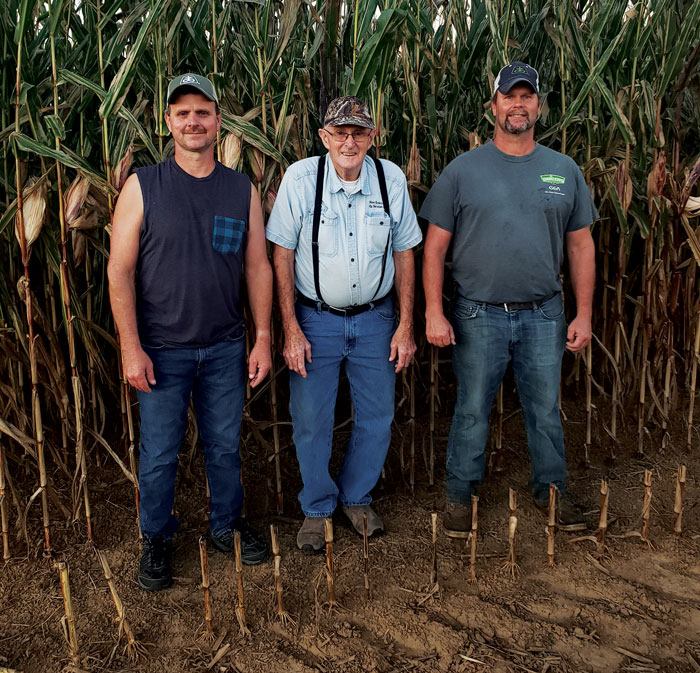
NO-TILL BENEFITS. When Jim Eshelman (center) passed his farm on to son-in-law Chris Bowman (left) and Rick Bowman (right), the young brothers saw that no-till required less equipment, fuel, parts and labor.
In the early years of no-till I learned to spread liquid manure a day or two ahead of planting. The manure would seal the soil surface, collecting moisture that would normally have come to the surface and evaporate into the atmosphere to mellow the hard crust a bit ahead of the planter. It worked great to improve no-till penetration, but now is an unnecessary step thanks to years of no-till and cover crops.
In Line
When Rick and Chris came to rent my farm, I told them I’d like for them to continue using no-till. They said they would give it a try. When asked their thoughts today, they said, “It sounded OK. There was less equipment, fuel, parts and labor.”
Soil conditions on my farm were already set up for no-till and crops were better on my farm than on any other land they farmed, even after they converted those acres to no-till.
To ensure they were successful and wanted to keep it up, I helped with off-season maintenance on the John Deere 7000 conservation planter and Haybuster no-till drill. There’s not much to do with the drill besides replace discs, but for the corn planter, it’s essential to keep things in line. Literally.
“Never trust a piece of equipment without going over it…” – Jim Eshelman
To do this, I have a person hold a line string to the coulter at the front of the planter and run it back through to the press wheels. The coulter, Tru-Vee seed discs and press wheel should all align, or we adjust them to the string. Especially with our hills, if that alignment gets off to the side it won’t close the seed slot and then you get poor stands.
They’ve since purchased a 6-row John Deere 1750 MaxEmerge corn planter with frame-mounted coulters and trash wheels.
It may be new, but I never trust a piece of equipment without going over it. What I do trust is Rick and Chris will continue farming in a way that’s good for their families economically and good for the soil for future generations. In the 22 years they’ve been running the farm now they’ve learned to get in the field when conditions are right, not when the neighbors are out.
They’ve utilized NRCS cover crop programs to further improve soil structure. Their corn yields are in excess of 200 bushels, which is very good for the area, and I don’t think the idea of plowing has every really entered their minds. My goal was to pass the farm to the next generation in better shape than I got it and I think they’ll do the same. I qualify that as a success.
No-Tilling at an Intersection Creates Convincing Comparison
An obvious visual difference between two tillage practices gave this no-tiller ample motivation to reduce soil disturbance and increase the presence of living roots.
By Bill Drury As interviewed by Martha Mintz
WHAT I LOVE about farming at the intersection of Iowa Highway 3 and U.S. Highway 69 is everyone stops there. If they’re looking, they can see a direct comparison of no-till and conventional tillage. Some years there’s a lot to observe, like this year.
Dry weather and fields with sandy pockets made for a challenging year. Years of no-till and cereal rye cover crops that helps hold more moisture meant my soybean fields survived. Unfortunately, conventionally farmed corn across the road saw losses on hill tops and in sandy pockets this year.
Check The Specs...
NAME: Bill Drury
LOCATION:Clarion, Iowa
YEARS NO-TILLING: 57
ACRES: 320
CROPS: Corn and soybeans
Spring brings more sights. Rocks dug up by pass after pass of tillage ahead of planting have to be rolled back into the earth. I can hear the thunk, thunk, thunking even in my soundproof tractor cab from across the road. I don’t have to roll rocks, and I pick far fewer rocks because I don’t till. I also don’t get stuck. I’ve seen more than one big piece of equipment rescued by the wrecker out of those fields.
In addition, my fields don’t erode. In fact, I’m gaining soil. Twice in the last 30 years I’ve received 200 truckloads of topsoil from ditches filled with sediment from conventionally farmed fields. When the county cleans the ditches, the soil is dumped in a small ravine next to my barn. I’ve gained about an acre of land off other peoples’ fields.
Nearly nothing comes off my fields. Raising crops with no erosion is my goal in life. It’s not an easy goal to meet. We’re just ½ mile from the Iowa River with slopes of 2-12%. Six terraces and eight waterways help, but the biggest success in stopping erosion — both wind and water — has been no-till and cover crops.
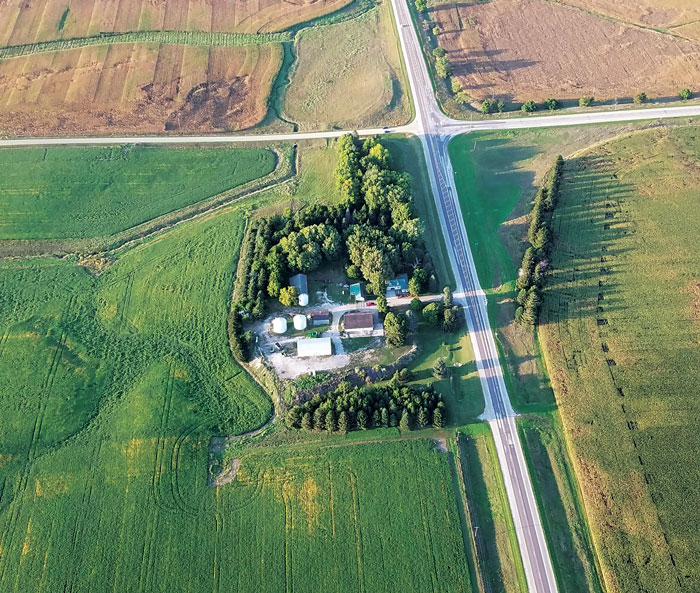
BOLD COMPARISON. Bill Drury’s soybeans planted into living cover crop in the spring are green in late September 2021 and starting to turn and the corn across the road that was planted into terminated cereal rye is still a bit green. The gravel road is the northern boundary of his farm. Corn and soybeans across that border are dead all the way to the Iowa River.
No-Till Legacy
No-till is really all I’ve ever known. My Grandfather and dad farmed together. In the early 1960s, they were looking to reduce time in the field, so my grandfather encouraged dad to investigate the Buffalo no-till planter a neighbor was using. In 1964, they bought their own four-row, 40-inch three-point mounted Buffalo no-till planter.
I was in grade school then. They would close school in the spring due to windstorms causing blackouts from soil blowing off bean stubble disced in fall. There was no dirt blowing off our farm, but water erosion was still a challenge, as were things like quackgrass in the waterways in those early days.
We had to compromise. One year we moldboard plowed to try and control the quackgrass. Then we tried a chisel plow with a disc. When Roundup finally came out it was our savior. Fall applications cleaned it up and we were able to cut out tilling. I don’t feel bad about having to till when options are limited. You have to do what you have to do with what you have to work with.
My spin
I was a soybean researcher, a loan officer and a farm manager for a bank. I know science and I know economics. For me, no-till is the obvious choice and I have way more tools than my dad and grandfather did to make it work. I hate driving a tractor. That’s the banker in me. Every minute I spend in the tractor is wear and tear on the equipment. Every set of tires costs money. And my time isn’t free, either.
That doesn’t mean I won’t make an extra pass in the field if it’s warranted. On my steepest fields I often plant a half rate of soybeans east to west, then plant the balance of the rate north to south. This really helps control water erosion by not creating defined furrows for the water to follow.
“For me, no-till is the obvious choice and I have way more tools than my dad and grandfather did to make it work…” – Bill Drury
I’ve experimented with ridge-till and deep ripping over the years, but I always return to no-till. I currently plant everything with my eight-row, 30-inch, three-point hitch John Deere 7100 planter. An experiment that’s staying is cover crops. I have 45 pounds of cereal rye or 45 pounds of a cereal rye/oats mix aerially broadcast on every acre every fall when possible.
One year I didn’t put any nitrogen (N) on in the fall where I broadcast cereal rye ahead of corn. Stalk nitrate tests in my corn the next fall showed levels of 800-900 ppm of N where the cereal rye cover had been. Corn growing where there wasn’t a cover crop clocked in at 200-250 ppm. There was a lower number where I had applied N as usual but didn’t plant cereal rye.
At harvest, there was a 20-bushel yield advantage where I had cover crops. I think the cereal rye retains N in the root and makes it available as the corn roots grow down to where it was stored. It may not be scientific, but you bet your life I now seed cereal rye on every acre going into corn.
Other things I’ve changed is increasing the buffer strips along the creek from the 20-foot ones my dad installed to 33-foot strips with the help of the NRCS. I also installed tile with a saturated buffer strip along the border strip engineered by Iowa Soybean — funded 75% by the Iowa Department of Agriculture and Land Stewardship and 25% by Smithfield — to filter tile water before the tile outlet to the creek.
Through my work in farm management for banks and my own farm, I’ve helped convert a lot of acres of Iowa to no-till and other conservation practices. There’s still plenty of farmers who don’t, but I’m glad it’s what I was brought up with. Even though I experimented with tillage and did what I had to do to make things work on my farm, I know less tillage and more living roots is the right direction.
Creating a No-Till Legacy After a Brief Rebellion
New management practices after a generational change left an established no-till operation with muddy wet spots in the field. But a return to tried-and-true methods restored soil functionality and paved the way for adopting more innovative practices.
By Andy Hawley | As interviewed by Martha Mintz
WE BOUGHT A subsoil ripper. It was an “I told you so!” waiting to happen for our no-till early adopter dad, Ed. In the 1980s my brother, Mark, and I came back to work the farm in partnership. We were young and thought we needed to do something different.
Encouraged by equipment dealers, we bought into the concept that our no-till soils were hard and needed loosening with tillage. We spent 2 years deep ripping the whole farm, damaging 20 years of no-till soil structure.
Check The Specs...
NAME: Andy and Mark Hawley and families
LOCATION: Stockton, Ill.
YEARS NO-TILLING: 53
ACRES: 830
CROPS: Corn, soybeans, alfalfa and cereal rye (for seed and as cover)
Deep ripping took high horsepower, lots of fuel and extra passes. There wasn’t much surface disturbance, but we fractured soil structure 12-15 inches deep. The result: fields that were never wet in the past suddenly had wet spots. Mud went right to the depth we plowed. After a couple years we admitted we were wrong. We returned to the family’s long-term, pure no-till tradition. And for much the same reasons.
“It just seemed to require too much work and expense to grow corn with conventional tillage. You can buy more machinery and more chemicals, but you can’t put more days on the calendar,” is what dad said when he was interviewed for the very first issue of No-Till Farmer in 1972.
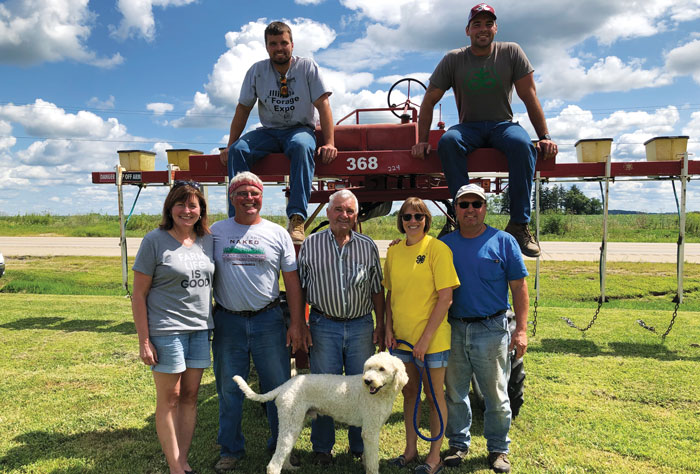
PUSHING FORWARD. After an experiment with bucking no-till tradition, the Hawleys are now fully committed, even building this custom cover crop interseeder. Top (L-R) Steve and Bob, front Leslie, Andy, Ed, Terese and Mark.
Old Faithful
As of today, we’ve parked all tillage equipment and focus on pushing the family legacy of no-till and cover crops even further. Cereal rye has long been part of our rotation. Dad introduced cover crops to the farm in 1973, using them to protect acres harvested for silage for the dairy back then and our cattle feeding operation today.
Besides erosion control, a cover crop can serve as extra forage when we’re able to graze it. Cereal rye was our main cover crop for years. It was inexpensive, we could grow it ourselves and it was dependable. It was just plain easy. You can throw cereal rye on cement and if it gets a sprinkle of rain it will sprout.
We’ve since discovered we can get added benefits such as fixing nitrogen (N) and getting more root diversity and higher quality grazing by planting a mix of cereal rye, Austrian winter peas and hairy vetch where we chop corn silage. This year there was moisture in the ground and the days were warm, so the cover crop was up going in just 3 days. Cover crops deliver what we like to call “slow-till.” Roots are doing our tillage, breaking up any compaction and creating paths for water, air and crop roots.
Interseeding is our current puzzle. Three years ago, we purchased a detasseling unit on a whim and modified it to broadcast cover crop seed in standing corn. Adding a few insecticide boxes and a gear box off a junk corn planter we were able to rig a system that uses drop tubes to broadcast cover crop seed under the crop canopy at V4-V5. The modified detasseler runs on narrow tires and seeds 12 rows. It has a small footprint and doesn’t run over much corn.
“Cover crops deliver what we like to call ‘slow-till’…” – Andy Hawley
We’re still refining the system. Part of the challenge is identifying cover crop varieties that will survive under the canopy. So far, rapeseed, kale and annual ryegrass do well. We’re still struggling to find a clover variety that will survive.
Our tried-and-true system is to drill cereal rye following soybeans, sometimes in a mix with hairy vetch and Austrian winter peas. When we no-till drill cover crops with our 30-foot 3010 Great Plains no-till drill, we’ve found the drill roughs up the soil just a bit. This creates some crevices and places for the manure we then broadcast to work itself into the soil. The growing cover crops sequester nutrients from the manure, too.
In spring, corn is planted into the green cover crop with our Kinze no-till box planter. The cover crop is terminated with glyphosate when cereal rye is 8-10 inches tall and the corn has two leaves. Up to that point, cereal rye is using its energy to putting roots in the soil. First joint is when it switches to reproductive mode and really starts growing above ground. We want to kill it just before it makes that switch, when it’s still tender and leafy. The top growth disintegrates, but the roots are still in the soil.
Soybeans are also drilled into living covers. We used to terminate the cereal rye the same as in our corn. Last year we let it go to head in our dicamba soybeans then terminated it with dicamba and glyphosate. It killed the 4-foot-tall rye dead. The soybeans were taller, but yielded the same. However, we got better weed suppression and a nice mat to trap moisture.
Another thing we learned was to keep things simple. Our corn planter has no trash wheels. There are more trash wheels hanging on shop walls than on corn planters as people search for the perfect option. We just do without them to avoid that trap.
Hopefully we can avoid more traps in the future, too. My father is 90 years old and still on the farm. His decision to go no-till when it was very new in the late 1960s has continued to be a benefit to us. It’s improved soil structure, soil organic matter and made our operation more economical. He set us up to thrive.
My wife, Leslie, and I; our sons Steve and Bob and his wife, Amy; my brother Mark and Terese all farm together now, carrying on what my dad and mother, Ed and Florence, started all those years ago.
Strengthening No-Till Soil Biology to Fight Disease, Reduce Inputs
With an eye on how carbon and biological activity impact plant health, cover crop seed pioneer Don Wirth’s experimental ways are helping him leave the land better than it was when he started farming it.
By Don Wirth As interviewed by Martha Mintz
DISEASE AND REGULATION led to very early widespread adoption of no-till practices in Oregon’s Willamette Valley, the “Grass Seed Capital of the World.”
Blind Seed disease became a huge problem in the late 1940s. Back then we were growing seed for forage. The solution was to burn annual ryegrass fields after harvest and then scratch back into them with a John Deere grassland drill. It worked perfectly. It would scratch a shallow trench and plant annual ryegrass.
We all did that for about 35 years, which was a great start to no-till even if we were destroying the residue. Then in 1969 we had a very dry year and the government put a moratorium on field burning for ten days. We saw the writing on the wall that the practice would be outlawed, so we had to come up with other strategies. It was eventually limited in 1991 and later banned.
Check The Specs...
NAME: Don Wirth
BUSINESS: Saddle Butte Ag
LOCATION: Tangent, Ore.
YEARS NO-TILLING: 52
ACRES: 3,000+
CROPS: 15 grass, forage and cover crop seed species
This was about when my wife, Maryanne, and I took over the farm. We did our best to work with the residue to keep it on the farm. One thing we use is flail choppers to chop straw and get residue fairly tight to the ground. That makes it easier to get through with the no-till drill and helps with the slug issues we have every year. Dealing with residue hasn’t been too bad as the bulk of the crops we produce only need to get the seed just deep enough to be covered.
Many farmers, however, deal with residue by baling and selling straw. Around 600,000 tons of straw are exported from Oregon every year. Not from our farm. We learned to work with the residue in no-till for good reason. They get paid $35 per ton for the straw, but by my calculations there is $50-75 of nitrogen (N), phosphorous (P) and potassium (K) per ton in that straw.
Besides N, P and K, there’s also the carbon that helps build soil health. Our biologically active soils have allowed us to reduce fungicide use by at least 30%. We have no reservations planting naked seed if needed. But few realize what the carbon and biological activity are worth to plant health.
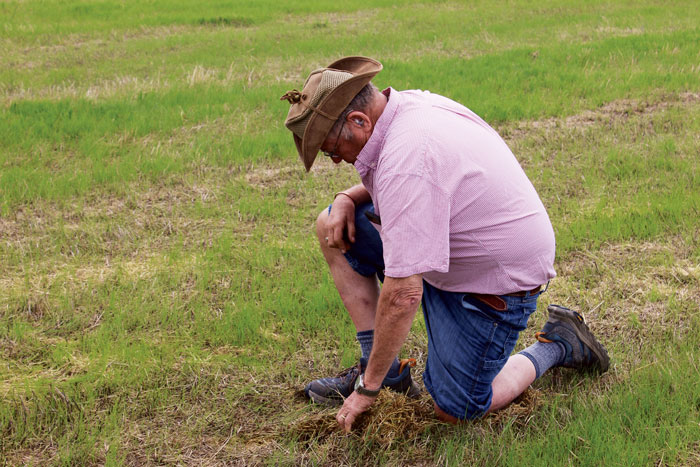
BOUNTIFUL HARVEST. In Oregon’s Willamette Valley, Don Wirth examines his 2021 Bounty annual ryegrass seed field. There have been five harvests since it was seeded, and it will be no-tilled this fall to meadowfoam for next year’s harvest. It will be no tilled to Bounty again next fall.
A prime example is the disease “Wheat Take-All.” It attacks the roots and crown of wheat and can destroy yields. In the early 1980s, if there was quackgrass in our wheat fields at all, the next several years we would have bad Take-All. As our soil biology strengthened, it was able to consume the fungus and now we never see Take-All.
Soil structure has also improved. We installed tile drainage in the 1980s. The tile drains fields better every year, even 40+ years later, as soil structure rebuilds and water more easily moves through the soil.
It’s also exciting what we see on other people’s farms. We initially grew grass seed for forage and turf, now we grow more than 15 species of grass, forage and cover crops for our seed company, Saddle Butte Ag.
I helped develop the use of annual ryegrass as a cover crop in the Midwest through trials and outreach. It’s amazing. We’ve gone from people laughing at us about cover crops to increasingly more widespread adoption. The annual ryegrass market went from nothing to at least 10 million pounds in the Midwest.
“Our biologically active soils have allowed us to reduce fungicide use by at least 30%…” – Don Wirth
Weed control is something that excites me about cover crops in our fields and others we follow across the nation. The late Mike Plumer did cover crop trials for us and reported that every place he used cover crops there was no marestail. It’s the same with annual bluegrass here, which prefers to grow on a bare soil surface. With straw or cover crop residue, it reduces the density of those weeds to almost nothing.
We should be able to take something from the soil and leave it as good or better than when we started. That’s my idea about farming and has been my challenge since the 1960s.
I’m constantly trying new things and my brain never shuts off. I’ve tried plenty of things that don’t work, but that’s not good enough for me. I look at it and want to figure out why it didn’t work. My experimenting is so constant neighbors and friends like to tease me, “What the heck are you going to try this fall?” I just see so much opportunity.
That’s what drives me. It makes farming fun. Some things have worked, some things haven’t. Now we have a seed company and grandkids coming along that are interested in the business and have inquiring minds themselves. Who knows what they’ll come up with.
The 2024 No-Till History Series is supported by Calmer Corn Heads. For more historical content, including video and multimedia, visit No-TillFarmer.com/HistorySeries.