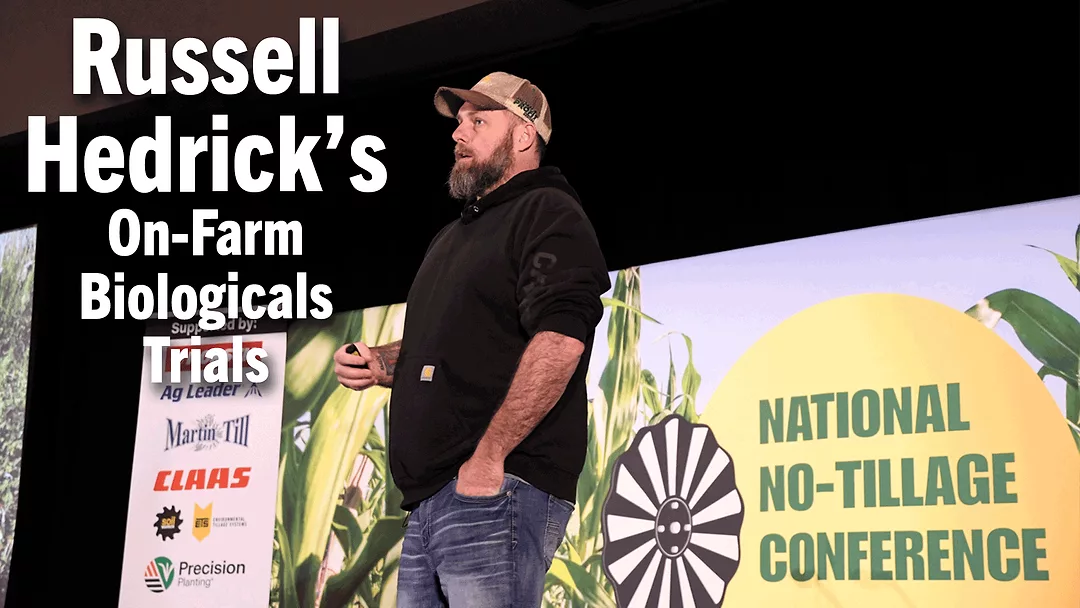
From one Leopold winner to another now, Russell Hedrick is always an open book when it comes to sharing the keys to his success. On-farm trials are a must for the Hickory, N.C., no-tiller, especially when it comes to biologicals.
“We're talking about some of the trials we did on our farm. This is the way we set it up where we do check strips. So, we had a check strip, Pivot Bio with the 40 units of nitrogen minus the 40. We had Holganix. There's a product out there called Fish Shit. You can't say that on TV, we learned. All right, you all are still with me. There's Ensoil Algae and then we had another check strip and then Concept Agrotech had a product called Soil Revive. But this is how we figure out what we do on our farm. Don't get me wrong, there's a lot of trial data out there. There's a lot of good information, but if you're not setting something up like this, you're missing a lot of good information. But essentially, did it make bushels or lose bushels and what was our net return? That's how we decide what we move to the farm the next year when it comes to biologicals.”
“How many of you in here use biological products? How many of you test them before you put them on your farm? That's way more than I thought it was going to be. So, one of the things we do with Rhize Bio is we send our soil, our seed, and our biological product. We just sent them some and they're going to run it here in the month of January. But if we're going to try a new biological product, they'll actually test it in our environment with our seed and we'll know, ‘Is there a chance for a positive return before we actually buy it in bulk and get it to the farm?’”
“This stuff is not cheap. We're going to spend thousands of dollars a year on a biological product. Why wouldn't we spend 200 bucks and test it in the laboratory before we get it to the farm? Some of the stuff that we're seeing, so polymer degradation, that's for residue breakdown, phosphorus release, nitrogen cycling. There's a lot of good management decisions that we get from this testing for 200 bucks.”
Hedrick set the dryland corn yield record with 459 bushels per acre in 2022.
Watch the full version of this episode of Conservation Ag Update.