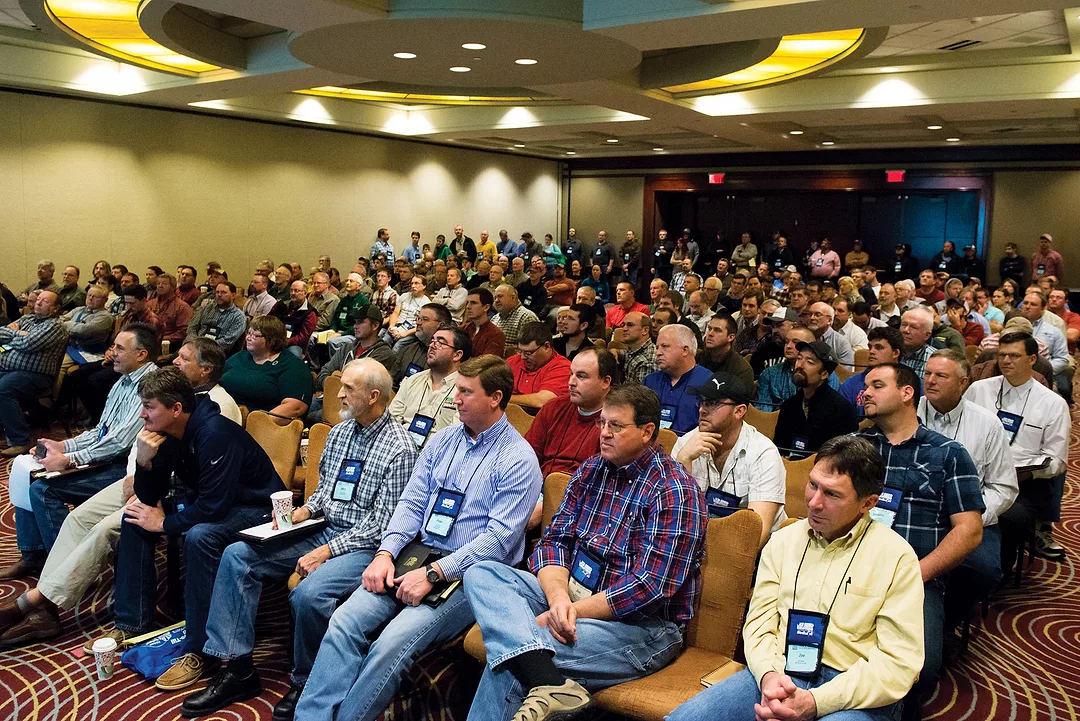
Whether your focus is on traditional no-till challenges or learning more about cutting-edge technology and practices, the upcoming National No-Tillage Conference has opportunities for every grower.
The 34th annual event in St. Louis features more than two-dozen speakers who will hit on major themes of interest to no-tillers everywhere, including soil health, residue management, precision technology, livestock integration and more.
If you’re looking to boost your farm’s performance in a specific area, check out the “tracks” below that offer a diverse learning experience at NNTC, Jan. 6-9 in St. Louis, Mo. Interested in attending? Also, tell them I sent you! Use the promo code JOHN to get a whopping 25% off your registration fee. Hope to see you next month in St. Louis!
Track 1: Attacking Everyday No-Till Challenges
Ideal Planter & Drill Setups
Workshop #1 (Tuesday): Bill Lehmkuhl, owner of Precision Agri-Services, discusses reviews the consequences for not maintaining your planter correctly and how to avoid those problems. And Phil Needham, owner of Needham Ag Technologies, covers discusses what to look for when buying a new or used drill, and how to set up, calibrate and ballast drills for best performance.
Steps for Boosting Yields
Classroom #1: Alpha, Ill., no-tiller and independent on-farm researcher Marion Calmer explores shares his agronomic observations on early soybean planting, short-stature corn, ideal fertilizer placement, corn root architecture and much more.
Managing Residue Issues
Classroom #2: Planting and seeding expert Phil Needham emphasizes the importance of spreading residue as evenly as possible with the combine, and will also share methods available to optimize the spread.
Dealing with Compaction
Frank Lessiter Legacy Lecture Series: Ken Brodbeck, an ag tire engineer, dives into new tire technology, including central tire inflation systems, and he shares decades worth of data showing how tire pressure affects soil health, yield and fuel economy.
Most Often, Less is More
Classroom #14: Cambridge, Ill., no-tiller Monte Bottens unpacks the concept of “Principles-First Farming,” evaluating practices through 5 soil health principles to reduce 5 common excesses.
Tuning Up for Harvest
General Session (Thursday): Calmer discusses how to tackle the challenges of harvesting high-yielding no-till corn, soybeans and wheat at high speeds and shares simple ways to eliminate pesky green pods and chaff in the grain tank during soybean harvest.
ROUNDTABLES
#12 (Wednesday) Teachable Moments from No-Till Failures
#15 (Thursday) Getting the Most Bang for Your Buck with Nitrogen
Track #2: The ROI on Biologicals, Soil Health and Regenerative Agriculture
Deep Dive on Carbon Flow
Workshop #2 (Tuesday): 2025 No-Till Innovator Award Winner Kris Nichols, a world-renowned soil microbiologist and founder of KRIS Systems (Knowledge for Regeneration and Innovation in Soils), provides a deep dive into using carbon flow as an approach for regenerative farming.
Soil Health ROI
General Session (Wednesday): Wayne Honeycutt, founding president and CEO of the Soil Health Institute (SHI), shares SHI’s latest data on the economic impacts of no-till and takes a big picture look at how healthy soils can reduce inputs, increase profits and build resilience to extreme weather.
Data Points for Profitability
General Session (Wednesday): Jonathan Lundgren, president of Ecdysis Foundation and Blue Dasher Farms, analyzes hard data from more than 1,000 farms across the country as he explores the expected outcomes from regenerative ag in fighting climate change, reversing desertification, increasing plant nutrition and earning more money.
Integrating Biologicals
Harry Young Memorial Lecture (Thursday): Pam Marrone, executive chair and co-founder of Invasive Species Corp. and a renowned researcher and entrepreneur, shares what’s driving the growth of biologicals in the industry; potential regulations coming down the pike; new technologies and products on the horizon, and how no-tillers can integrate biologicals on their farm based on their modes of action.
The Good and Bad with Bios
Classroom #12: Marrone helps no-tillers understand how to evaluate the voluminous numbers of biologicals coming online and determine which ones will best fit their needs. Learn how to spot the winners and losers with the products and boost your chance of succeeding with them on your farm.
Executing on Soil Health
General Session (Thursday): Austin, Minn., no-tiller and Leopold Conservation Award winner Tom Cotter, a regenerative farmer who runs 14 cash crops in rotation with cover crops and grazing on every acre, shares practical strategies from a working farm on executing the soil health principles, including the wins and failures to learn from.
ROUNDTABLES
#7 (Wednesday) Key Takeaways from Using Biologicals
#11 (Wednesday) Making Sense of Carbon Programs & Tax Credits
Track #3: Getting the Most from Cover Crops
What’s New in the World of Covers
General Session (Friday): Rob Myers, a top authority on cover crops and director of the Center for Regenerative Agriculture at the Univ. of Missouri, provides a look at new cover crop varieties coming to market, and shares how virtual fencing, drones, robots and other technologies and policy trends will affect the future of cover crop practices.
The Lowdown on Interseeding
Classroom #5: Cotter shares how interseeding cover crops into standing cash crops “changes everything” with earlier establishment, longer growing windows and better soil coverage.
Cover Crop Research Insights
Classroom #8: Independent research agronomist Jim Stute reveals brand-new data from a multi-location SARE-funded project across southeastern Wisconsin, evaluating the overall corn and soybean yield response and net ROI of cereal rye.
Getting More from Your Cover Crop System
Classroom #16: T.J. Kartes and Brian Wieland, cover crop experts from Saddle Butte Ag — the 2025 No-Till Innovator Award winner in the Business & Service category — explore how strategic species mixes, interseeding techniques, drone-based applications and precise termination can strengthen no-till systems and boost long-term profitability.
ROUNDTABLES
#1 (Wednesday) Cover Crop Strategies, Successes & Challenges
#26 (Thursday) Seeding Cover Crops & Spraying with Drones
#38 (Friday) Teachable Moments from Cover Crop Failures
#40 (Friday) Moving Off the Starting Blocks with Interseeding Covers
Track #4: Improving Farm Profitability with Precision Technology, Innovative Equipment
Living on the Bleeding Edge with Tech
General Session (Wednesday): John Fulton, a professor for the Department of Food, Agriculture and Biological Engineering at Ohio State Univ., dives into breakthroughs in soil health evaluation, soil sensors, autonomy, artificial intelligence (AI) and more.
Boosting Success with Aerial Imagery
Classroom #11: Indiana no-tillers Brian Sutton and Mike Starkey share how to use advanced aerial imagery to build planting prescriptions for corn, soybeans and cover crops, and improve in-season N management and scouting.
Getting off the Starting Block with Strip-Till
Classroom #3: Dysart, Iowa, strip-tiller and no-tiller Pete Youngblut covers the basics of getting started with strip-till, including what to expect in the first year, the benefits of the practice and potential landmines to avoid.
Tool for Increasing Nutrient-Use Efficiency
Classroom #9: The no-till/strip-till father-son duo of Ray and Ryan Flickner will discuss their use of cutting-edge tools and technologies to increase water- and nutrient-use efficiency with precision technology and other key takeaways from the Flickner Innovation Farm.
ROUNDTABLES
#18 (Thursday) Biggest No-Till Equipment Paybacks
#21 (Thursday) Autonomy & AI: Does It Have a Place on Your Farm?
#35 (Friday) Biggest Precision Technology Paybacks
#36 (Friday) Getting Consistent Results with Variable Rate Fertility
Track #5: The Benefits of Livestock Integration and Cutting-Edge Dairy Management
What's to Gain from Adding Livestock?
Classroom #15: Michael Thompson, a former NNTC Most Outstanding Speaker and No-Till Farmer’s Conservation Ag Operator Fellow for 2025, shares the advantages he’s realized through integrating livestock on his farm operation to turn weaker crop acreage into beef, as well as drag-lining hog manure and using compost extract made on his farm to build soil fertility.
Award-Winning Dairy Practices for Soil Health
Classroom #13: Alex Udermann of Meadowbrook Farm in Sartell, Minn., this year’s No-Till Innovator Award winner in Crop Production, shares how his family implements a variety of conservation practices to conserve soil, water and biodiversity in their conservation award-winning dairy operation. This includes no-till, cover crops, buffer strips and wetland restoration, sustainable manure management and precision fertigation.
Strategies for Increasing Forage Density
Classroom #18: Members of the Northeast Iowa Dairy and Agriculture Foundation — the 2025 No-Till Innovator of the Year in the Organization category — put their latest findings under the microscope for all to see as they explore how to increase highly digestible forage density per acre.
Livestock Fencing — It’s Not That Hard
Classroom #17: Kaitlyn Dozler, virtual fence program manager for the Univ. of Missouri, provides a crash course on virtual fencing technology, including how no-tillers are using it to integrate livestock in both cover crop and pasture systems.
ROUNDTABLE
#25 (Thursday) Ideas & Strategies for Integrating Livestock