Michael Thompson will be speaking at the upcoming 2026 National No-Tillage conference in our Conservation Ag Fellowship Capstone Lecture "No-Till Soil Building to Survive Tough Times." Learn more about this session and how you can save your seat next to fellow no-tillers.
Takeaways
-
Maintain adequate field residue to protect soil moisture
-
Build soils with a diverse approach that includes crops, livestock and manure
-
Increase soil carbon content for better water-holding capacity
Michael Thompson spent much of the summer anxiously watching his corn stress in the heat. July was hot and dry and the picture was bleak, with many days over 100 degrees F with a lot of wind.
“That was really the do-or-die time, when many folks lost much of their corn crop because the plants were already stressed going into the summer,” Thompson recalls.
Despite the localized severe drought on his northwestern Kansas operation, sporadic rain showers through late July and August were sufficient to make grain.
Thompson is No-Till Farmer’s 2025 Conservation Ag Operator Fellow, chosen because of his personal dedication to soil stewardship and no-till regenerative farm management. No-Till Farmer is following Thompson’s 2025 experience to learn more about his farm and management decisions.
Thompson Farm & Ranch covers nearly 4,000 acres near Almena, Kan., where flexible farm management decisions have provided consistently profitable years since the late 1990s for Thompson, his brother Brian and their father Richard.
By early September, Thompson’s anxiety had been replaced with optimism that his 2,000 acres of dryland corn would provide a harvest. He credited 25 years of no-tilling, along with soil-health-building contributions of his 200-head Angus-based cow herd, with helping avert disaster.
“On the hottest days when a lot of corn in our area was trying to die, our fields were trying to live…”
“During the summer when things really looked tough we’d get a very small shot in the arm of 0.25-0.30 inches just to keep us going,” he says. “Even on the hottest days when a lot of corn in our area was trying to die, our fields were trying to live. They were rolled tight, but they weren’t in a death spiral or losing leaves or yellowing.”
Thompson quipped that his yields won’t be anything to be excited about but expects to run a combine across all his corn acres.
“When we planted, I honestly thought we’d likely be putting this corn in a bale or grazing it, but there’s potential for 80-100 bushels of corn in some of our fields, while others likely will only yield 30-40,” he says. “But we made grain, and in our area this year that’s a win.”
Harvesting Moisture
The Thompsons say 20 inches of annual precipitation on their operation is a “good year,” but this year’s corn crop was made with under 11 inches of total precipitation from January until late August. Labor Day rains boosted the farm’s running total to 13 inches, which added green to native pastures and sparked new life into 500 acres of warm-season cover crops the family planted as “grazing drought insurance.”
The 500 acres of covers came out of what normally would have been soybean production, but Thompson says he always plans for drought, and the shift out of soybeans to cover crops was a “flexibility move” to hedge against what appeared to be an impending very dry summer.
“Another thing that helped us this year in our push for flexibility was splitting nitrogen applications rather than applying it all up front,” Thompson explains.
Neighboring operations that applied the full season’s nitrogen pre-plant saw a quick flush of growth after emergence, while Thompson’s fields languished in comparison.
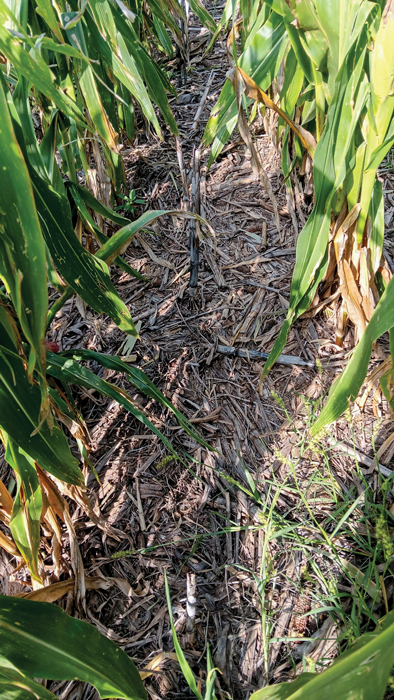
RESIDUE MULCH. No-tilling with adequate residue helped Michael Thompson’s dryland corn emerge and make grain on less than 10 inches of rain that had fallen since January. The thick ground cover helped with water infiltration and evaporation control providing 2-3 feet of available soil moisture at planting. Source: Michael Thompson
“The difference we’re seeing now is we have a harvestable crop, but some of those full-fertilizer fields that had the extra growth early on apparently used up much of the available soil moisture and then couldn’t turn it into grain,” he says.
“It’s not like anyone around here is going to see huge yields, but I think our conservative attitude at rationing inputs helped our crop grow in a more measured manner, conserving what moisture we had until showers came along to keep it growing.”
Thompson also believes years of crop rotations of corn, soybeans, small grains and cover crops helped improve the farm’s soil structure and water-holding capacity. And using cattle to graze post-harvest stalks and residue have added to soil biology and overall nutrient cycling across the farm.
In addition, the flexibility of having a livestock grazing component helps with residue management for no-tilling and provides a means to salvage crop failures and turn them into beef to capitalize what otherwise might be a total loss.
“By keeping our soils covered with residue and cover crops we get far better water infiltration from rainfall, and we prevent standing water in low spots. That evens out the highly-variable precipitation and gives us reasonably dependable amounts of soil moisture to plan around,” he explains.
Reaching Deeper
At planting this year, soil moisture behind corn-on-corn was about 30 inches deep, and where he’d grown cereal rye and had a bit more residue in the field he could probe down to about 40 inches for roughly another foot of moisture.
“The biggest thing I learned this year walking the fields during those dry days is we’re not farming in a flowerpot anymore. An inch of moisture translates into yield and we’re farming much deeper today.”
When his family moved to no-till it seemed like there was only 18 inches of soil and that’s why drought was such a problem.
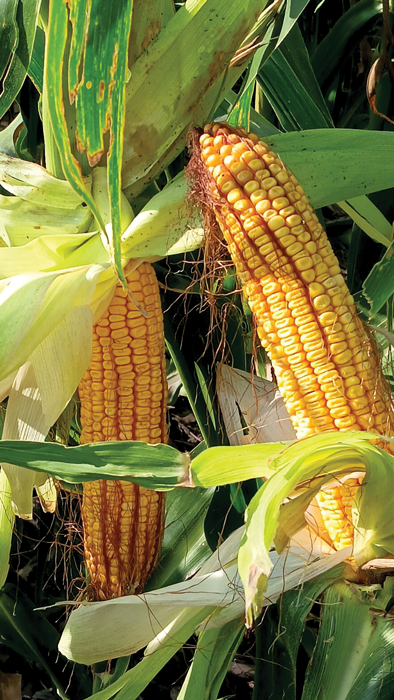
SEPTEMBER KERNELS. By mid-September Thompson’s corn was at dent stage, hinting at a pre-October harvest. Despite very dry conditions, the deep-rooted corn hung on through July and August with only sporadic light showers with no yellowing or browning of leaves. Source: Michael Thompson
“We also had lots of zinc striping, iron chlorosis, micronutrient deficiencies and sulfur problems. A lot of those problems existed because we didn’t have a robust root system for our crops. And we had no nutrient cycling,” Thompson says.
“My time in the field with a shovel has taught me once you begin to open up the soil profile to allow the roots to go down 2-5 feet, you have much more access to water and nutrients,” he explains, noting crop rotations, cover crops and eliminating compaction-causing tillage have enabled his crops access to much deeper resources.
By the end of July, Thomson thought there was no way his corn plants would hang on, but their strong root system and his historic primary goal of building his soils allowed them to reach deeper into the profile for adequate moisture and nutrients.
“The biggest thing I learned this year walking the fields during those dry days is we’re not farming in a flowerpot anymore…”
“In our immediate area we noticed the corn of folks who have been doing long-term crop rotations — whether it be through cover crops or just their general cropping management — managed to hang on and make grain throughout those horribly hot days of August,” he says. “Likely their soils are a little higher in organic matter and they have some nutrient cycling going, but their additional management seems to have paid off.”
Thompson expects to harvest corn by late September and he’s eager to see yield monitor results for a more accurate assessment of his dryland corn production under local conditions, which mirrored those experienced during the drought of 2011-12.
Cattle Component
While Thompson was eagerly watching the weather radar for a hint of rain much of the summer, he and his family were also busy moving cattle to fresh forage in the face of extremely dry weather.
Fearing a hot, dry season and potential lack of forage, the Thompsons sold all their heifers and steers in early April to capture the spring’s high sales receipts and reduce grazing requirements. Generally, the family retains some heifers for replacements and adds additional pounds to steers with summer grazing.
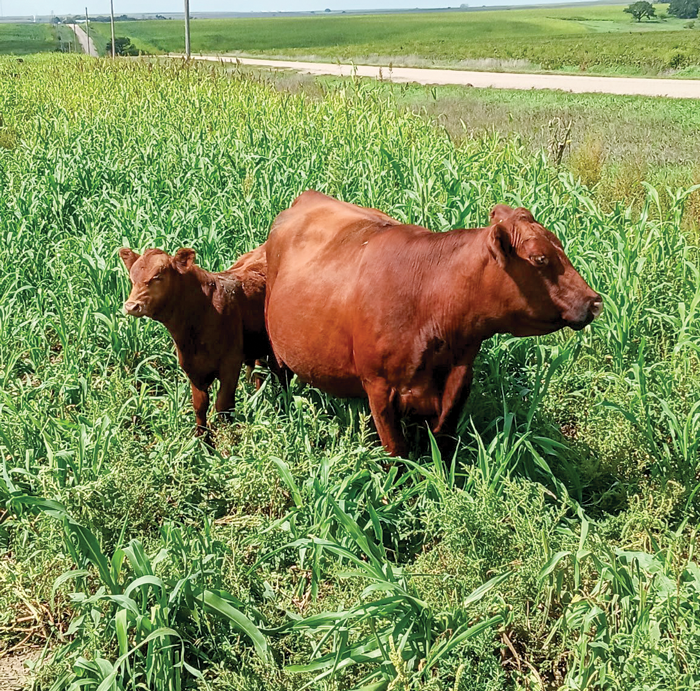
GAINS IN DROUGHT. The 200-head Angus-based commercial cow herd at Thompson Farm & Ranch provide the family with marketing and management flexibility as well as soil-building biology. Ten-day rotations on warm season perennials this year kept the cattle in good shape, and when Labor Day rains fell, they quickly began gaining weight on warm season covers shown here. Source: Michael Thompson
“We also split all of our cattle into an older and younger herd and planned to move them between larger pastures to ensure the grass had as much time as possible for growth in the dry conditions,” Thompson explains. “We had planned to further cull our older less-than-prime cows during the summer if necessary.”
That never happened. When the native pastures showed little regrowth because of the lack of rains, the Thompsons moved their herds between large paddocks of warm season perennial grasses every 10 days.
“That didn’t mean always trailering the herds,” Thompson explains. “Some of it was moving across the road to another pasture or moving them a mile or two down the road to fresh forage, but it did keep us moving all summer to keep them happy and satisfied.
“Because we’d sold the heifers and steers in the spring, our numbers were manageable, and we kept them all. After the early September rains they began putting on weight again and the cover crops which had been looking dire and were only knee-high are now as tall as me, so it looks a lot better.”
“Ultimately, efforts at improving diversity in your fields will help provide additional resiliency to whatever Mother Nature may throw at you…”
The fall rains rejuvenated some of the native pasture so both herds were back on grass temporarily before heading back to consume some of the tail-end of the warm-season cover crop pasture. Some of that growth was also destined to be baled as a winter forage hedge.
“We’ll graze most of the covers, leaving enough residue to catch rain and snow this fall and hopefully get our depleted subsoil moisture back,” he says.
While he says he never “wanted to be a cowboy,” Thompson sees the cow herds as a vital part of his “full flex” farm management toolbox.
“When combined with cover crops, having cattle rotate through our farmland grazing stalks and residue has helped build our soils, their organic matter content and water infiltration capacity,” he explains. “I understand that for every part carbon in the soil that carbon will hold 7 parts water, so livestock have been a big part of building our farm’s ability to store and hold moisture.”
Also, he says grazing cover crops helps trample residue into the soil, while the resulting manure and urine trigger nutrient cycling, a process that can reduce runoff, suppress weed growth, and helps sequester carbon — all results he has experienced.
“I’m not recommending having a mixed operation to everyone, but for us and those farther west where it becomes even more arid, I think the diversity cattle provide can be invaluable in less-than-ideal years. It’s just a different way of looking at things,” he says.
“If you have a severely limited crop you’ll still need to harvest it mechanically if you don’t have cattle. With machinery wear and tear and fuel costs the grain might not even pay for the harvest. Whereas, if you can graze those acres you can at least produce pounds of beef to save the cost of harvest and hopefully make the best of a bad situation,” he explains.
4th Annual Conservation Ag Operator Fellowship
No-Till Farmer’s annual Conservation Ag Operator Fellowship program follows a selected no-till farmer throughout the year and shares the real-time decision-making processes and solutions needed to make no-till and conservation ag practices work in real-world conditions.
The 2025 fellowship program features Michael Thompson from Almena, Kan. No-Till Farmer’s editors and industry advisors selected Thompson because of his extensive use of cover crops, animal agriculture and 25-years of no-till experience to regenerate an unprofitable farm into an expanding and weather-resilient dryland operation featuring corn and soybean production and flexible use of a 200-head Angus-based commercial cow herd.
Follow Thompson throughout the year with feature stories in each edition of Conservation Tillage Guide, an online multimedia series and question forum, and a capstone presentation at the 34th Annual National No-Tillage Conference in St. Louis, Mo., Jan. 6-9, 2026.
He adds diversity can come in many forms and it doesn’t have to rely on managing cattle.
“For us the cattle provide the diversity, but for others like us in the High Plains it may come in the form of hog or feedlot manure and compost. Still others may need to look at specialty crops or incorporating legumes into the rotation. Ultimately, efforts at improving diversity in your fields will help provide additional resiliency to whatever Mother Nature may throw at you,” he says.
Biological Help
Always on a quest to learn, Thompson carried through on his plans to field test some biological products despite the drought and even plans to extend some of those tests to actual renovation of compacted field traffic patterns and turnrows.
An experimenter with commercial and home-brew vermicompost extracts, Thompson used an Aerway aerator equipped with saddle tanks and drip tubes to apply worm casting solution to a spent alfalfa stand in the indentions left by the machine’s rotating shanks.
“We had lots of vermin mounds and badger holes out there, so I figured we’d use the Aerway to do some leveling and I’d kick-start some biology at the same time by dripping the worm waste solution,” he explains. “It’s just a field experiment to see what will happen, but I was intrigued with the process so I’m going to use the same method to renovate some compacted headlands and traffic patterns where we drive during harvest.”
He’s keeping records on his own mixture vs. a similar commercial product to check for differences in performance.
Thompson’s recipe included 250 pounds of vermicompost in 1,000 gallons of water for a 10-gallon-per-acre rate through the Aerway. A neighbor took a similar recipe and sprayed 20 gallons per acre over the top of a waist-high warm-season cover crop, which was planted behind wheat harvest.
“We’re going to run some soil samples on both plots to see if it made any difference in the soil,” he added.
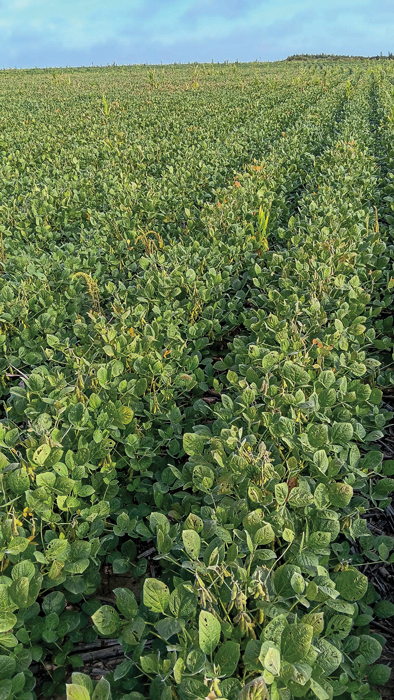
PROMISING SOYBEANS. While the Thompsons severely curtailed their soybean acres this year in favor of warm season cover crops for more haying and grazing, the acres they planted to beans also seemed to weather the drought well. After a summer of anxiety Thompson was eagerly awaiting yield results on the soybean crop. Source: Michael Thompson
Other biologicals Thompson used this year on strips in his corn field were yucca and kelp extracts, both in-furrow products billed as having positive effects for crop drought resistance.
“I’ll have to wait until we run the combine, but my overall visual impressions during the season were the crops seemed a bit greener and showed a more robust root ball,” he says. “I liked what I saw from both products.”
A Fall Assessment
Looking back at a very hectic summer, Thompson told No-Till Farmer he’s just thankful he didn’t strike out with the corn and still has hope for the acres he planted to soybeans.
“I’m just tickled to get the base-hit and some small victories. We were able to move forward and not fall back, and in a year like 2025 that’s a big win to me.”
The 2025 Conservation Ag Operator Fellowship program is made possible with the support of Titan Tires and Yetter Farm Equipment.

Titan International, Inc., is leading global manufacturer and supplier of Goodyear Farm Tires, Titan tires, Titan wheels, and undercarriage products for a wide variety of off-the-road equipment within the Agricultural, Earthmoving, Mining, Construction and Consumer sectors. Supporting a strong network of aftermarket dealers and blue-chip OEM customers all over the world, Titan is a company that end-users can count on for innovative and durable products and quality service.

Profitable Solutions for Production Agriculture For over 95 years, Yetter Farm Equipment has designed and manufactured innovative and effective solutions for the agriculture industry. Today, we are proud to be recognized worldwide as an industry leader in row cleaners, closing wheels, strip-till equipment, planter attachments, fertilizer placement attachments, rotary hoes, toolbars, and harvest attachments. Our extensive experience—combined with our relationships with dealers, OEM partners, and innovative farmers—helps us engineer practical solutions for the many different farming operations and conditions in the agriculture industry. Our goal is that our products help our customers maximize yield potential every year. Visit www.yetterco.com to learn more about Yetter products or call 800-447-5777.