TAKEAWAYS
- Combine cover crops and livestock to improve farm flexibility and profitability
- Select corn hybrids that can help you avoid seasonal drought and heat
- Consider shifting soybean acres to warm-season covers if covering the soil is a priority
When No-Tiller Farmer first visited with Michael Thompson in late February, fields appeared to be in good shape, but precipitation was needed. And by late June, Thompson feared the 2025 season was becoming a year he always plans for but prays doesn’t happen.
Thompson is No-Till Farmer’s 2025 Conservation Ag Operator Fellow, and he was chosen because of his personal dedication to soil stewardship and no-till and regenerative farm management. No-Till Farmer will visit with Thompson throughout the year to learn more about his farm and management decisions along the way.
In early May, Thompson was just finishing a week of planting 2,000 acres of triple-stack Pioneer corn following a very welcome 2.5-inch soaker in late April. Through ample residue from past cover crops he planted at a normal (2-2.5 inches) planting depth and hoped his 105-115-day hybrids would provide a hedge against possible drought and typical heat of August.
But he remained cautious about the crop’s prospects and was keeping a close eye on local weather forecasts. When No-Till Farmer visited later that month, due to a lack of precipitation and high winds the top inch or two of soil in many fields was bone dry, although Thompson dug under the top layer and could see was moisture around the seedling roots.
“That rain before planting was the first we’d had since the first of the year,” he said, noting he was gambling on the likelihood of regular rains through May and June. “If those rains don’t come, I may have just planted some very expensive cow feed. We can weather drought longer than folks who haven’t banked soil moisture with cover crops and no-till, but it still must rain to make a crop.”
Game of Chess
Thompson says he’s always planning for drought, at least as a possibility, and this season has been a warning blip on his radar since late December. By June 1, the farm typically will have received at minimum 8-10 inches of precipitation, so 2025’s prospects were ominous. But at that point Thompsons’ fields had received only 4 inches of rain, and 9 days later only 0.4 inches additional had fallen.
As of the third week of June, a moderate to severe drought still loomed over his farm area, the U.S. Drought Monitor showed. Still, he had a good corn stand and, while thirsty, the crop looked quite healthy. Nearby, neighboring fields which had been worked conventionally were much drier at planting and exhibited much poorer stands.
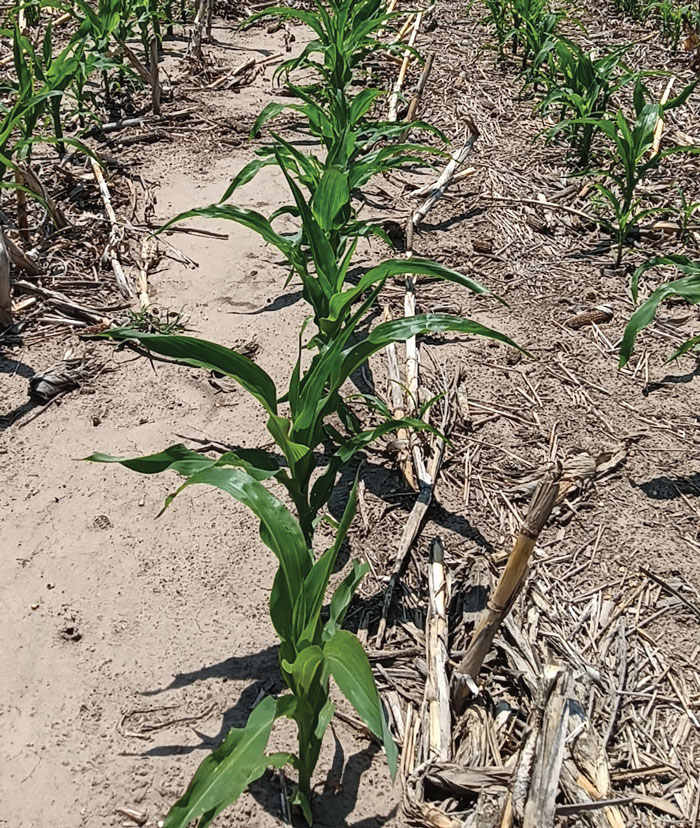
Fed by residual soil moisture protected by cover crop residue, Thompson’s triple-stack Pioneer corn stand showed much mid-June potential, but its need for rain was obvious. Michael Thompson
“All of our corn looked better than those fields, so it shows when we do take some measures toward building soil structure it can negate some of the problems that drought presents,” he says. “In the end, however, it still takes rain.”
Primarily a dryland corn and soybean grower, Thompson says a commitment to no-till, extensive use of cover crops and management flexibility made possible by his Angus-based commercial cow herds have helped him make profitable use of the farm’s limited rainfall.
Thompson Farm & Ranch covers nearly 4,000 acres near Almena, in northwestern Kansas, where flexible farm management decisions have helped Michael, his brother Brian, and their father, Richard thrive for more than 25 years. They say an annual precipitation of 20 inches is a “good year.”
“By keeping our soils covered with residue and cover crops we get far better water infiltration from rainfall and avoid having water standing behind our terraces and in low spots where it quickly evaporates,” Thompson says. “Our management has actually helped us even out our highly-variable rainfall and gives us reasonably dependable amounts of soil moisture to plan around.”
What Matters Most
The main priority in the family’s planning, however, is taking care of the soil, as they try to make all their cropping and grazing decisions with the soil as the highest priority. Thompson is convinced the farm’s profitability is tied directly to soil conditions.
“If the soil on a field doesn’t have enough cover we might plant a cover crop in place of a cash crop, or maybe planting two cover crops back-to-back,” he says. “In pastures, that might include deferring grazing or moving cattle early, but getting the soil properly covered will be our main concern.”
“I just don’t want to cover the farm in expensive inputs for a crop that ultimately becomes an insurance check…”
In “normal” precipitation years the family can bin 120-140 bushels of corn in an area where 70 bushels is average. Also, they expect to harvest 30-50 bu./A-soybeans given sufficient late-summer rains. The two crops usually account for about 80% of the arable land each year, with corn populating about 60-75% of those fields.
“Even though we were convinced drought was a possibility this year we took a chance on increasing corn acres because of the profit potential if it did rain,” Thompson says. “Also, we wanted to shift about 500 acres of soybean production into cover crops to ensure sufficient ground cover and potential grazing, particularly if drought crimped our pasture production.”
In dry years, he explains, it’s difficult enough to grow enough residue with soybeans, and if he uses existing soil moisture for to grow a soybean crop it then becomes very difficult to get rye, wheat or triticale cover crops started for fall and winter.
4th Annual Conservation Ag Operator Fellowship
No-Till Farmer’s Conservation Ag Operator Fellowship program follows a selected grower throughout the year and shares the real-time decision-making processes and solutions needed to make conservation ag practices work in real-world conditions.
The 2025 fellowship program features Michael Thompson from Almena, Kan. No-Till Farmer’s editors and industry advisors selected Thompson because of his extensive use of cover crops, animal agriculture, and 25-years of no-till experience to regenerate an unprofitable farm into an expanding and weather-resilient dryland operation featuring corn and soybean production and flexible use of a 200-head Angus-based commercial cow herd. The 2025 program is made possible with the support of Titan Tires and Yetter Farm Equipment.
Follow Thompson throughout the year with feature stories in each edition of Conservation Tillage Guide, a multimedia series and question forum, and a capstone presentation at the 34th Annual National No-Tillage Conference in St. Louis, Mo., Jan. 6-9, 2026.
Because keeping the soil covered is their priority, the Thompsons decided to shift those soybean acres into warm-season cover crop blends with forage sorghum, sorghum sudan, millets, and legumes as a hedge against drought.
“At least we can extend our grazing season with the covers if need be,” he explains. “We’ll know a lot more come July and August about what we’re going to do with some of those acres, however.
“The same goes for the corn. If we don’t get any rain by July 4, we’re going to be pretty cooked by mid-July. Appreciable rains in late June, however, could help us still make a crop. If not, I really hope we can get the corn up to waist high to at least make some significant grazing for the cattle. It’s all about remaining flexible in the face of nature’s variables.”
Hooves are Key
The Thompsons’ livestock play heavily into the flexibility equation, and long before the first corn was planted in May this year, the family sold all heifers and steers in early April. The move helped capture high current cattle prices plus it reduced future grazing requirements. Most going to sale were in the 500- to 550-pound range, while some nearly-yearling individuals were 750 to 800 pounds.
“We generally retain some heifers for replacements and keep steers to capture additional gain from grazing,” Thompson explains. “But this year, because of the potential of drought, we got rid of the extra animals.”
“Cattle stimulate soil biology in a way that’s impossible without them…”
By mid-June the rest of the cattle had been moved from cool-season cover crops to the operation’s 800 acres of grass, but the Thompsons were still planning on culling older, less-than-prime cows to further reduce numbers if necessary.
“The other management strategy we’re using is keeping the cattle in larger herds,” Michael says. “We have an older and younger herd, and instead of splitting them up into a dozen different pastures and smaller herds, as we would if we had ample grass and it was raining, we’re leaving them in the larger herds and just moving them between the bigger pastures to allow the grass as much growth as it can get with current conditions.”
While he is not always a fan of livestock, Thompson has come to respect and love them for what they’ve done for his operation in conjunction with cover crops.
Grazing covers helps trample residue into the soil while the resulting manure kick-starts nutrient cycling. The process can reduce runoff, suppress weed growth, improve water infiltration and helps sequester carbon in the soil — all benefits Thompson has seen.
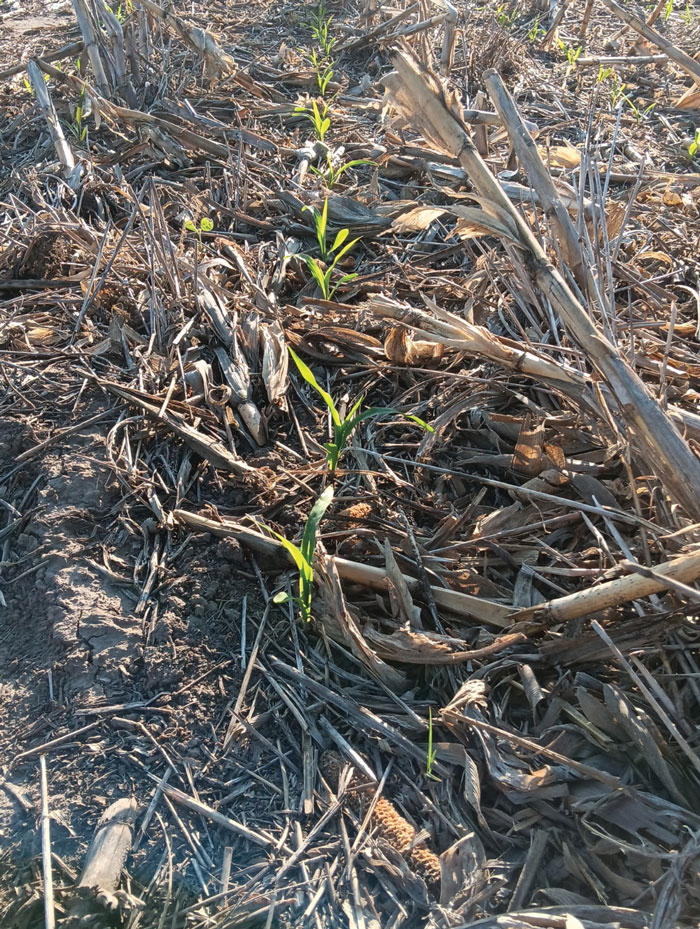
Last season’s grazed warm-season cover crop residue remained through the winter to cover the soil and protect soil moisture for a uniform healthy corn stand. Thompson no-tilled 2,000 acres of corn to seed-zone moisture in early May despite dust flying behind his planter. Michael Thompson
“Cattle stimulate soil biology in a way that’s impossible without them,” he explains. “On our farm they have accelerated the pace to better soils. We have some fields now registering 4% or more organic matter and that came through only a few years of grazing. At the same time the cattle have added cash flow to the farm.”
He says cattle enable the “full flexibility” of his family’s management by turning hailed-out crop disasters into beef dollars and, given the possibility of extended drought in 2025 they could graze their way to partially offsetting the possible lost investment in the corn crop.
A Summer Outlook
Looking forward from the first day of summer, Thompson says much depended upon rains that might fall between then and late July.
“That will tell us if we can consider additional inputs to the corn crop in the form of foliar applications or if we need to just cut our losses,” he explains. “If we get some beneficial moisture of course we’ll give the crop the best shot we can, but if the rains don’t show up we’re not going to invest any more money — particularly with our subsoil being moisture-deficient right now.”
While Thompson he hates to sound “wishy washy” as he’s buying time to remain flexible, he says some of his corn likely will receive more inputs.
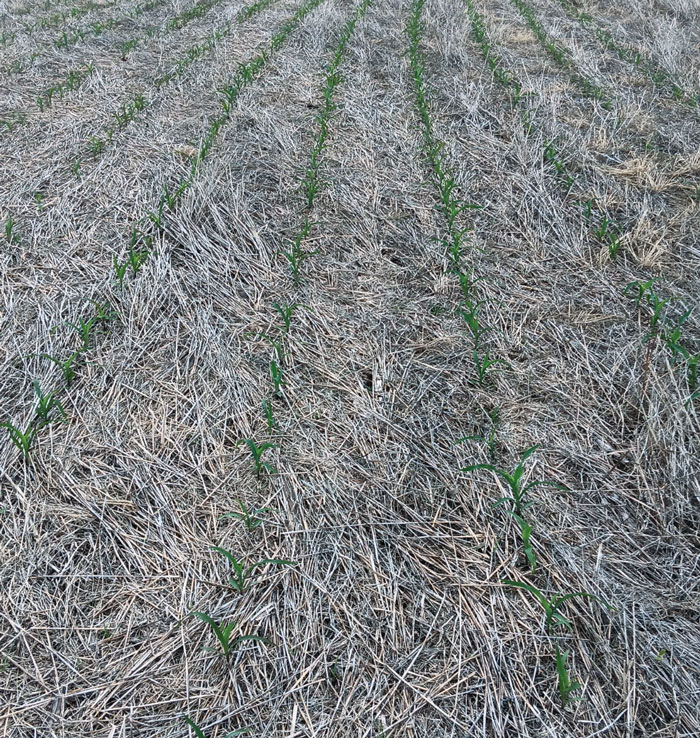
With barely 2.4-inches of rain since the first of the year, Thompson’s corn crop had no problem providing quick evidence of uniform emergence by mid-May. Only 2 more inches of rain would fall over the next month. Michael Thompson
“I feel if we don’t do something — and just give up — it will represent another year officially down the drain and we’re only given so many years to farm. I’m noticing grayer hair and that reminds me I need to be busy learning what works and what doesn’t, so if we can put a limited amount of foliar on so the crop hangs on a couple of weeks until a rain, maybe it’ll be worth it.
“I just don’t want to cover the farm in expensive inputs for a crop that ultimately becomes an insurance check.”
Thompson’s 2025 on-farm trials involving biologicals such as vermicompost extract, compost extract, a kelp growth hormone and yucca extract likely will receive additional fertility and care, particularly if beneficial late June and July rains occur.
What Scares You?
Having navigated the drought of 2011-2012, Thompson says this year’s situation is serious, but not the “end of the world” for him. Still, he says recent trends in local rainfall are quite concerning.
“What scares me is we’ve had quite variable moisture the last 4 or 5 years,” he explains. “We once got at least half or three-quarters of the county included in a rain. Now, rains are generally limited to just small pockets of our region.”
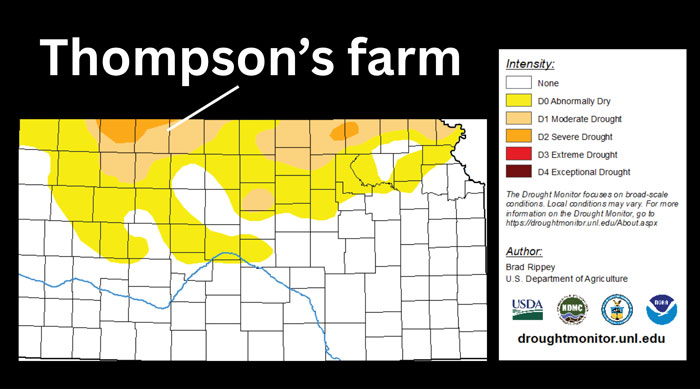
This graphic shows Thompson’s farm was in a triangle of drought in northwestern Kansas straddling the Nebraska state line. He says the operation is in a “severe drought within a drought” because of very localized rainfall. Michael Thompson
He’s concerned the situation may not be coincidental but may be evidence of a changing water cycle.
“While I’m not an irrigator, I really worry about the drawdown of the Ogallala Aquifer and the future if we as an industry have to take our farm’s type management further west into what are now irrigated acres to extend the life of the aquifer,” he says. “We’ve improved our use of the spotty precipitation through improved soil structure and organic matter. I just hope people across the western U.S. are monitoring all this and are doing what they can to improve their soils now.”
The 2025 Conservation Ag Operator Fellowship program is made possible with the support of Titan Tires and Yetter Farm Equipment.

Titan International, Inc., is leading global manufacturer and supplier of Goodyear Farm Tires, Titan tires, Titan wheels, and undercarriage products for a wide variety of off-the-road equipment within the Agricultural, Earthmoving, Mining, Construction and Consumer sectors. Supporting a strong network of aftermarket dealers and blue-chip OEM customers all over the world, Titan is a company that end-users can count on for innovative and durable products and quality service.

Profitable Solutions for Production Agriculture For over 95 years, Yetter Farm Equipment has designed and manufactured innovative and effective solutions for the agriculture industry. Today, we are proud to be recognized worldwide as an industry leader in row cleaners, closing wheels, strip-till equipment, planter attachments, fertilizer placement attachments, rotary hoes, toolbars, and harvest attachments. Our extensive experience—combined with our relationships with dealers, OEM partners, and innovative farmers—helps us engineer practical solutions for the many different farming operations and conditions in the agriculture industry. Our goal is that our products help our customers maximize yield potential every year. Visit www.yetterco.com to learn more about Yetter products or call 800-447-5777.