Takeaways
- Keeping soils covered can help even out highly-variable rainfall and provide reasonably dependable amounts of soil moisture to plan around.
- Moving to more in-season N sidedressing or Y-drops with 28% or 32% can alleviate upfront N loading and salt loads.
- Warm-season covers return significant amounts root exudates to the soil to build soil aggregation and carbon, which in turn helps water-holding capacity.
Expanding a dryland farm and cattle operation — where you’re happy if the rain gauge collects 20 inches of water over a year’s time — is a tough proposition, but Michael Thompson is doing just that with a rock-solid commitment to soil health and a flexible mindset.
Thompson, his brother Brian and father Richard, operate Thompson Farm & Ranch which covers nearly 4,000 acres near Almena, Kan., where flexible farm management decisions have proven profitable for more than 25 years while continually building the health of the soil.
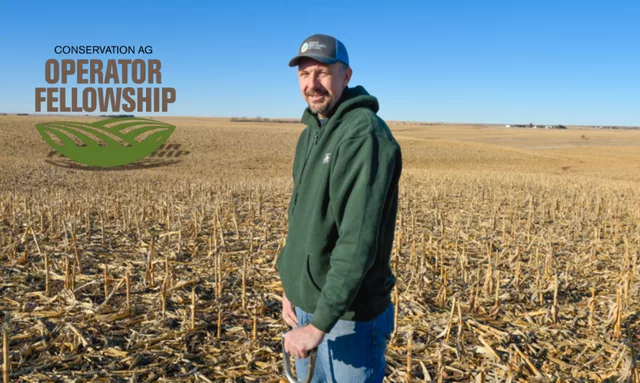
Michael is No-Till Farmer’s 2025 Conservation Ag Operator Fellow, chosen because of his personal dedication to stewardship of soils and to no-till and regenerative farm management. Primarily a corn and soybean crop producer, Thompson says adopting no-till, extensive use of cover crops and management flexibility afforded by his Angus-based commercial cow herd have helped him make profitable use of his farm’s limited rainfall.
4th Annual Conservation Ag Operator Fellowship
No-Till Farmer’s annual Conservation Ag Operator Fellowship program follows a selected no-till farmer throughout the year and shares the real-time decision-making processes and solutions needed to make no-till and conservation ag practices work in real-world conditions. The 2025 fellowship program, made possible with the support of Titan Tire and Yetter Farm Equipment, features Michael Thompson from Almena, Kan. No-Till Farmer’s editors and industry advisors selected Thompson because of his 25 years of no-till experience, extensive use of cover crops and livestock integration, which has regenerated an unprofitable farm into an expanding and weather-resilient dryland operation. Thompson raises corn and soybean and manages a 200-head Angus-based commercial cow herd. Follow Thompson throughout the year with feature stories in each edition of Conservation Tillage Guide, an on-line multimedia series and question forum, and a capstone presentation at the 34th Annual National No-Tillage Conference in St. Louis, Mo., Jan. 6-9, 2026.
Beginning with an initial 480-acre land purchase near his family’s farm in Norton County, Kan., in the late 1990s, Thompson now owns 2,800 acres of cropland and about 800 acres of native pasture in the area, including adjacent land in Furnas County across the state line in Nebraska. Another 600-acres of rented land rounds out the farm’s land base.
There have been some changes to his operation since No-Till Farmer last spoke with Thompson in 2019, when his operation included 2,000 acres of cropland and 1,000 acres of pasture. Despite 5 years of chronic drought in northwest Kansas his operation has continued to expand.
He credits taking care of the soil with cover crops and well-planned use of grazing to level out soil moisture levels, taking what Mother Nature gives him and paying close attention to the specific locations where he implements different practices.
Highest Priority
When “normal” in-season precipitation comes, the Thompsons can raise 120-140 bushels of dryland corn in an area where 70 bushels is “average.” With favorable conditions those yields have hit 170. They expect soybeans to average from 30-50 bu./A given ample late-summer showers, but he notes the crop is variable depending upon the intensity of summer’s heat.
Also, “normal” in-season precipitation comes, the Thompsons can raise 120-140 bushels of dryland corn in an area where 70 bushels is “average.” With favorable conditions those yields have hit 170. They expect soybeans to average from 30-50 bu./A given ample late-summer showers, but he notes the crop is variable depending upon the intensity of summer’s heat.
"We try to make all of our cropping and grazing decisions with the soil as the first and foremost priority,” Thompson explains. “If the soil on a field doesn’t have enough cover we’ll do what’s necessary to remedy the situation. In pastures, that might include deferring grazing or moving cattle early. In cropland it might mean planting a cover crop in place of a planned cash crop. Sometimes it involves planting two cover crops back-to-back. But getting the soil properly covered will be our main concern.”
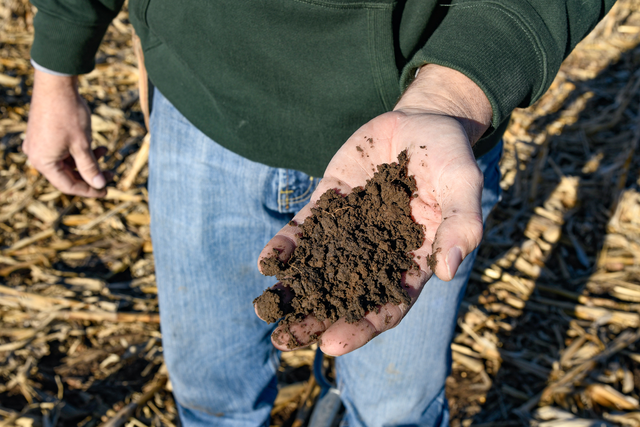
COVER UP. The Thompsons have found keeping soils covered improves water infiltration and they don’t have standing water behind terraces and in low spots where it quickly evaporates. “Our management has actually helped us even out the highly-variable rainfall and gives us reasonably dependable amounts of soil moisture to plan around,” Michael Thompson says. Source: John Dobberstein
Thompson says his rolling silty-loam and clay-loam fields blow easily if they are left unprotected in hot summer winds, and without surface cover what rains that occur easily wash away bare soil.
"By keeping our soils covered we get far better water infiltration from rainfall and don’t have standing water behind our terraces and in low spots, where it quickly evaporates,” Thompson says. “Our management has actually helped us even out the highly-variable rainfall and gives us reasonably dependable amounts of soil moisture to plan around.”
Rude Awakening
At age 18, Thompson envisioned himself joining his parents in their operation and becoming a dedicated 100% cash grain farmer. He was going to finish high school, take some ag classes and come back to the farm. At the time, he hated cattle and saw no need for them. He wanted to farm every acre of land.
That was when real life, and the results of generations of conventional farming, upended his plans.
"I remember when my parents sat me down and explained the farm wasn’t profitable and there was no way he could make a living there. They told me nicely, ‘Don’t come back to the farm.’ I didn’t listen, but I began to realize I’d have to do things differently than what three previous generations of my family had been doing,” he recalls.
There were many reasons farming wasn't working for the Thompsons, he says.
"We had always farmed conventionally so we had years of compaction. The soil was so hard, we had to work it to fluff it up, and then it would rain, and we’d get stuck in the fields. We were either stuck or on ground so hard we couldn’t plant,” he explained. “An even bigger problem was we had such a low water-infiltration rate — a half inch per hour, tops.
"What rain we’d get would run down our hilly fields into the ditch and disappear. Our fertility bills were huge, yet our soils were chronically low in fertility. Our soils were low in organic matter, some less than 1%, and we had no nutrient cycling whatsoever.”
Thompson was also aware how rough it was to farm around deep ditches in the field. As he reluctantly enrolled in college, he continued looking for ways to “fix the farm.”
“We wouldn’t have healthy plants without the nutrient cycling we’re getting from healthy microbials in the soil…”
Until that time, he says, like so many conventional farmers, he and his family had viewed the soil as only a medium into which crops are planted. “We didn’t think about soil being alive and living with important biological activity in it,” he recalls.
"When I started farming on my own, I spent a lot of time reading books and studying on-line articles, going to conferences, studying alternatives, and trying to learn all I could to successfully farm in our harsh climate with high summer temperatures, infrequent rains, severe winter conditions and light soils that blow and wash easily,” he explains.
As a practicing student he realized he would have to mimic the native prairie culture which originally built the soils he was trying to farm, and that meant quitting the plow – which he did in 2000.
No-till immediately began to slow erosion on the hills — and recognizing that was what put Michael’s father on board with what his son was doing.
"Suddenly there were no more deep ditches, only low spots,” Michael recalls. “Dad noticed the ditches were going away, and he saw the terrace channels were no longer holding rainfall runoff — which was now soaking into the field where it was protected from evaporation.”
Weeds were still a problem, so the Thompsons adopted cover-cropping using a variety of multi-species mixes, but even that didn't provide adequate control.
Out of necessity, despite his dislike for cattle, Thompson realized his family’s cattle would eat weeds as well as cover crop mixes.
"We began turning out the animals and we began to see almost immediate positive in weed pressure and crop performance on grazed acres that included cover crops,” he says. Despite decades of compaction from conventional tillage, water infiltration rates accelerated, along with significant nutrient scavenging by cover crops.
Thompson found a path that would lead him to a prosperous farming career – within miles of his boyhood home – and would make dryland row-crop production possible and profitable where “common wisdom” said it wouldn’t work. And he’d found a new forage source in cultivated covers to provide the cowherd with nutrition in times native pastures were needing a rest.
'Cattles are my Cheat'
"I was never a cattle lover, but I respect them now and love them for what they’ve done for our operation,” Thompson admits. “I have good friends who are building their soils here in the western regions with full crop production and no cattle, but for me this has been my ‘cheat’. The fact we’ve been able to be profitable and boost some soils into the 4% organic matter range in such a short time has just worked for us.
Cattle, he says, stimulate the soil biology in a way that isn’t possible without them. “I won’t say it’s impossible to improve soil health conditions without cattle, but I know on my farm they accelerate the pace to better soils.”
“It’s not impossible to improve soil health without cattle, but on my farm they accelerate the pace to better soils…”
In addition to increased microbiological activity and soil microbe populations, the manure and urine of grazing cattle are responsible for significantly darkening the soils across the Thompson farm – an observation Michael attributes to increasing amounts of soil organic matter.
Thompson’s cow herd and its annual crop of 400-500 lb. weaned calves provides significant income to the farm along with financial flexibility to sell calves early if grazing is sparce, or 500-800 lb. stockers later in the year on good pasture, or from grazing cover crops. The heavier calves are many times products of what Thompson calls “full flexibility” allowing him to turn crop disasters into beef dollars.
“Over the last several years the cattle have turned hailed-out crops into profits, creating something out of what would be a total disaster if we were only grain farmers,” he explains. “The cattle have been good to us with our mixed operation even in drought years, but particularly when we get beneficial moisture on rangeland.”
He’s also quick to re-emphasize the soil building benefits of livestock on farmland.
“With no-till and livestock production, along with cover crops, we’ve been able to increase our organic matter and our nutrient cycling. We wouldn’t have healthy plants without the nutrient cycling we’re getting from healthy microbials in the soil.”
Cropping Transition
Until about 2020 the Thompsons cropped a diverse portfolio of corn, sorghum, winter wheat, soybeans, oats, barley and triticale, but because of low small-grain prices they nimbly shifted to today’s primarily row-crop emphasis, using soybeans as a transition crop to covers between rotations.
“Economics dictated in our environment the cereals had become non-starters for us,” Thompson explains. “We get better returns replacing those acres with corn and beans, or, if nothing more, returning them to grazing or cover crops.”
The farm’s row-crop production is supported by a nearly all-red fleet of tools aimed at no-till production. Thompson’s machine shed and motor pool includes 2 Case IH tractors, (250 and 235), a pair of Case IH 2388 combines, a 16-row Case IH 1250 planter, a Case IH 500T air drill, an AGCO 6000 stripper header, a pair of Geringhoff 8-row corn heads, 2 Case IH 1020 flex headers, an Aerway aerator and a Case IH 3185 sprayer.
He uses the Case IH planter set on 30-rows for corn and usually sets the air-drill on 10-inch spacings for soybeans.
“On our heavier ground, if we have lots of residue, we’ll plant corn on corn and then go back to soybeans,” he explains. “Depending upon the weather, some fields will be an annual oscillation of corn and beans. Regardless, we’re continually watching residue amounts and overall cover to make those choices, and when we need to build back some soil cover we’ll plant cover crops.”
Working with Covers
Michael says he can't emphasize enough how important cover crops are to his success in the highly variable conditions he faces, and the vital role they place in maintaining soil moisture and preventing erosion. He also notes how valuable they are to extending his grazing season in otherwise lean forage years.
Favoring a monoculture of cereal rye during late fall and winter because of its aggressive and intensive root system, Thompson primarily uses triticale, rapeseed or hairy vetch for early cool-season production. Spring cool-season covers are typically a mix of barley, oats, rapeseed, turnips and field peas. Summer warm season is covered with a mix of sunflower, buckwheat, millet, forage sorghum, sunnhemp, soybean, cowpea and mung bean.
“Cattle have turned hailed-out crops into profits, creating something out of what would be a total disaster…”
“I really like winter-grown cereal rye for the flexibility it provides in our conditions,” Thompson explains. “We usually let it get tall in the spring — when we can graze it if we need forage — or we have the choice of spraying it out for cash crop or cover crop production.”
He says the warm-season mixes return significant amounts root exudates to the soil, which helps build soil aggregation and builds soil carbon which also in turn helps hold water.
“We’re seeing our soils turn darker because of the carbon, so the darker soils become, the more water holding capacity they have and that plays right into the resilience and flexibility we’re trying to build into our operation,” he says.
Precision Nutrients
While the farm's soils are naturally adequate in P and K, it takes nitrogen (N) to grow corn and better management of N inputs is high on Thompson's management decision list.
“We’re being very conscious about nitrogen-use efficiency and how much nitrogen we use so we’re doing a lot of split applications,” Thompson explains. “We used to have high enough CECs in our soils we could hold onto much more nitrogen than we can now.
“Traditionally, you’d put everything (nitrogen) you wanted on a corn crop at the beginning of the season. We still use some nitrogen up front, but we’re moving more to in-season sidedress or Y-drop streaming 28% or 32% liquid applications with our sprayer. From a soil health standpoint, upfront nitrogen loading causes a significant salt load, so it probably isn’t a very good idea anyway.”
Thompson follows his corn crop’s needs with tissue sampling and regular field observations and makes overall pre-season nitrogen decisions based on soil sample analysis of intended cash-crop fields using the Haney test. That protocol tests for biological activity and potential probabilities of in-season nitrogen release from soil organic matter.
He’s also experimented with biological applications and is setting up test plots for the 2025 season to evaluate several products he thinks might help in his overall goals of building and protecting the soil while producing healthier crops.
“Last year was my first season to experiment with biologicals,” he says. “Before that we were treating our seed with Vermicast, which is basically worm poop. We’d take worm castings and liquify them and I just applied it as a drench to the seed because we weren’t totally set up on our drills and planter to handle liquids. Hopefully this season we’ll have all three machines set up for liquid application.”
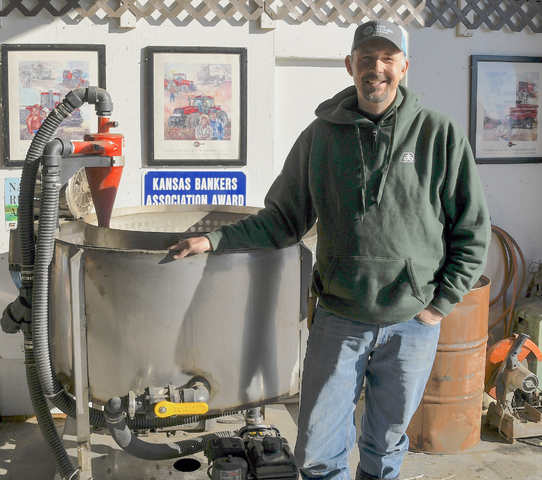
HELPING PLANTS. After experimenting with vermicompost-treated seed and seeing some visible results, Michael Thompson assembled this compost extractor. The machine will allow him to apply compost through the liquid system on his planter to boost root systems and plant health in his farm’s dryland environment. Source: John Dobberstein
The machinery modifications should enable the Thompsons to evaluate several products aimed at getting crops through the emergence stage and on to healthy seedling stands.
This season Thompson plans to test vermicompost extract, compost extract, kelp and yucca extract. (Follow No-Till Farmer’s on-going coverage of Thompson’s 2025 growing season, including results and observations from these on-farm trials.).
“I’m all about trying to get a good solid root system with our environment where we don’t know when our next rain will come,” he says. “The better root system we have the more chances we have of getting better nutrition into the plant and the more nutrient cycling it eventually will do.”
Philosophy in Action
Asked about the biggest accomplishment he sees from his farm’s 25-year evolution from the initial move to 100% no-till through the addition of cover crops and grazing, Thompson says: “I’d say just getting through some of these weather extremes.
“We’ve had a lot of drought and times we’ve been well below our average rainfall but still grown crops. Not all of it was harvestable, but even those were ‘harvested’ with a cow. Mostly I’ve been impressed with how much healthier our crops are overall now and how resilient they are because of stimulated soil biology.
“I guess the main thing that has changed in my philosophy and core belief over the years is I now know none of the profit on the farm is possible without good soil."
The 2025 Conservation Ag Operator Fellowship program is made possible with the support of Titan Tires and Yetter Farm Equipment.

Titan International, Inc., is leading global manufacturer and supplier of Goodyear Farm Tires, Titan tires, Titan wheels, and undercarriage products for a wide variety of off-the-road equipment within the Agricultural, Earthmoving, Mining, Construction and Consumer sectors. Supporting a strong network of aftermarket dealers and blue-chip OEM customers all over the world, Titan is a company that end-users can count on for innovative and durable products and quality service.

Profitable Solutions for Production Agriculture For over 95 years, Yetter Farm Equipment has designed and manufactured innovative and effective solutions for the agriculture industry. Today, we are proud to be recognized worldwide as an industry leader in row cleaners, closing wheels, strip-till equipment, planter attachments, fertilizer placement attachments, rotary hoes, toolbars, and harvest attachments. Our extensive experience—combined with our relationships with dealers, OEM partners, and innovative farmers—helps us engineer practical solutions for the many different farming operations and conditions in the agriculture industry. Our goal is that our products help our customers maximize yield potential every year. Visit www.yetterco.com to learn more about Yetter products or call 800-447-5777.