
Washington Wheat Farmer Advocates for Herbicide Targeted by RFK Jr.’s ‘MAHA’ Report
By Orion Donovan Smith
Published July 27, 2025 on The Spokesman-Review
A wheat grower from Spokane County recently visited the U.S., Capitol to drum up support for glyphosate, a widely used weed killer that was targeted in a May report commissioned by Health Secretary Robert F. Kennedy Jr.
Gil Crosby, who farms near Fairfield and serves as vice president of the Washington Association of Wheat Growers, spent 2 days in D.C. meeting with congressional staff to warn against restricting the use of glyphosate. The MAHA Report — taking its name from Kennedy’s “Make America Healthy Again” initiative — identified the herbicide, which wheat growers rely on to control weeds, as potentially harmful to children.
“As a farmer, we’re not out to put anything out there that’s not safe for public consumption or to harm our soil, because that’s our livelihood,” Crosby said in an interview. “We’re trying to be good stewards of the land, so we can keep farming the ground and so generations can keep farming the ground.”
Crosby and other farmers from across the country were part of a visit organized by the Modern Ag Alliance, a lobbying group founded by the German biotechnology company Bayer. In 2018, Bayer acquired Monsanto, which began marketing glyphosate under the brand name Roundup in 1974.
It could cost farmers three times as much to get the same end result they’re getting with glyphosate…
The biotech industry’s funding of research on the safety and effectiveness of glyphosate has contributed to suspicion from Kennedy and others about the legitimacy of that research, as the report notes. While the report doesn’t explicitly say the chemical is unsafe, it raises questions that have unnerved farmers who rely on the product in a business that’s already facing pressure from rising input costs, tariffs and more.
“The worst-case scenario is that we lose that tool and we have to go back to farming conventional,” Crosby said. “And we’d increase our costs tremendously if we lose that tool.”
Not using glyphosate, he said, would force farmers to use more costly alternatives and potentially tilling their fields, which removes nutrients from the soil.
“It just adds more costs to a very shrinking margin,” Crosby said. “All of us farmers are trying to be great stewards, because if we lose our dirt, I mean, we’re not farming.”
Ian Burke, a professor in Washington State University’s Department of Crop and Soil Sciences, said the introduction of glyphosate was “transformative” for the Northwest when it was introduced in the 1970s.
“It would probably cost farmers three times as much to get the same end result that they’re currently getting with glyphosate,” Burke said. “It’s a very well known, well understood product. Farmers are very reliant on it.”
Burke said there’s an ongoing debate among scientists about whether all weeds need to be eliminated, but it’s uncontested that they take up valuable moisture, which is especially harmful to non-irrigated, dryland wheat farming in the Inland Northwest. Not controlling weeds would be “catastrophic” for certain farmers in the region, he said, estimating that it could reduce yields by half.
“Any additional cost is a stress, and any individual farmer has their own set of special circumstances that might lead them to bankruptcy,” he said, “but this is a complicating factor among many that they face.”
Burke said Bayer, Corteva Agriscience and other biotech companies, along with the Washington Grain Commission, have funded some of his research into the efficacy of herbicides in the Northwest.
Crosby has allies among Northwest Republicans — including Reps. Dan Newhouse and Michael Baumgartner of Washington, Reps. Russ Fulcher and Mike Simpson of Idaho and Sens. Mike Crapo and Jim Risch of Idaho — who signed a letter to President Trump warning that “anti-agriculture interest groups seem to have influenced” the MAHA report.
“The Assessment employed reports and rhetoric mischaracterizing proven-safe chemistries and ingredients,” the lawmakers wrote, referring to the MAHA report. “The Assessment questions the safety of critical crop protection tools. However, the Assessment’s cited evidence found the opposite conclusion. The cited study found chemistries, like glyphosate, are safe.”
Kennedy, a former environmental attorney who entered the 2024 presidential campaign as a Democrat before becoming an independent and eventually endorsing Trump, has suggested that glyphosate and other chemicals may be responsible for increasing rates of asthma, diabetes and other diseases among Americans.
The Environmental Protection Agency has said there are “no risks of concern to human health from current uses of glyphosate” and “no evidence that glyphosate causes cancer in humans.”
But in 2015, the International Agency for Research on Cancer, part of the World Health Organization, classified glyphosate as “probably carcinogenic to humans.” The two organizations reviewed different sets of studies, underscoring the ongoing controversy into which the Trump administration is now wading.
Read the original article on The Spokesman-Review »
Viewpoint: A Disturbing Conversation About Glyphosate With a Science-denier
By Nevil Speer
Published July 7, 2025 on Feedstuffs and July 17, 2025 on Genetic Literacy Project
The intent of my previous column on glyphosate was simply to encourage some critical thinking. In it, I wrote: Glyphosate is an important piece of technology that benefits everyone – both directly and indirectly. And as such, it deserves careful consideration to ensure we’re not too hasty lest we throw the baby out with the bathwater.
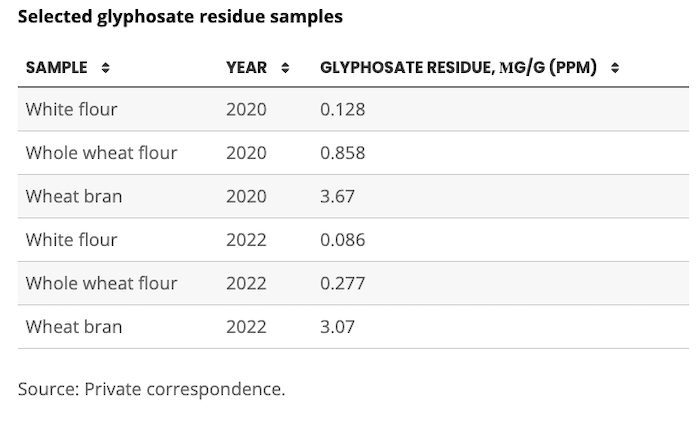
The column eventually made its way to No-Till Farmer. That spurred one reader to email asking me to call. The discussion quickly turned to his concern about farmers using glyphosate on their wheat crop prior to harvest. He mentioned some test results and asked: “Would you like me to send them to you?” I said sure! I’m always looking to learn something.
The results from two samples (2020 and 2022) are detailed in the table at the end of the column.
I know NOTHING about either the accuracy or repeatability of the results. But I was anticipating some sort of dramatic demonstration of the concern.
Accordingly, I emailed back, pointing out: “The highest residue level on the list is ~3,700 nanograms (3,700 parts per billion). That’s the equivalent of 3.7 micrograms (parts per million). [The Food & Drug Administration’s] tolerance for residue is 400 parts per million – more than 100X of the residue results you’ve attached here. I’m not sure what the concern here is given the data. But thank you for sharing anyway. This is an important topic with respect to all sorts of food products.”
Here’s where it gets interesting. My caller didn’t respond but, rather, had the lab’s CEO (and “health director”) email me about the results. None of his comments reference the results themselves. Rather, it was all about glyphosate.
Some of the important excerpts from the email are below (emphases mine):
- “The problem is that the levels considered safe by the [U.S. Environmental Protection Agency] are not based on current scientific evidence. … The FDA-allowed levels are more than 100-fold higher than what is considered ‘safe’ according to the most recent science.”
- “These high levels are not acutely toxic, that is, consuming that amount will [not] knock you off your feet, but it is high enough to cause serious problems when consumed chronically, which is what happens when you regularly consume conventional wheat as bread or other products.”
- “There is an epidemic of non-alcoholic fatty liver disease in North America, which is likely caused by these low levels of glyphosate.”
- “Glyphosate has been around long enough for this to be seen in the population of young people, and, indeed, we are seeing frequency of obesity in children that has never previously been observed. In the U.S., more than 30% of the young men who volunteer for the Army are rejected because they are overweight. A general recently observed that this problem is creating a national security emergency, where we cannot recruit enough people into the military to defend the country!”
Based on those comments, we’re supposed to assume: (a) the previous science is all wrong (more on this below), but (b) several sentences later, he’s using the word “likely” (so much for facts and science), (C) glyphosate somehow accumulates in the system (despite the half-life being less than 12 hours in the body) and (d) this all crescendos with glyphosate now tagged as a national security emergency (which is really over the top, as we all know the obesity epidemic is a complex epidemic).
Meanwhile, the dialog completely bypasses any recognition of the premise of my first column, which is that glyphosate has proved to be important technology that’s benefitted society – and, therefore, “deserves careful consideration when it comes to policy.”
I subsequently asked for a summary of glyphosate tests from the lab. The response: “That is a long list. Something I have never done. But I can send you are [sic] report that consolidates quite a lot of the data with different foods and beverages. I would ask that you keep that report confidential.”
You don’t have a summary of your lab’s results? And the information is confidential? At this point, I’m done.
Let’s return to the “most recent science.” There’s a lesson to be learned from a prior Feedstuffs column I wrote several years ago talking about Dr. Ivan Frantz’s obsession with cholesterol. Frantz was a staunch proponent of replacing animal fats with vegetable fats (i.e., new science) – convinced cholesterol was going to kill us – but it turns out “the vegetable oil people didn’t live longer.”
It reminds me of Billy Joel’s great song “Shades of Grey,” which goes: “The more I find out, the less that I know.” The point is that no matter how strongly we may feel about something, we get things wrong.
Never mind glyphosate; per the first column, what’s most important is the broader principle. Exploration of new policies and/or guidelines (for whatever reason it might be) cannot, and should not, be reliant on overdramatic interpretations. Rather, the process must be grounded in discipline and rigor and objectivity, or else nobody wins.
Credits: Dr. Nevil Speer holds a Ph.D. in Animal Sciences from Colorado State University and is an industry consultant in both academia and private industry. Follow Nevil on X @nevil_speer
A version of this article was originally posted at Feedstuffs and was reposted to Genetic Literacy Project with permission. Follow Feedstuffs on X @Feedstuffs
Read the original article on Feedstuffs »
Read the article on Genetic Literacy Project »
Bayer Sets Aside Additional $1.37 billion for U.S. Litigation
By
Published July 31, 2025 on Reuters
German pharmaceutical and biotechnology group Bayer aid on July 30 that it had set aside an additional $1.37 billion in provisions to address ongoing litigation in the United States over the weed killer Roundup.
Bayer, which is grappling with costly U.S. product liability litigation, has already paid about $10 billion to settle disputed claims that Roundup, based on glyphosate, causes cancer.
Among 192,000 claims, 131,000 have been settled or deemed ineligible…
Plaintiffs have said they developed non-Hodgkin’s lymphoma and other forms of cancer due to using Roundup, either at home or on the job. The company has since replaced glyphosate in U.S. consumer products with different weed-killing substances.
On Thursday, Bayer announced a significant settlement with a plaintiffs’ law firm, reducing unresolved glyphosate claims to 61,000. Of the total 192,000 claims, 131,000 have been settled or deemed ineligible, Bayer said.
Read the original article on Reuters »
Brussels Considers Changing Stance on Glyphosate and Cancer
By Paolo DeAndreis
Published July 17,2025 on Olive Oil Times
The European Commission may instruct research agencies to review the scientific research into glyphosate, one of the most commonly used herbicides in agriculture.
“We are waiting to shortly confirm a mandate from the European Commission for the European Food Safety Authority (EFSA) and the European Chemicals Agency (ECHA) to assess the study,” a commission spokesperson told Olive Oil Times.
“Once we receive all the raw data and information needed to assess the study properly, we will evaluate whether the findings reported in the study would impact the conclusions that we and the European Chemicals Agency reached in our latest assessments of the safety of glyphosate in 2023,” the commission explained.
Following the review, the current EFSA stance on glyphosate may change, a decision that will inform the EU’s regulatory activity regarding the popular herbicide.
A new investigation into the potential health risks associated with glyphosate has emerged from a recent paper on long-term exposure, published by Environmental Health.
The paper, authored by a team of international researchers and several scientists from the Italian Ramazzini Institute, provides new evidence of the carcinogenic potential of glyphosate and glyphosate-based herbicides, such as Roundup Bioflow and RangerPro.
Herbicides are often used in olive farming to control weeds growing under the trees, thereby reducing competition for water and nutrients.
Many olive growers appreciate how its use can simplify field management, lower labor costs and avoid mechanical weeding.
The recent research is part of the Global Glyphosate Study, a multi-institutional project designed to thoroughly assess the toxicity of the compound, from prenatal life through old age.
According to the research, scientists administered glyphosate and two commercial herbicides to Sprague – Dawley rats for two years, starting on the sixth day of gestation.
Following the review, the current European stance on glyphosate may change…
Commonly used in biomedical research, Sprague – Dawley rats are known for their calm temperament and genetic diversity. Due to these traits, they are widely used in long-term toxicology and cancer studies.
Their predictable growth and health profiles make them a trusted model for evaluating potential health risks in humans.
The research tested doses including the European Union’s acceptable daily intake.
The results show a statistically significant increase in both benign and malignant tumors in multiple organs, including skin, liver, thyroid, nervous system, kidneys, spleen and pancreas.
The research also highlighted the increase in leukemia cases, many of which led to early deaths (less than one year of age), a finding considered extremely rare in this species.
According to the researchers, their findings strengthen those announced in 2015 by the International Agency for Research on Cancer (IARC), which classified glyphosate as ”probably carcinogenic to humans.”
The researchers also noted that their results are consistent with epidemiological evidence on the health effects of glyphosate-based herbicides.
The European Commission spokesperson recalled that during the peer review of glyphosate’s safety in 2023, all information made available by the latest scientific research was taken into consideration.
The spokesperson also explained that EFSA and ECHA would need to review the raw data to reach a correct assessment.
“It’s important we apply the same standard of scientific scrutiny to studies carried out by researchers as we would to studies we receive from industry,” the spokesperson said.
The commission also confirmed that it has already requested raw data about the ongoing research from the Ramazzini Institute in the past few years.
“Unfortunately, we did not receive them,” the spokesperson said. ”The raw data are important to allow us to verify the methodology used, the composition of test material and the results of a study.”
“In this case, reviewing the raw data would be especially relevant as the findings appear to contradict the main body of evidence and the conclusions reached by EFSA, ECHA and many other regulatory bodies around the world on the safety of glyphosate,” the spokesperson added.
For years, glyphosate has been at the center of a heated global debate about its safety.
Specific forms of the substance were blocked by courts in France in 2019.
In other cases, environmental organizations have protested against the lack of government action on glyphosate, including in Spain when a high concentration of the herbicide was found in the waters of Mar Menor, a coastal lagoon in the southeastern autonomous community of Murcia.
Several studies also sparked public concern, one of which provided evidence that following a non-organic Mediterranean diet can expose consumers to pesticides and herbicides, namely glyphosate.
Read the original article on Olive Oil Times »
French Court Rules Bayer not Liable in Landmark Glyphosate Birth Defect Cases
Published July 31, 2025 on France 24
A French court on July 31 ruled inadmissible a complaint brought by a family against German chemicals company Bayer claiming their son’s disabilities were caused by his mother’s exposure to the weed killer glyphosate when pregnant. "It would probably cost farmers three times as much to get the same end result that they're currently getting with glyphosate," Bayer, which produces the herbicide, said it acknowledged the court’s decision, “which did not find the company liable.”
The lawsuit was one of the first cases centering specifically on prenatal exposure to glyphosate…
Lawyers for the Grataloup family said: “It is clearly a big disappointment for the Grataloup family and for us ... The case deserves to be submitted to the appeals court.”
The lawsuit was one of the first high-profile cases centering specifically on prenatal exposure to glyphosate and congenital malformations in a child.
Research has suggested prenatal exposure to glyphosate may affect babies’ health at birth, but successful lawsuits have been rare. Bayer has said the product is safe for human use.
The German pharmaceutical and biotechnology group has paid around $10 billion to settle disputed claims in the United States that its weedkiller Roundup, based on glyphosate, causes cancer.
The European Union last renewed the approval of the use of glyphosate in 2023, through December 2033.
Read the original article on France 24 »