 Premium content is for our Digital-only and Premium subscribers. A Print-only subscription doesn't qualify. Please
No-Till Farmer
Get full access NOW to the most comprehensive, powerful and easy-to-use online resource for no-tillage practices. Just one good idea will pay for your subscription hundreds of times over.

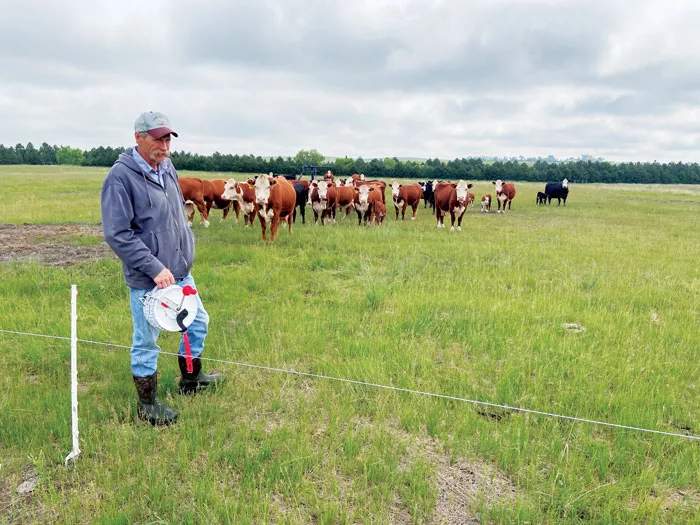
Dave Carpenter used annual and biennial cover crops, crimping and bale grazing to establish soil protection, followed by perennials, transforming this degraded cropland into a productive paddock. “When you add soil armor and livestock you add life back to the soil, and the remaining soil health principles fall into place,” he says. Source: Dave Carpenter
Editor’s Note: Jay Fuhrer, retired NRCS soil health specialist and conservationist at the Menoken Farm demonstration farm in Menoken, N.D., wrote the 5 principles of soil health. In this series, Fuhrer explains each principle and provides an on-farm example of the theory in practice. In the fifth and final installment of this series, Fuhrer examines soil health principle 5: livestock integration.
Imagine if we could invent a way to distribute aerobic and anaerobic microbes effectively and economically across our agricultural landscapes: something mobile and capable of processing plant material into nutritional protein.
The invention should also come in various sizes suitable for specific needs, like playing a close role with plants, soils and the carbon cycle. Yes, this is a little tongue-in-cheek comment!
The fossil record tells us our planet has a long association with animals. Plants, animals and soils have coexisted and supported each other over geological time, to which modern agriculture owes its existence.
One of my favorite quotes explaining the landscape magnitude of animals is from The Journals of Lewis and Clark by Bernard DeVoto:
“This scenery already rich, pleasing and beautiful was further heightened by immense herds of buffalo, deer, elk and antelope which we saw…

Get full access NOW to the most comprehensive, powerful and easy-to-use online resource for no-tillage practices. Just one good idea will pay for your subscription hundreds of times over.
Download these helpful knowledge building tools

We have engineered and developed the most advanced concave system that threshes all crops, eliminates rotor loss, improves grain quality, gives you a cleaner sample – all with one set of XPR concaves.

At Titan International, our product portfolio reflects our commitment to innovation and high-quality products. Titan International offers a full line of solution-focused wheel, tire, and undercarriage products for a wide variety of off-the-road equipment in agriculture, construction, forestry, mining, power sports, high-speed trailers, and outdoor power equipment segments. As one of the largest North American manufacturers, with a network of dealers all over the world, Titan is an industry leader that original equipment manufacturers and operators can count on for durable products and quality service.

Provide expert analysis and decision support to increase productivity and profitability.