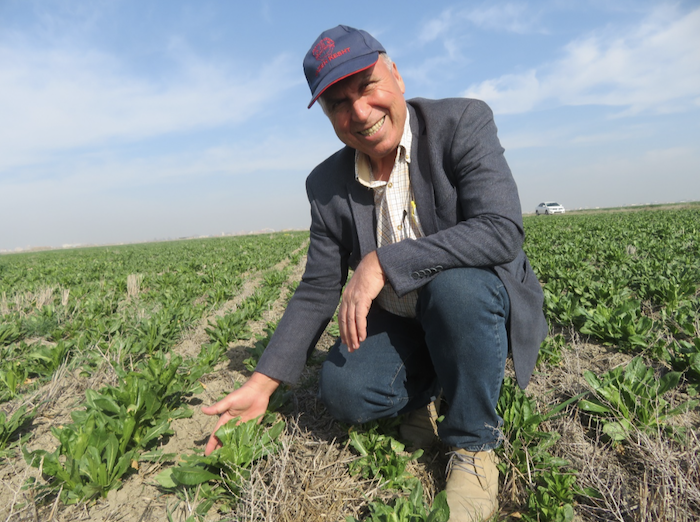
In Iran’s dry and semi-arid lands, which see less than 9 inches of annual rainfall, tillage is no longer just a management decision, it is a risk. After more than 2 decades of research, education, field trials and direct engagement with rainfed farmers, I have reached a clear conclusion: for dryland agriculture in Iran, no-till and conservation agriculture (CA) are no longer optional. They are essential for survival.
Across much of the country, rainfall is scarce, erratic, and increasingly unpredictable. In these conditions, a single moldboard plowing pass can release an entire season’s stored soil moisture into the air. I have witnessed countless fields where conventional tillage (CT) failed to increase yields and instead pushed farmers closer to crop failure.
These realities shaped my conviction that CA must be taught and implemented as a complete, integrated system, not as isolated practices.
A National Mission
My professional journey with CA began in small research plots and skeptical farmer fields, often under harsh environmental conditions. Over time, this work evolved into a national responsibility. In November 2025, Iran’s Ministry of Agriculture asked me to lead a nationwide training-of-trainers program aimed at strengthening CA across the country.
For two days in November, 2 agricultural specialists’ men and women from each of Iran’s 31 provinces gathered at the Isfahan Agricultural Research Center for an intensive 2-day course. These participants were not policymakers or administrators. They were extension agents and applied researchers the individual’s farmers trust when making critical management decisions.
My role was not to promote a trend, but to share lessons learned from Iranian soils, Iranian machinery constraints, and Iranian farming realities.
3 Principles or It Fails
Throughout the training, I repeated one message drawn from years of success and failure: CA does not work when practiced partially.
The course focused on the three interlinked principles of CA:
- Minimum soil disturbance
- Permanent soil cover
- Diverse crop rotations
Using long-term field data and on-farm experiences, I demonstrated how skipping even one principle often leads to disappointment. In dryland systems, crop residues are not waste — they are protection. They reduce evaporation, buffer soil temperature, and shield the soil from erosion. Likewise, the moldboard plow, once a symbol of good farming, has become a liability under water-limited conditions.
To ensure continuity beyond the classroom, each participant received my newly published book,
Conservation Agriculture: An Ecosystem-Based Approach to Sustainable Farming.
This book is not a theoretical exercise. It is built on years of field observation, dialogue with farmers, and adaptation of global CA principles to Iran’s diverse agro-ecological zones.
My aim was to provide each trainee with a practical reference guide they could rely on when working with farmers, addressing skepticism and avoiding the common mistakes caused by incomplete adoption.
Building Local Champions of Soil Health
The Ministry’s strategy — one I strongly support — is to decentralize expertise. By training province-based specialists, Iran is building a network of CA promoters who understand their own soils, climates and farming cultures.
These specialists are expected to help farmers reduce fuel and labor costs, increase productivity with fewer inputs, eliminate residue burning, control soil erosion and gradually remove the moldboard plow from the production cycle.
In my experience, lasting change occurs when knowledge is delivered by people who live and work alongside farmers.
Momentum on the Ground
The results are becoming visible. In the current cropping season, 2025-26 CA in Iran has expanded to approximately 1.5 million acres, representing a 100% increase over the past 5 years. This growth is not driven by policy alone. Farmers are adopting CA because they see real benefits better moisture retention, lower production costs, and greater yield stability in dry years.
A key factor supporting this expansion is the progress made by domestic machinery manufacturers. Iranian companies now produce high-quality no-till seeders, including disc- and tine-type designs, adapted to local soils, residue levels and available tractor power. When machinery fits farmers’ realities, adoption accelerates.
In Iran’s rainfed systems, CA is not about maximizing yields in good years. It is about not losing everything in bad ones. Retaining residue, conserving moisture and minimizing soil disturbance have become essential strategies for protecting both soil and livelihoods.
Looking Ahead
From my perspective as a senior researcher and national trainer, Iran has crossed an important threshold. CA is no longer viewed as an imported idea or a pilot project. It is increasingly recognized as a national response to water scarcity, soil degradation, and climate stress.
For dryland regions worldwide, Iran’s experience offers a clear message: when science, training and locally adapted technology move together, no-till farming stops being an experiment and starts becoming a future.