.webp?t=1765819283&width=1000)
Takeaways
- Tougher corn stalks with trait-added hybrids lead to more no-till planter tire damage
- Longer corn stalks cause less tire damage than shorter stalks left after harvest.
- Today’s improved tire designs allow higher-speed no-till planting.
Ask major players in the ag industry what is driving planter tire design today and four concerns pop up immediately:
- Soil compaction.
- Stubble damage.
- The increasing size of farm equipment.
- The desire for high-speed planting.
No-tillers and strip tillers need tires that reduce compaction and stand up to jagged stalks produced by today’s high-yielding, genetically modified hybrids.
These stronger stalks and stubble are causing damage to planter tires that range from sidewall cuts and punctures. Damage can be so severe that planter tires need to replaced.
Save Fuel, Reduce Compaction
“Our LSW Super Single Tire and wheels save fuel and reduce compaction by at least 33%, which leads to higher yields because of less soil damage,” says Morry Taylor, chairman of Titan International.

Morry Taylor speaking at the 2025 National No-Tillage Conference
He says planters equipped with these tires can also work at higher speeds because the wheels are taller. These assemblies reduce bouncing at high planting speeds compared to older tire and wheel designs that had a weak spot in the mid-side wall, which were the same as the wheels and tires for pickup trucks.
“Titan is also using a deepdrop rim, which increases the volume of air in the assembly,” says Taylor. “One other thing no-tillers should know is that a tractor or combine equipped with Super Single LSW tires and wheels is cheaper than dual tires when buying new equipment.”
Several years ago, Scott Sloan told our No-Till Farmer editors that he was seeing more puncture issues with implement tires due to the tougher stalks from the newer trait-oriented corn hybrids. “The industry has experienced an increase in damage since the mid-90s.” says the product engineering manager for Titan International. “The industry has worked to develop stronger compounds to resist damage, but has had difficulty keeping up with the on-going pace of change in plant genetics.”
Corn stalks and stems in recent years are stronger, as seed companies have bred plants for better standability and higher resistance to wind and insect damage.
Corn stubble can often become stuck in the tread or the groove of a planter tire. As the tire rolls, the stubble can work its way through the tire and sometimes puncture a tire or cause a leak.
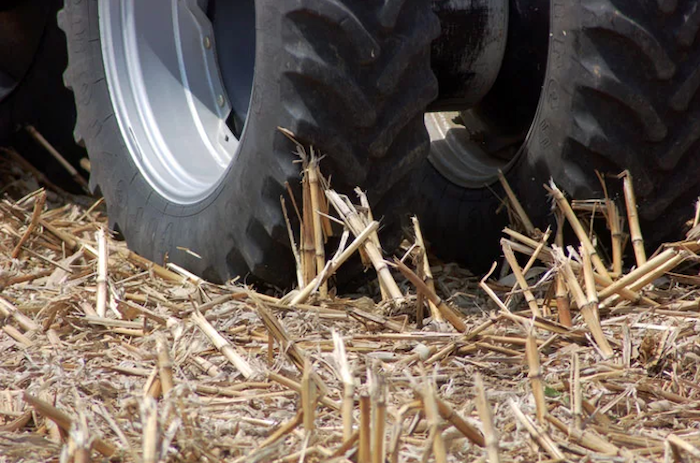
Leaving corn stalks taller helps prevent serious stubble damage to tires on no-till planters. Shorter stalks meet the tire at an acute angle, which increases the possibility of puncture and makes it more difficult for the tire to deflect.
Taller or Shorter Stalks?
Another factor leading to more planter tire damage is the design of the corn header. These headers are devised to leave a 3-4-inch stalk in place. This combined with the added strength bred into today’s corn plant, it’s like leaving a perpendicular piece of steel in the field.
“In the past, corn headers left a taller stalk that would lay over when contact was made with the no-till planter tire,” Sloan says. “Now, with a much shorter stalk, you might as well be going over a bed of rebar.”
The shorter the stalk, the tougher it is on tires. Longer stalks can be pushed over or deflected better by today’s planter tires compared to short, angle-cut stalks that don’t bend. Shorter stalks also meet the tire at an acute angle, which increases the possibility of puncture.
Related Content
- Morry Taylor on the National Debt: ‘The Creeping Menace That Will Destroy America’
- The Story of Morry Taylor & Titan International, Part I: Where I Come From
- The Story of Morry Taylor & Titan International, Part II: If I Had a Bridge, I’d Sell It to You
- The Story of Morry Taylor & Titan International, Part III: What I Learned from Building an Empire