.webp?t=1765819283&width=1000)
Takeaways
- Boost your income by selling stalks and straw from no-tilled corn and wheat fields.
- Look at other alternative on-farm income opportunities.
- Think “outside the box” by marketing other products from your no-tilled crops.
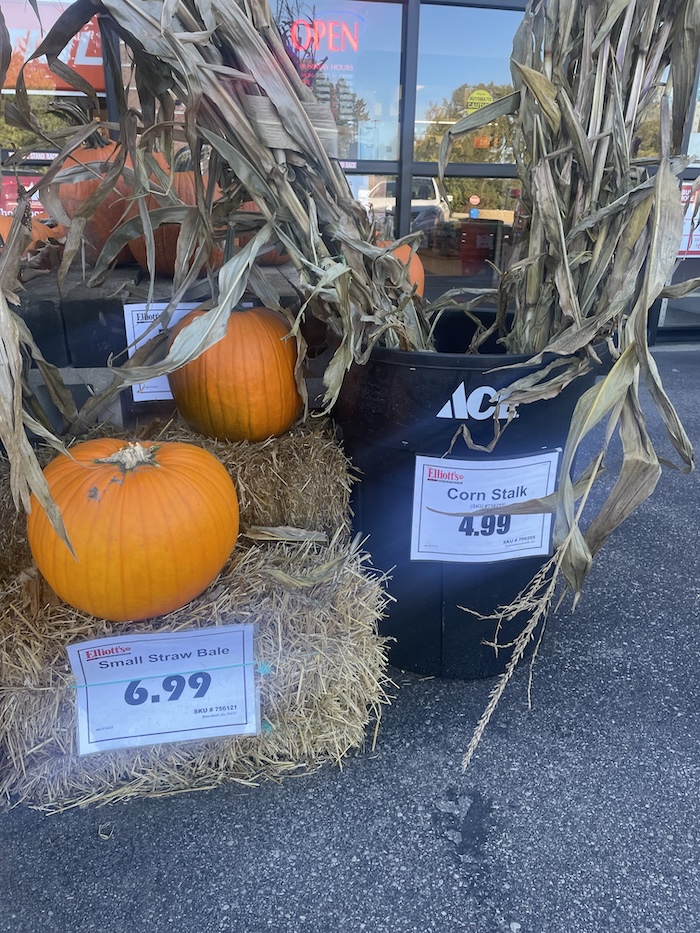
On a visit to our local hardware store earlier this month, the autumn display shown here caught my eye.
In our western suburb of Milwaukee, this is not a place of business that attracts farmers, but city slickers and suburbanites with dollars to spend on seasonal home decorations.
My crazy “thinking outside the box” mentality got me to pondering about alternative options to just selling the grain from your no-till wheat and corn fields. Especially with current prices for both of these grains in the toilet.
Humor My Analysis
Let’s say your 85-bushel per acre no-till wheat crop sells for $5.15 per bushel. That represents a gross income of $437.55 per acre.
At the hardware store this morning, small square straw bales for fall home decorating were selling for $6.99 per bale
With an 85-bushel per acre no-till wheat crop, you can expect to get around 7,000 pounds of straw. Figuring that these small square straw bales each weigh 50 pounds, that’s 140 bales per acre.
Selling at $6.99 per bale, that’s $978.60 per acre. If you wholesale these bales at 50% of the retail price, you’d earn $489.30 per acre. That’s $51.75 per acre better than simply selling the wheat.
Selling straw and corn stalks may be worth more per acre than selling the grain from your no-tilled fields.
Yes, I know you can’t find a retail market for 56,000 bales from 400 acres of no-tilled wheat. But in our suburban county, there are 178,099 housing units, according to 2024 U.S. Census Bureau data. If only 11% of these households bought three bales each for their porches, that would come close to matching all the straw baled from 400 acres of no-tilled wheat.
But if you could sell 140 bales along with the wheat, that’s $926.85 per acre. On 400 acres of no-till wheat, it would be an amazing $370,740 of gross income.
No one has ever accused me of normal thinking. But these “dream-like” returns would certainly provide enough dollars to replace the all-important lost wheat residue with a “Cadillac worthy” cover crop mix.
Selling straw and corn stalks may be worth more per acre than selling the grain from your no-tilled fields.
What About the Corn Stalks?
Let’s look at the corn stalks displayed at the hardware store that were priced at $4.99 with six corn stalks in each bundle.
With a 200-bushel corn crop selling for $4.19 per bushel, the gross income for the grain sold at the elevator would be $838.00 per acre.
Let’s figure there was a final stand of 38,000 stalks per acre. Gathering all those stalks, there would be 6,333 bundles per acre to sell at retail.
At $4.99 per bundle, that represents $31,601 per acre of income. Figuring your share at 50% of the retail price returns $15,800 per acre. Selling both the grain and stalks from 1,200 acres of no-tilled corn would gross $16,638 per acre. With 1,200 acres of no-till corn, that’s over $20 million in revenue. Certainly enough to cover the cost of seeding 1,200 acres to cover crops and settling any outstanding bank notes.
City slickers and suburbanites have big dollars to spend on Halloween decorations…
Taking a more conservative approach No-Till Farmer contributor and retired Ohio State University ag engineer Randall Reeder tackled a similar alternative corn marketing idea in Ohio’s Country Journal.
He suggested taking a small portion of your no-till corn crop and harvesting it the old-fashioned way by cutting each corn stalk with a knife and shocking it to dry, something many Amish farmers still do. Then tie about a dozen stalks together and sell these bundles to home owners and businesses for autumn decorations.
Reeder says a garden store in the Columbus, Ohio, area is selling similar-sized corn stalk bundles for $6.99. If you harvested 30,000 stalks per acre and sold 10-stalk bundles at a wholesale price of $3 per bundle, that’s a return of $9,000 per acre of no-tilled corn.
Frank, This Proves You Are Nuts
Yes, I know these calculations are crazy. And when I showed a rough draft of this proposed “Frankly Speaking” piece to one of our No-Till Farmer editors this afternoon, he read it, shook his head and asked how many beers it took to come up with these ideas.
But Wait, There’s More…
Here are a few other examples I know of where no-tillers think outside the box.
- A Michigan no-tiller and fellow high school classmate took in $30,000 each September and October by welcoming busloads of elementary school kids to his pick your own pumpkin patch and farm animal petting zoo.
- The Wisconsin no-tiller who sold rocks sitting in fence rows for decades to Chicago area landscaper contractors at a handsome profit.
- The long-ago experience on our family’s Michigan Centennial Farm where as a teenager I loaded 85-pound rocks on a trailer. And now see similar-size rocks selling for $100 at local garden stores.
- Then there’s the swamp on the home farm where we used to toss leaking 10-gallon milk cans from the family’s long gone dairy operation. I’d guess there’s 50 old rusty milk cans buried there that could be sold at local garden stores for $125 each. Digging up 50 cans would have a retail value of over $6,000.
Let me know if you have similar ideas for boosting income for no-tillers in these times of low grain prices. Email me at lessitef@lessitermedia.com with your ideas.