
Two weeks ago I listened to Revolutionary Wheat Breeding: Hybrid Wheat, an episode on Corteva’s Agriscience Explained podcast.
I have been curious on Corteva’s breakthrough capability to make hybrid wheat commercially viable in North America and the podcast did a fantastic job of explaining. It also made me curious to look more at where major competitors to Corteva, like Bayer, BASF and Syngenta are on their route to hybrid wheat.
What Is Hybrid Wheat?
Hybrid wheat has long been pursued for the same reason corn hybrids transformed agriculture: yield gains from hybrid vigor and stress tolerance.
Hybrid wheat is created by crossing two different wheat plants to produce offspring that combine the best traits of both parents. The goal is to capture hybrid vigor — where the first-generation seeds are more robust than either parent line alone, just like in corn or canola for example.
Developing hybrid wheat has taken decades because wheat naturally self-pollinates, making controlled crosses difficult and costly. But once perfected, hybrid wheat could help farmers achieve more consistent yields, better yield stability and improved quality.
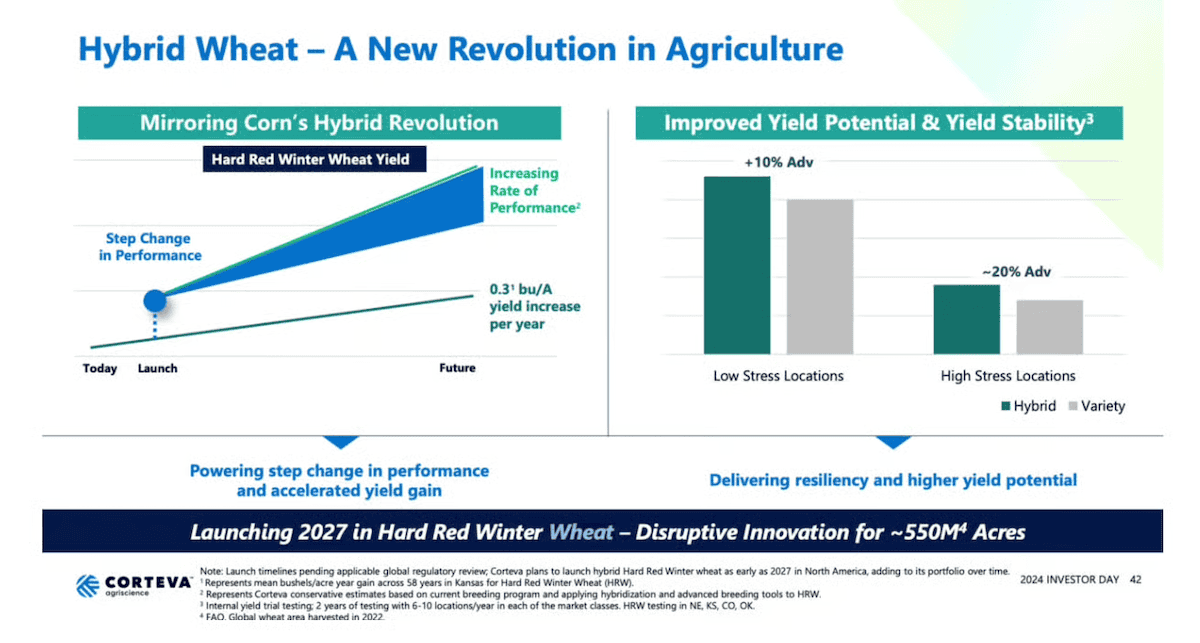
Corteva is moving Hybrid Wheat closer to commercial reality with a 2027 target launch, combining three decades of research with genetic breakthroughs and clever seed production systems.

Why Wheat Is Harder Than Corn
- In 2011, I remember sitting in a presentation where the statement was that hybrid wheat would be launched in North America in 2020.
- 2020 came and went without hybrid wheat in North America, with many entities entering, and leaving the hybrid wheat efforts.
- Wheat physiology and reproduction work against hybridization:
- Wheat is self-pollinating, unlike corn’s natural cross-pollination.
- Each wheat head contains dozens of tightly packed florets, making manual or mechanical sterility control nearly impossible.
- The crop cycle, specifically for winter wheat, is long (planted in fall, harvested next summer), slowing breeding progress.
- Wheat only flowers for a short time, leaving a narrow pollination window, meaning lower success rates.
- Wheat produces very little pollen compared to other crops. What pollen it does produce is very heavy, making it more difficult to move from male to female plants.
In November 2024 Corteva announced a breakthrough that would enable them to scaleably and cost effectively commercialize hybrid wheat in North America.
The launch date for Corteva’s hybrid hard winter red wheat is 2027…
Historically, there are two methods used in hybrid production. Cytoplasmic Male Sterility (CMS) systems breed sterility into the female line and restore fertility in the hybrid through a restorer gene, but they’re difficult to stabilize in wheat’s genome and can cause inconsistent performance. Chemical Hybridizing Agents (CHAs), temporarily suppress pollen formation through a chemical spray, simplifying breeding but adding cost, timing risk, and environmental sensitivity — all challenging in wheat.
Apomixis has been considered a potential avenue for hybrid wheat. It is a form of asexual seed formation where plants produce seeds genetically identical to the mother, effectively cloning themselves through seed rather than fertilization. For breeders, it could lock in hybrid vigor, allowing one high-performing hybrid to be replanted indefinitely without losing yield or consistency. The challenge is that apomixis involves multiple, poorly understood biological steps such as suppressing meiosis, forming embryos without fertilization, and developing viable endosperm, which no one has yet replicated reliably in wheat. Even if solved, its commercial incentive is limited, since farmers could save seed indefinitely.
Newer nuclear gene-based sterility systems have been shown to be better overcome both issues by controlling sterility directly within the plant’s genome. They’re more stable, precise, and scalable— offering a clearer, lower-cost path to consistent hybrid seed production.
Corteva’s key innovation is a nuclear male sterility system.
Wheat Plays Key Role in No-Till Rotations
Since 38% of no-tillers include winter wheat in their crop rotation, the coming breakthrough with hybrid hard red winter wheat will be of interest. This is especially true among no-tillers who double-crop soybeans after wheat harves
—2025 No-Till Operational Benchmark Study data