
While a pitched rhetorical battle continues over our country’s food production system, a recent survey about the Make America Healthy Again movement points to challenges ahead for advocates of traditional farming systems.
MAHA Commission released a preliminary report last month that was, among other things, critical of pesticide use in agriculture — including glyphosate, atrazine and chlorpyrifos. The report was cheered by food safety advocates and criticized by farm organizations. A follow-up report with strategic plans is due from the MAHA Commission in mid-August.
Farmdoc Daily posted a detailed, well-researched article about the latest Gardner Food & Agricultural Policy Survey, which is completed each quarter with about 1,000 U.S. consumers selected by Qualtrics. The survey’s overall purpose is to assesses public perceptions of current issues in the food system.
This May survey assessing public awareness and perceptions of MAHA showed the following:
* 65% of participants knew about MAHA prior to the survey, a 6-point increase over a YouGov survey from 6 months ago. But awareness of MAHA is still far lower than public awareness of some major MAHA players: Over 90% report awareness of Secretary of Health and Human Services Robert F. Kennedy, Jr.
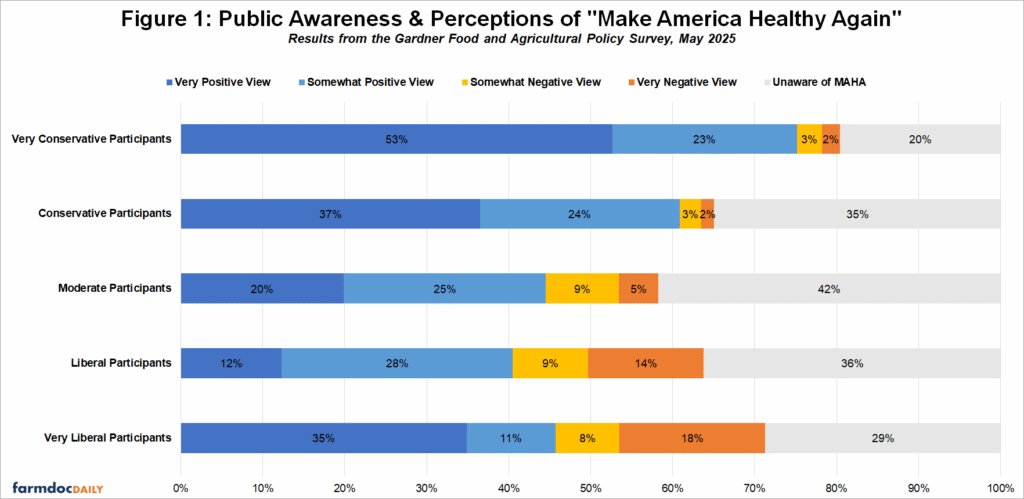
Figure 1 shows the proportion of participants who reported having a very positive view of MAHA, somewhat positive view of MAHA, somewhat negative view of MAHA, very negative view of MAHA, or were unaware of MAHA prior to the survey across participants’ self-reported political ideologies (from very liberal to very conservative).
*For those who knew about MAHA, 43% reported they had a very positive view, 36% had a somewhat positive view, 11% had a somewhat negative view and another 11% had a very negative view. Both awareness and perception differed across political ideologies.
* Awareness was slightly higher among those identifying as very liberal or very conservative politically compared to those who were moderates. And positive or negative feelings about MAHA were higher among those on either end of the political spectrum.
* Those aware of MAHA prior to the survey, 78% said MAHA reflected their values about food, 72% said MAHA reflected their values about medicines, and 77% said MAHA reflected their values about agriculture. But researchers were unable to identify with what policies or promises participants’ values align.
* 77% of those with prior knowledge of MAHA expect the movement to make the food system safer, 74% expected the same of the health system and 68% expected this of the environmental system. But those groups did not report higher levels of concern about either the safety or health of the food system than other participants.
The Modern Ag Alliance and numerous other farm organizations are fighting to preserve modern crop protection tools. They argue the products have already been approved by federal regulators and have a proven safety record.
Because political views seem to influence perceptions about MAHA, sorting out the facts from the rhetoric this summer will only get tougher. Farmdoc Daily mentions some studies cited in MAHA’s report were found to not exist, which the White House says it will address.
This survey doesn’t show a drumbeat of concern about the safety or health of our food supply. That means more convincing, pleading and cajoling will be needed to get consumers to choose a side in this fight.
If nothing else, it shows the need for farmers, agronomists and other stakeholders to continue doing their homework.