
Researchers at the University of California Riverside are working with a little-known class of plant hormones in hopes they can someday trick weeds in cash crop fields to germinate at a time when they harmlessly starve to death. Their work also underscores the importance of subterranean microbial populations and fungal networks.
Based on studies showing strigolactones are associated with signaling the transport of moisture and nutrients to crop roots, along with the fact they help improve build mycorrhizal fungi networks, AND trigger germination of weed seeds, UCR scientists think it may be possible provide a novel mode of action to fight chemical-resistant weeds in farm fields.
UCR plant biologist David Nelson says usually plant hormones to not “radiate externally” by being exuded through the roots at the same time they are active within the plant, but strigolactones possess this trait. They were originally identified when observations showed they aided in the germination of the weed species striga (from which they were named) in the roots of cotton plants.
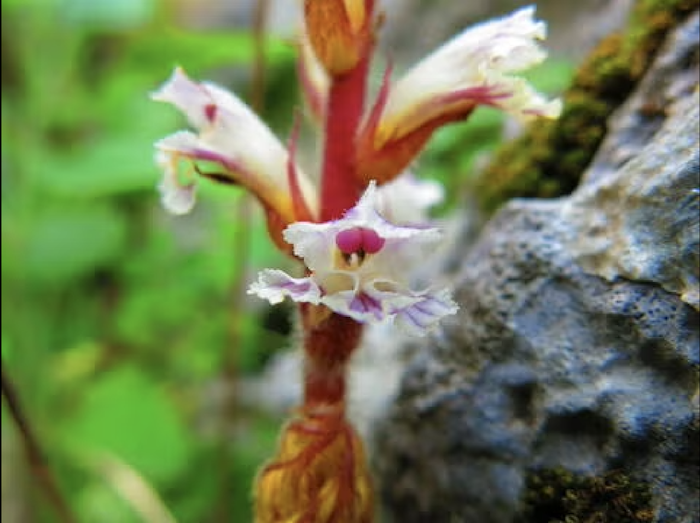
WIPEOUT. Parasitic broomrape survives by siphoning nutrients from other plants. The pods on a single stock of it can hold thousands of seeds. In cotton, striga seeds awaken to mycorrhizal fungi activity and develop in time to hijack the nutrients of the emerging crop. (University of California Riverside photo)
In the presence of strigolactones striga seeds apparently are signaled to germinate and once that occurs the emerging striga plant invades adjacent cotton plant roots and hijacks moisture and nutrients – becoming a fierce parasitic competitor of the cotton.
“These weeds are waiting for a signal to wake up. We can give them that signal at the wrong time – when there’s no food for them — so they sprout and die,” Nelson explains. “It’s like flipping their own switch against them, essentially encouraging them to self-destruct.”
To understand strigolactones production, the research team led by Yanran Li, now with UC San Diego, developed an innovative system using bacteria and yeast. By engineering E. coli and yeast cells to function like tiny chemical factories, they recreated the biological steps necessary to produce the hormones in a controlled environment and potentially in economic quantities.
“This is a powerful system for investigating plant enzymes,” Nelson says. “It enables us to characterize genes that have never been studied before and manipulate them to see how they affect the type of strigolactones being made.”
Scientists still have questions about whether the “weed suicide” strategy will work in real-world farm-field size areas.
“We’re testing whether we can fine-tune the chemical signal to be even more effective,” Nelson says. “If we can, this could be a game-changer for farmers battling these weeds.”
The researchers say strigolactones also hold promise for medical and environmental applications suggesting they could be used as anti-viral or anti-cancer agents. Also, there’s interest in their potential role in combatting citrus greening disease which is crippling citrus production in Florida.
Evidence for No-Till
Beyond the impact the UCR research may provide on future weed control tactics, it also demonstrates the importance of seemingly-insignificant hormonal compounds in the relationship crop roots have with the rhizosphere in which they are grow. Roots affect the soil and its microbial population—which includes mycorrhizal fungi—and those in turn affect the well-being of the roots themselves and, consequently, the plant.
Soil health experts have long advocated against topsoil disturbance with plows, chisels and disks, which not only destroy soil aggregation (a product of plant exudates), but wreck the valuable mycorrhizal fungi networks which work in tandem with hormones like strigolactones to enhance plant uptake of nutrients and moisture.
Studies show nitrogen starvation enhances strigolactones production and exudation in sorghum, corn, and lettuce, suggesting that these plants depend on the fungal networks for nitrogen. In rice, sulfate deficiency also promotes strigolactones exudates which indicates the networks are likely important to sulfur acquisition.
Once such networks have been destroyed it takes a long time to rebuild them from naturally-occurring spores found on various crop and pasture plants. Eventually, if the soil is left undisturbed, the fungal networks will interconnect all plant roots in a continuous field and even between fields, explains Allen Williams of Understanding Ag.
“The biggest deficiency we see in almost all cropland and pastureland we have tested is mycorrhizal fungi which often comprise less than 3-4% of the total living microbial biomass in our soils. Greater than 90% of all the soil samples we look at are bacterially dominated (85-95%) and terribly deficient in mycorrhizal fungi.”