Efficiency drove our shift to no-till in 1999. The practice meant less fuel, fewer tractor passes and reduced man hours. For all other aspects of our operation, though, it was more, more, more.
Now view magazine-like digital flipbooks on your desktop and tablet. Starting with 2015 issues, included for FREE with your Digital or Premium subscription, view the magazine on your laptop, tablet, and mobile device.
Driven by increasing occurrences of herbicide resistance and a push to reduce pesticide use, the companies behind today’s weed control innovations are leveraging everything from artificial intelligence to lasers to drones to target weeds where they grow.
Folks interested in the future of agricultural weed control are spending a lot of time following the dollars being spent on precision technology and artificial intelligence (AI) as major farm equipment and chemical companies collaborate to improve the efficiency of their products.
In Europe, the carbon market overseen by the EU generated €57 billion ($59 billion) in revenue over the past 8 years, and prices paid to farmers are flirting with $100 per metric ton.
Throughout his 25-plus years studying insects, Thomas Dykstra has found one thing to be unequivocally true: Insects only feed upon food that is considered unfit, nutritionally poor, dead or dying.
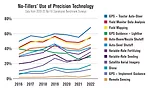
More than half of farmers who responded to the 14th annual No-Till Operational Benchmark Study plan to use auto-steer, field mapping and yield monitor data on their farms this year.
Use of precision agriculture technology continues to increase among no-till farmers, a demographic that experts say has a strong history as early adopters of farming technology
Veteran Kansas no-tiller farms around dry High Plains weather, seeking to eliminate summer fallow when possible and using conserved soil moisture to grow something on every acre throughout the season.
Farming 25 miles southeast of Dodge City in southwestern Kansas with limited irrigation, long-time no-tiller Lance Feikert says it’s difficult to set a rotation schedule and stick with it because of rainfall variability.
Whether using high-tech crop imagery or intuition, in-season nitrogen applications should be adjusted to the crop’s potential as well as future conditions for maximum yield and minimal risk.
With today's sky-high nitrogen (N) prices, nobody wants to apply more N to their crops than is needed. But on the other hand, commodities are commanding a pretty penny, so leaving yield on the table is also ill-advised.
Get full access NOW to the most comprehensive, powerful and easy-to-use online resource for no-tillage practices. Just one good idea will pay for your subscription hundreds of times over.
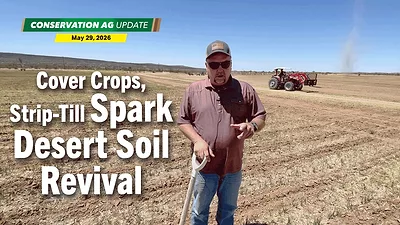
On this episode of Conservation Ag Update, brought to you by Titan International, we pay a visit to Strip-Till Innovator Robert Boyle’s farm in Coolidge, Ariz., for an up-close look at how he’s transforming his soils with cover crops and diverse rotations.
We have engineered and developed the most advanced concave system that threshes all crops, eliminates rotor loss, improves grain quality, gives you a cleaner sample – all with one set of XPR concaves.
At Titan International, our product portfolio reflects our commitment to innovation and high-quality products. Titan International offers a full line of solution-focused wheel, tire, and undercarriage products for a wide variety of off-the-road equipment in agriculture, construction, forestry, mining, power sports, high-speed trailers, and outdoor power equipment segments. As one of the largest North American manufacturers, with a network of dealers all over the world, Titan is an industry leader that original equipment manufacturers and operators can count on for durable products and quality service.