 Premium content is for our Digital-only and Premium subscribers. A Print-only subscription doesn't qualify. Please
No-Till Farmer
Get full access NOW to the most comprehensive, powerful and easy-to-use online resource for no-tillage practices. Just one good idea will pay for your subscription hundreds of times over.

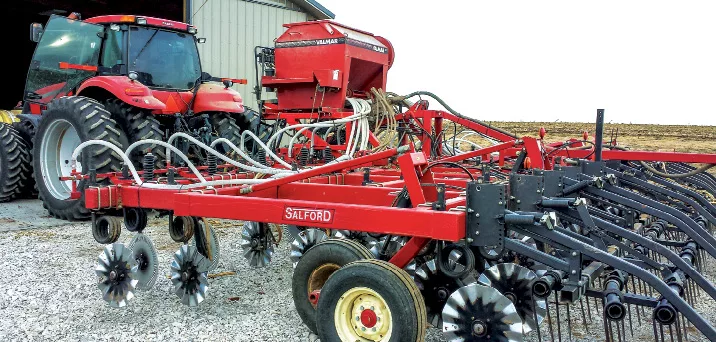
Above photo: RIGHT MACHINE. Shenandoah, Iowa, no-tiller Chris Teachout uses this Salford vertical-till tool, with an affixed Valmar 2055 air seeder unit, to seed cover crops like cereal rye in his corn-soybean rotation. He says the machine mimics buffalo hoof action by incorporating seed into the soil without causing too much soil disturbance.
Chris Teachout compares his cover crop philosophy to taking a new gun out on a bear hunt: No hunter uses a new gun on the big hunt without practicing with it first to work out all the kinks.
In the same fashion, Teachout says growers should experiment with cover crops on their own operations, continuously adjusting for increased returns and improved soil health.
“That is how I learn,” he says. “Then I can tweak as I go along.”
Teachout’s 1,800-acre operation near Shenandoah in southwestern Iowa focuses on corn and soybeans, but with a cover crop twist that has not only increased yields but also decreased water and nutrient run-off, hiked up organic matter and substantially reduced nitrogen (N) requirements.
Teachout says cover crops aren’t new to his family, recalling how they aerial seeded in the mid-1980s to provide winter forage for their farrow-to-finish and cow-calf operations. He even remembers reading a 1910 farming guide that recommended interseeding rapeseed, cowpeas or wheat in between wide corn rows.
“We either forgot about these concepts or dismissed them,” Teachout says. “Why did we not stick with that?”
The last of Teachout’s family livestock operations ended in…
Get full access NOW to the most comprehensive, powerful and easy-to-use online resource for no-tillage practices. Just one good idea will pay for your subscription hundreds of times over.
Download these helpful knowledge building tools

We have engineered and developed the most advanced concave system that threshes all crops, eliminates rotor loss, improves grain quality, gives you a cleaner sample – all with one set of XPR concaves.

At Titan International, our product portfolio reflects our commitment to innovation and high-quality products. Titan International offers a full line of solution-focused wheel, tire, and undercarriage products for a wide variety of off-the-road equipment in agriculture, construction, forestry, mining, power sports, high-speed trailers, and outdoor power equipment segments. As one of the largest North American manufacturers, with a network of dealers all over the world, Titan is an industry leader that original equipment manufacturers and operators can count on for durable products and quality service.

Provide expert analysis and decision support to increase productivity and profitability.