 Premium content is for our Digital-only and Premium subscribers. A Print-only subscription doesn't qualify. Please
No-Till Farmer
Get full access NOW to the most comprehensive, powerful and easy-to-use online resource for no-tillage practices. Just one good idea will pay for your subscription hundreds of times over.

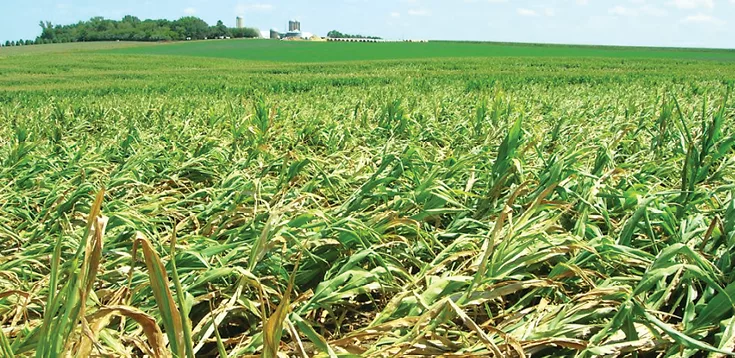
MAJOR DAMAGE. This photo shows Cry3Bb1 (YieldGard) and mCry3A (Agrisure) corn planted with a split-row planter that suffered substantial lodging and node injury at the hands of western corn rootworm larvae.
Experts across the Corn Belt are warning farmers about more documented cases of resistance to Bt corn by the western corn rootworm (WCR).
A cold, wet winter and late corn planting in some Northern states could spell trouble for many cornfields, especially those planted with single-trait Bt corn year after year.
Of the four Bt proteins registered in the U.S. for corn — Cry3Bb1, Cry34/35Ab1, mCry3A and eCry3.1Ab — field-evolved resistance has been documented for both Cry3Bb1 and mCry3A traits, and cross-resistance has also been confirmed between those two traits.
Cry3Bb1 is the protein found in YieldGard VT3 and YieldGard VT3 Pro hybrids, while mCry3A is the protein used in some Agrisure hybrids.
Five Illinois counties have reported field-evolved WCR resistance to Cry3Bb1 corn, and researchers in Nebraska, Minnesota, Wisconsin and Iowa have also reported WCR resistance issues.
During a recent webinar, several university experts shared tips on how farmers can improve long-term management of rootworms and keep resistance at bay.
Diversified techniques are needed to manage corn rootworms effectively while reducing the risk of resistance developing. But that’s a difficult task due to the strong adaptation ability of WCRs, says Iowa State University entomologist Aaron Gassmann.
Gassmann says his laboratory began studying Bt resistance in corn rootworms in 2009 after getting complaints from farmers about…

Get full access NOW to the most comprehensive, powerful and easy-to-use online resource for no-tillage practices. Just one good idea will pay for your subscription hundreds of times over.
Download these helpful knowledge building tools

We have engineered and developed the most advanced concave system that threshes all crops, eliminates rotor loss, improves grain quality, gives you a cleaner sample – all with one set of XPR concaves.

At Titan International, our product portfolio reflects our commitment to innovation and high-quality products. Titan International offers a full line of solution-focused wheel, tire, and undercarriage products for a wide variety of off-the-road equipment in agriculture, construction, forestry, mining, power sports, high-speed trailers, and outdoor power equipment segments. As one of the largest North American manufacturers, with a network of dealers all over the world, Titan is an industry leader that original equipment manufacturers and operators can count on for durable products and quality service.

Provide expert analysis and decision support to increase productivity and profitability.