 Premium content is for our Digital-only and Premium subscribers. A Print-only subscription doesn't qualify. Please
No-Till Farmer
Get full access NOW to the most comprehensive, powerful and easy-to-use online resource for no-tillage practices. Just one good idea will pay for your subscription hundreds of times over.
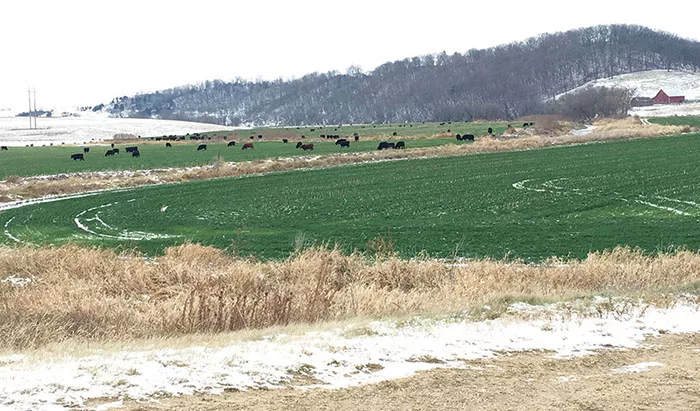
For about 10-15 years, no-tilling corn into 300 acres of soybean stubble was the extent of the Kieler family’s use of the conservation practice.
But that changed as their dairy operation began to grow. With the Kielers quadrupling their number of dairy cows from 100 to 400 within the last 15 years, they’ve transitioned to more corn silage production and have ramped up adoption of no-till, as well as cover crops, to protect their hilly fields in Platteville, Wis., from erosion and save on labor, fuel and equipment costs.
In addition to the expanding dairy operation, the Kielers built a new farm 2 years ago for their 200 steers and switched from upright silos to bunkers. With the new setup they determined it’d be easier to eliminate their corn earlage production and just grow corn silage. With that came an increase in their use of no-till.
“We don’t want to do any tillage on the corn silage in the fall,” Eric Kieler says. “It just turns to fodder and washes bad.”
Eric, who farms with his parents, Ann and Louie, wife, Leah, sister Renee, and brother-in-law, Matt, along with a few full-time and part-time employees, oversees most of the crop work and equipment maintenance on the family farm.
The Kielers grow about 1,200 acres of corn and 300 acres of soybeans, with the rest of their 1,000 acres primarily in alfalfa hay. Aside from a few acres of continuous corn, their rotation is typically 3 years corn, oats…

Get full access NOW to the most comprehensive, powerful and easy-to-use online resource for no-tillage practices. Just one good idea will pay for your subscription hundreds of times over.
Download these helpful knowledge building tools

We have engineered and developed the most advanced concave system that threshes all crops, eliminates rotor loss, improves grain quality, gives you a cleaner sample – all with one set of XPR concaves.

At Titan International, our product portfolio reflects our commitment to innovation and high-quality products. Titan International offers a full line of solution-focused wheel, tire, and undercarriage products for a wide variety of off-the-road equipment in agriculture, construction, forestry, mining, power sports, high-speed trailers, and outdoor power equipment segments. As one of the largest North American manufacturers, with a network of dealers all over the world, Titan is an industry leader that original equipment manufacturers and operators can count on for durable products and quality service.

Provide expert analysis and decision support to increase productivity and profitability.